


The transport sector accounts for around 25 percent of global greenhouse gas emissions, with aviation activities among its significant contributors. Ground Support Equipment (GSE), such as Baggage Towing Tractors (BTT), still largely relies on fossil fuels, resulting in high carbon emissions, noise pollution, and high operational costs.
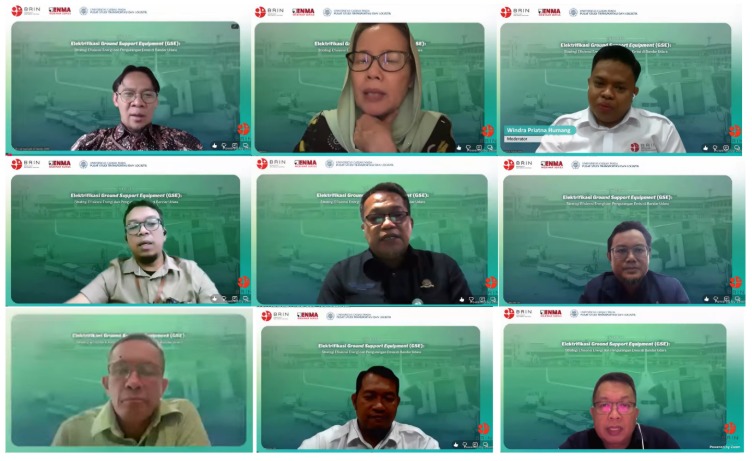
These issues took center stage at the webinar “Electrification of Ground Support Equipment (GSE): Energy Efficiency Strategies and Emission Reduction in Airports” organized by the Center for Transportation and Logistics Studies, Universitas Gadjah Mada (Pustral UGM), in collaboration with BRIN on Wednesday (Nov. 19).
Caretaker of Pustral UGM, Professor Siti Malkhamah, emphasized that GSE electrification is a strategic measure aligned with national targets for reducing emissions. She noted that modernizing airport equipment is essential not only for improving energy efficiency but also for enhancing environmental health and operational comfort.
The webinar drew 750 participants from government institutions, the aviation industry, academia, and transportation practitioners.
Head of the Organization for Energy and Manufacturing Research (OREM) BRIN, Professor Cuk Supriyadi Ali Nandar, stated that transitioning to low-emission GSE requires multisectoral collaboration.
“Through this webinar, we hope to formulate recommendations and follow-up actions to foster real commitments that advance not only technology but also emission reduction,” he said.
Echoing this, Head of the BRIN Center for Transportation Technology Research, Dr. Aam Muharam, affirmed that GSE electrification presents a strategic opportunity to reduce airport carbon footprints while enhancing the competitiveness of the national aviation sector.
“It supports national and international emission reduction targets and strengthens the competitiveness of airports by enabling quieter, cleaner, and more cost-efficient operational ecosystems,” he remarked.
The Indonesian Ministry of Transportation also highlighted the importance of a GSE electrification roadmap, as outlined in KM 08 of 2023, as part of climate change mitigation efforts in the transport sector.
Head of the Sub-Directorate for Airport Operations and Management, Cece Tarya, explained the four stages of the national electrification strategy to be implemented from 2025 to 2029.
“This action encompasses energy efficiency, renewable energy utilization, as well as policy measures and technology feasibility evaluations,” he noted.
PT Angkasa Pura Indonesia presented its plan to convert its fossil-fuel operational vehicles from fossil fuels to electric cars. Airport Engineering Group Head, Akbar Putra Mardhika, stated that by 2030, the company aims to convert 197 operational units and develop 147 charging stations (SPKLU).
“Nonetheless, several challenges remain in the implementation of airport electrification, including charging infrastructure, emergency considerations, and investment costs,” he explained.
The use of electric technology in BTTs was also discussed by Maintenance and Engineering Services Group Head of PT Gapura Angkasa, Laode M. Syamrin. He demonstrated that electric BTTs can reduce operational costs by up to 20.73 percent over ten years.
“Currently at Soekarno-Hatta Airport, Gapura’s 1,500-capacity electric BTT is used only for baggage towing, not for cargo towing,” he said.
A BRIN study showed that transitioning from diesel BTTs to electric BTTs offers long-term financial and environmental benefits. BRIN Research Engineer, Mohamad Ivan Aji Saputro, explained that electric BTTs contribute to national energy efficiency, operational flexibility, and substantial emission reductions.
“Overall, the technological shift from diesel to electric BTTs is feasible and delivers financial and economic advantages for both operators and the public,” he noted.
Pustral UGM Researcher, Juhri Iwan Agriawan, highlighted that GSE electrification directly reduces CO₂, NOx, and PM emissions on airport aprons. Improved air quality and worker health are among the significant positive impacts.
“GSE electrification is a strategic step that supports the Net Zero Emission target and the national Green Airport program,” he said.
Through the technical recommendations and operational insights presented during the webinar, Pustral UGM and BRIN hope that GSE electrification can become a measurable national policy agenda. Synergy among government, industry, and research institutions will be essential to realizing a more efficient, low-emission, and sustainable air transportation sector.
Author: Jesi
Editor: Triya Andriyani
Post-editor: Rajendra Arya