


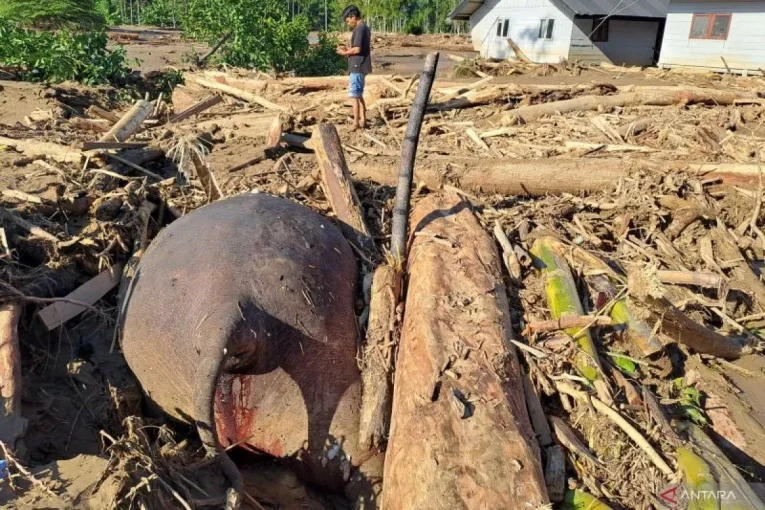
The recent floods and landslides in Sumatra have not only claimed hundreds of human lives but have also destroyed wildlife habitats and killed protected animals. A Sumatran elephant (Elephas maximus sumatranus) was found dead after the floods in Pidie Jaya Regency, Aceh Province. The elephant was discovered submerged among piles of forest logs and thick black mud carried by the floodwaters. The death is suspected to have resulted from the collapse of its natural habitat due to the disaster.
Responding to the incident, Professor Raden Wisnu Nurcahyo of the Faculty of Veterinary Medicine, Universitas Gadjah Mada (FKH UGM) emphasized that the event should serve as a serious warning for all parties to pay closer attention to wildlife habitats.
He stressed that protection must extend beyond elephants to all animal species, particularly as Sumatra hosts a wide diversity of flora and fauna.
“When habitats disappear due to human actions, the flora and fauna inevitably become victims as well,” said Professor Nurcahyo on Tuesday (Dec. 2).
According to Professor Nurcahyo, the flash floods triggered by land-use change for oil palm plantations have fragmented elephant populations and pushed them into increasingly constrained spaces.
Beyond palm oil, elephant habitats have also been converted into mining areas, roads, settlements, and agricultural lands. In addition to the loss of wildlife, the landscape itself continues to shrink due to human activity. This situation has forced elephants into residential areas.
“An elephant needs space to socialize, to gather with its group, with other herds. It has established routes for bathing, finding food, and reproducing in a comfortable habitat, allowing the population to grow. But under these conditions, they become increasingly cornered and are inevitably drawn into settlements,” he explained.
Professor Nurcahyo noted that preventing similar incidents requires conservation efforts focused on protecting elephants’ natural habitat. He stressed that the best habitats lie in Sumatra’s forests; therefore, restrictions on mining activities and on road construction that cut through forests must be enforced.
For Professor Nurcahyo, however, the “main killer” of the elephants is land conversion into palm oil plantations.
“In Aceh specifically, regulations must be put in place immediately to prohibit any further land clearing for palm oil,” he said.
Professor Nurcahyo underscored that the disasters in Sumatra are the result of human activities such as deforestation, palm oil expansion, and land clearing for mining. These actions affect not only human communities but also wildlife.
“We must remember that space must be shared between wildlife and flora. If we fail to share space, more disasters will follow,” he concluded.
Author: Salwa
Editor: Gusti Grehenson
Post-editor: Rajendra Arya
Photograph: Antara