


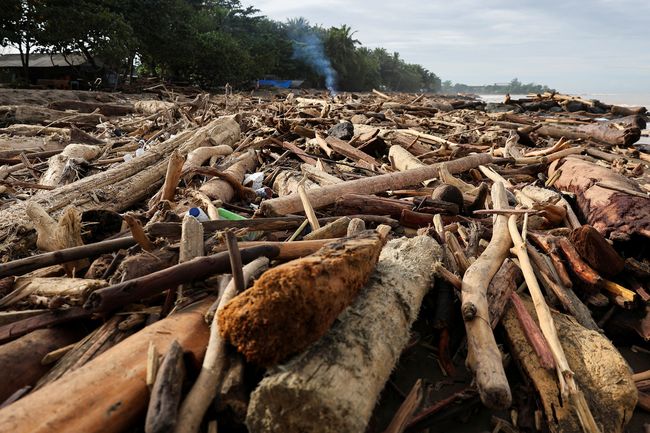
Severe floods and landslides that struck Sumatra have exposed the misguided direction of development models centered on natural resource extraction. While benefiting a small elite, such models weaken the environment’s carrying capacity and ultimately increase the disaster risks borne by the wider community.
Latest data from the National Disaster Management Agency (BNPB) website, as of Thursday (Dec. 11), recorded a total of 986 fatalities. A further 224 people were reported missing, and 5,100 were injured. The disaster affected 52 regencies and cities across three provinces.
BNPB also noted that 157,900 houses were damaged, with around 800,000 people still displaced. In addition, the disaster damaged 1,200 public facilities, 219 health facilities, 581 educational facilities, 434 houses of worship, and 498 bridges.
According to calculations by the Center of Economic and Law Studies (CELIOS), regional losses reached IDR 2.04 trillion in Aceh, IDR 2.07 trillion in North Sumatra, and IDR 2.01 trillion in West Sumatra.
Jambi, Riau, and South Sumatra were also affected, each suffering losses of around IDR 2 trillion, as disrupted transportation routes hampered the distribution of consumer goods and the operation of industrial supply chains. Meanwhile, BNPB estimates that recovery costs for affected areas in Aceh, North Sumatra, and West Sumatra could reach IDR 51.82 trillion.
Once again, the scale of losses and reconstruction costs far outweighs state revenues from natural resource extraction, a key factor behind the current disaster. CELIOS calculations show that non-tax state revenue (PNBP) from the mining sector in Aceh as of 31 August amounted to only IDR 929 billion.
Revenue-sharing funds (DBH) from oil palm plantations in Aceh stood at IDR 12 billion, while DBH from minerals and coal reached IDR 56.3 billion in 2025. This total revenue falls well below the disaster-related losses in Aceh, estimated at IDR 2.04 trillion. CELIOS even estimates that overall economic losses from this disaster could reach IDR 68.67 trillion.
There is substantial evidence linking the scale of recent floods and landslides in Sumatra to environmental degradation in the region. Deforestation and forest degradation in upstream areas have eroded natural functions such as water absorption and erosion control. As a result, when extreme rainfall triggered by Tropical Cyclone Senyar occurred, severe flooding and landslides struck downstream areas.
Professor of Environmental Geomorphology at Universitas Gadjah Mada (UGM), Djati Mardiatno, did not deny the impacts of extractive development models. He argued that extractive development inevitably reduces environmental carrying capacity, thereby increasing vulnerability to disasters.
Forest destruction and altered hydrological systems due to extraction, he explained, heighten the risk of ecological disasters such as flash floods, landslides, and river overflows.
“The recent floods and landslides in Sumatra, for example, are often linked to such extractive development models,” he said at the UGM campus on Friday (Dec. 12).
Professor Mardiatno emphasized that extractive development generates significant socio-ecological impacts. Among these are the dispossession of indigenous and local communities from their living spaces, forcing them off their land as areas are converted into extractive concessions.
Such land-use changes effectively strip communities of their right to a safe and livable environment. The professor also described the prosperity produced by extractive development as illusory.
“Although extractive development is often promoted as an economic pillar, several studies show that villages surrounding mining areas are actually more vulnerable to social hardships, including lower education levels, limited access to clean water, and heightened disaster risk,” he explained.
He further warned that extractive development without strict governance and sustainability principles remains highly destructive to environmental carrying capacity. It can even trigger socio-ecological crises, with environmental damage manifesting in pollution, deforestation, and biodiversity loss.
“Excessive exploitation that exceeds nature’s capacity will inevitably make recovery extremely difficult,” he said.
Professor Mardiatno argued that several measures can be taken to ensure environmental sustainability and minimize future disaster risks. He stressed the importance of establishing and adhering to environmental carrying capacity thresholds (D3TLH) as an early warning system for environmental degradation.
Disaster risk factors, he added, must also be incorporated into development planning processes in areas slated for utilization.
“It is time for the government to impose a moratorium on permits and act decisively against companies that fail to uphold environmental sustainability principles in their operations. It is also time to shift away from extractive economic models that are generally exploitative and destructive toward development models that are more prudent, inclusive, and sustainable,” he concluded.
Author: Agung Nugroho
Post-editor: Salma
Photograph: CNBC Indonesia