


In an era when change unfolds faster than organizations can fully understand the situations they face, higher education institutions need navigational leadership. In such circumstances, leaders may not always have complete information or a comprehensive understanding of the challenges before them. They can no longer rely solely on individuals presumed to have all the answers or provide certainty. Instead, leaders need to involve multiple stakeholders in interpreting situations, sharing assessments, and acknowledging uncertainty.
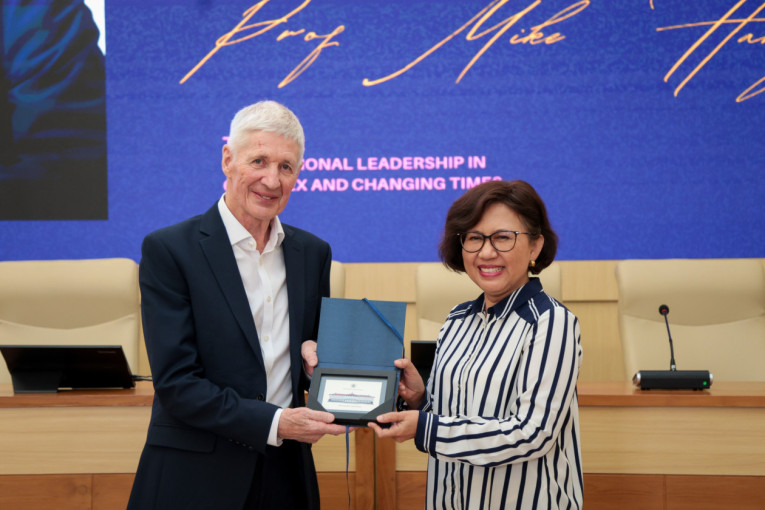
“No single leader, whether in a ministry or an industry, has the complete picture of a problem. Each party has only part of that picture,” explained Professor Mike Hardy, a British academic who serves as Professor of Intercultural Relations and founded the Centre for Trust, Peace, and Social Relations (CTPSR) at Coventry University. He made these remarks during a Leadership Sharing Session workshop held in the multimedia room of UGM’s Central Building on Tuesday (Oct. 20).
According to Hardy, today’s rapidly changing circumstances require a shift in how leadership is understood. He also distinguished between a crisis and a rupture, which occurs when an established pattern or condition breaks down and cannot simply be restored. While a crisis is often understood as a disruption that can be resolved to restore normal conditions, a rupture requires leaders to accept that circumstances have changed and develop new approaches.

Hardy cited land subsidence in Jakarta as an example. In his view, the problem cannot be resolved simply by trying to restore the previous situation. “Leaders need to understand the changes that have occurred and develop measures to address the new circumstances,” he explained.
In situations like these, Hardy emphasized the importance of having clear objectives while remaining flexible in determining strategies. An organization’s goals must remain intact, but the means of achieving them do not always have to remain the same.
“Leaders must be willing to evaluate and change their approach when circumstances show that previous strategies are no longer appropriate,” he said.
To help leaders develop a more comprehensive understanding of a situation, Hardy introduced four perspectives: looking out, looking together, looking through, and looking in.
“These four perspectives help leaders understand the external environment, listen to different stakeholders, examine underlying issues, and reflect on the values and assumptions that influence their decisions,” he said.
Hardy also highlighted the importance of building trust through concrete action. In his view, the public cannot be convinced by statements or reports alone; people also need to see the changes leaders actually implement.
“That is why employees, partners, and other stakeholders need to be involved in the decision-making process, rather than simply being given an explanation after decisions have been made,” he explained.
He stressed that navigational leadership does not mean an organization operates without direction. Rather, its goals must remain clear even when the path toward them changes in response to circumstances. “This approach views leadership as an adaptive, collaborative, goal-oriented, and ethical process,” he concluded.

In her remarks, UGM Rector Professor Ova Emilia emphasized the need for leadership that can adapt to change without losing sight of an institution’s direction, values, and goals. She highlighted the challenges higher education institutions face in remaining relevant, adaptive, innovative, and competitive amid increasingly complex circumstances.
“These dynamics also pose challenges for UGM as it pursues its strategic agenda, from transforming governance and strengthening its global reputation to developing talent and fostering greater interdisciplinary collaboration,” she said.
According to Ova, leadership is not merely a matter of holding a position; it also involves the ability to guide an organization, make decisions, and drive positive change.
“Therefore, UGM leaders must be able to face future challenges without abandoning the university’s identity and values,” she said.
Author: M. Aidil Syahputra
Editor: Gusti Grehenson
Post-Editor: Priyananda
Photo: Donnie