


October holds profound historic significance for the Indonesians, particularly in the journey of our national language. Each year on Oct. 28, the spirit of the 1928 Sumpah Pemuda is reignited. It is this spirit that is nurtured and celebrated annually through the observance of Bulan Bahasa.
National pride swelled with the recognition of Bahasa Indonesia as an official language in international forums by UNESCO.
In tandem, Indonesian literary works have found their place on the global stage, with numerous novels by distinguished authors being translated into other languages.
In response to this timely spirit and remarkable achievement, the Indonesian Language and Literature Program at the Faculty of Cultural Sciences, Universitas Gadjah Mada (FIB UGM), organized the 2025 Festival Bulan Bahasa under the theme “Pusaka Baswara: Warisan Bangsa Pelita Dunia”.
According to Dr. Pujiharto, Head of the Indonesian Language and Literature Program, this achievement elevates the dignity of the Indonesian language from merely a national heritage to a “baswara”, a shining light that becomes a beacon for the world.
Festival Bulan Bahasa is an annual tradition rooted in the spirit of the 1928 Sumpah Pemuda, particularly the third pledge to uphold the national language, Bahasa Indonesia.
Dr. Pujiharto stated that the tradition has been long-standing and has become an inseparable part of academic life.
“This celebration has a very long historical root. Since I began my studies in 1988, this event has already become a tradition. This shows how the spirit of Sumpah Pemuda truly must be celebrated,” he said on Tuesday, Oct. 28, 2025.
He added that although the form of the event varies each year, depending on the creativity of the organizers, its essence remains the same: to enliven and keep the Indonesian language and literature vibrant.
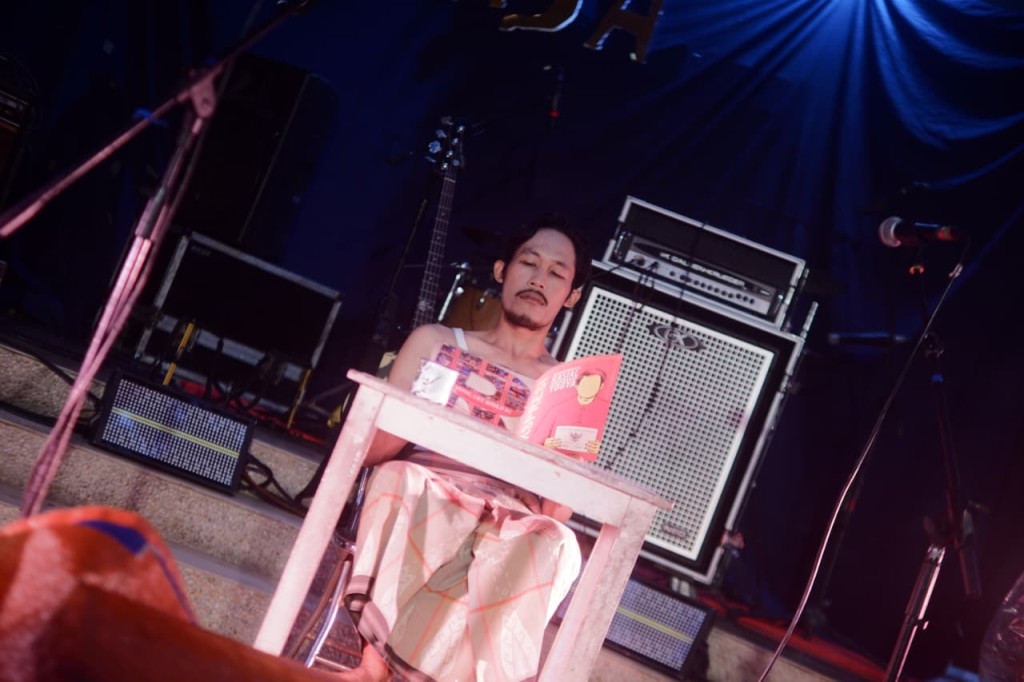
Held over two days, the festival presented a varied range of activities.
The first day featured a discussion titled “The Death of Literature in the Faculty of Literature.”
Visitors were also able to enjoy an exhibition, a photo booth, and a creative scrapbook stand.
Meanwhile, the second day focused more on performances, enlivened by a poetry reading by author Yuditeha, Stand-Up Comedy UGM, and musical performances from various bands.
The festival’s chairperson, Aril Alfi, emphasized that the Bulan Bahasa activities will include a workshop with Zaky Yamani on Nov. 7, a theatre staging of Kami Bercerita with the play “Tumirah Sang Mucikari” adapted from the work of Seno Gumira Ajidarma on Dec. 1, as well as a series of competitions such as poetry reading, poetry writing, short-story writing, and essay writing.
Dr. Pujiharto hopes future celebrations of Bulan Bahasa can be held on a larger scale.
He views the event not only as the concern of a study program but as a matter of national importance.
“The Indonesian language must continue to be voiced, and endeavored so that it becomes a global language. This event needs to be understood within the framework of nationhood and homeland. This is a critical moment for us to rise as a nation through the Indonesian language,” the head concluded.
Author: Aldi Firmansyah
Editor: Gusti Grehenson
Post-editor: Lintang Andwyna
Photographs: Bulan Bahasa and Stockphoto