


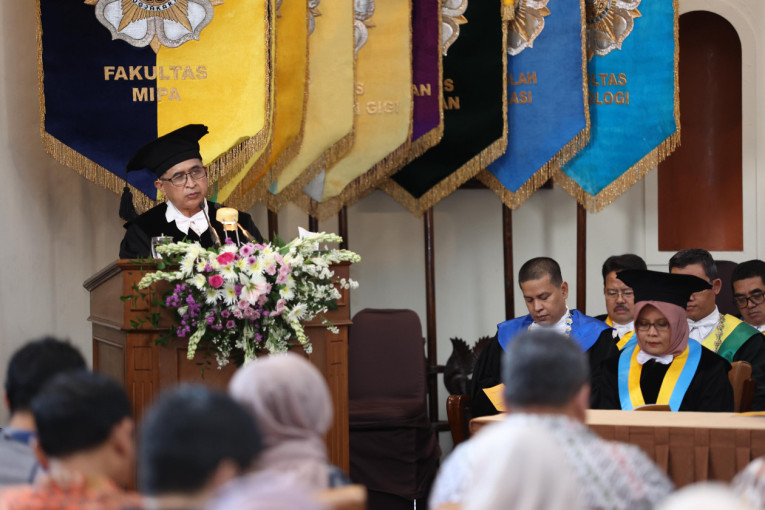
Actuarial science currently plays a role in enabling us to systematically understand and manage risk.
The science of Mathematics provides a formal language to explain core actuarial concepts, such as risk, the time value of money, and uncertainty.
Despite being rooted in deep mathematical and probability theory, the challenges of the actuarial world are now increasingly complex.
The emergence of big data, machine learning, statistical learning, and predictive analytics demands a more adaptive and dynamic approach.
This was stated by the lecturer of the Faculty of Mathematics and Natural Sciences, Universitas Gadjah Mada (FMIPA UGM), Dr. Gunardi.
He delivered this in his inaugural speech as a Professor in Actuarial Science at the Senate Hall of the UGM Central Office on Tuesday (Jun. 17).
In his inaugural speech titled “From Theory to Reality: The Contribution of Mathematics, Statistics, and Stochastics in Actuarial Science,” Professor Gunardi said that in actuarial practice, we not only face static uncertainty.
Instead, we also encounter uncertainty that evolves over time.
“For this reason, stochastics serves as an important tool in understanding and modeling dynamic random processes,” Professor Gunardi explained.
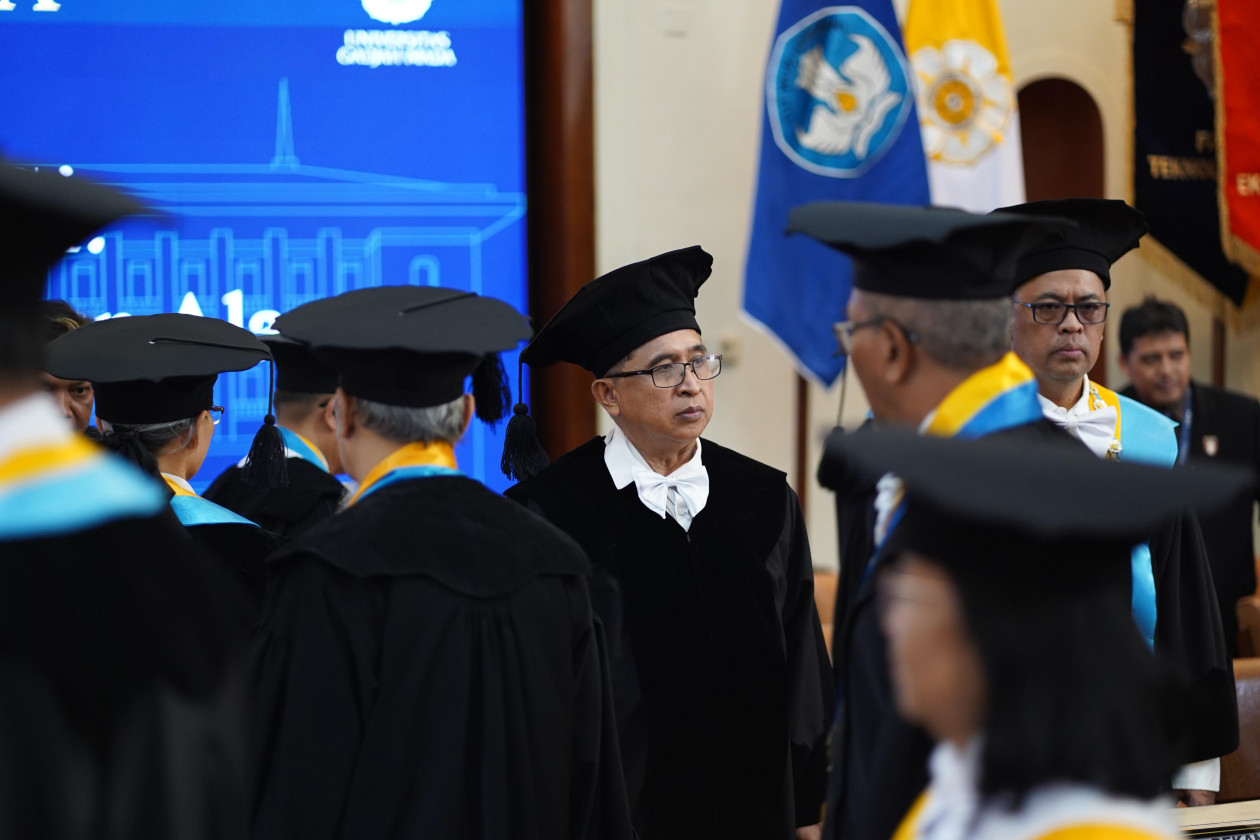
According to Professor Gunardi, a modern actuary is not merely sufficient in understanding theory.
He or she must also be able to ground abstract concepts into relevant and sustainable real-world solutions.
“This is a call for all of us to enrich learning and research, build bridges between theory and application, and inspire a new generation of actuaries to continue pushing the boundaries of the discipline,” Professor Gunardi stated.
With a combination of theory and real-world application, Professor Gunardi said, actuarial science becomes an important tool for helping individuals, companies, and countries address future risks.
The development of actuarial science in the present and future includes the use of artificial intelligence in product development and operational efficiency.
It also includes developing a realistic social security system in Indonesia, producing adaptive and realistic financial reports, and developing actuarial science aligned with Sharia principles.
At the end of his speech, Professor Gunardi affirmed that academics and practitioners in actuarial science have a great responsibility to continue developing more innovative methods.
They must also contribute to building a more stable and sustainable financial system.
“I hope this science continues to develop and provide broad benefits to society,” Professor Gunardi concluded.
Author: Kezia Dwina Nathania
Editor: Gusti Grehenson
Post-editor: Afifudin Baliya
Photographer: Firsto