


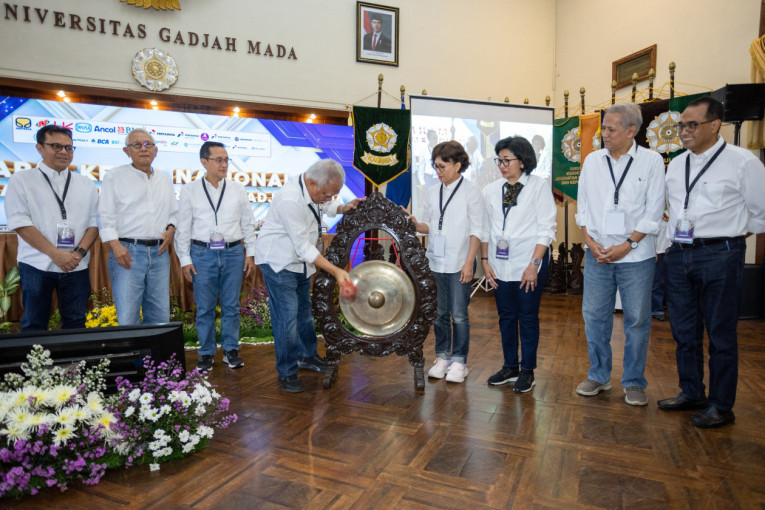
The Chair of the Central Executive Board of Kagama and Head of the Nusantara Capital Authority (IKN), Dr. Mochamad Basuki Hadimuljono, outlined the progress of IKN’s development, which has been underway over the past several years. Hadimuljono proudly noted that many Kagama members have been directly involved in carrying out the project.
“Almost all of the implementers are from Kagama,” Hadimuljono said during the National Working Meeting of the Universitas Gadjah Mada Alumni Association (Kagama), held at the UGM Senate Hall on Saturday (Dec. 13).
Hadimuljono shared how the president entrusted him with leading the development of IKN.
“When I was appointed to lead the development of IKN, I told the president that no one in Indonesia had experience building a city. The Ministry of Public Works has experience building roads, dams, housing, waste, and sanitation facilities, but building an entire city was something entirely new,” he recalled.
Although there were initial concerns that the IKN project might face delays or lack prioritization, the issuance of Presidential Regulation No. 79 of 2025 has firmly established IKN as Indonesia’s capital in 2028.
“With the signing of this regulation, the president has legally and constitutionally committed that IKN will become the capital of the country,” he explained.

Hadimuljono stated that the development of IKN has now entered its second phase for the 2025 to 2029 period, which includes the construction of legislative and judicial buildings, as well as offices, housing, and supporting areas scheduled for completion by 2027.
“We have begun building the ecosystem for offices, housing, and urban areas so that in August 2028, the president can officially declare IKN as the capital of Indonesia,” he said.
On the same occasion, in his capacity as Chair of the Kagama Central Executive Board, Hadimuljono emphasized that this year’s National Working Meeting aimed to evaluate, formulate, and strengthen Kagama’s future synergy.
He underscored the spirit of guyub rukun migunani, reminding UGM alumni not only to embody values that foster harmony, but also to contribute meaningfully to society. He also highlighted the significance of the ongoing Nitilaku tradition.
“Nitilaku means remembering our roots at Universitas Gadjah Mada as a people-centered university, honoring our journey, and continuing the struggle by carrying forward that torch,” he said.

The Chair of Kagama’s Advisory Council ex officio, the Rector of Universitas Gadjah Mada, Professor Ova Emilia, noted that over the past two years, numerous collaborations between Kagama and UGM have been realized, including the Gajah Mada Peduli program, scholarships, disaster relief initiatives, research downstreaming, and collaborative community service programs (KKN-PPM).
Furthermore, this year, cooperation between UGM and Kagama successfully resulted in the establishment of 60 professional certification schemes.
Professor Emilia added that in the realm of the tri dharma of higher education, UGM remains committed to advancing various strategic programs, including shifting the campus paradigm from a teaching-oriented culture toward a research and innovation-driven culture.
“Kagama, which consists of practitioners working directly in the field, serves as an extension of the university, and this is where strong collaboration is essential,” she said.

She also revealed that UGM recently received a special award from the President of Timor-Leste, José Ramos-Horta. The recognition was closely linked to UGM’s contribution to advancing education in Timor-Leste through its alumni working in key sectors, totaling approximately 3,000 members of Kagama Timor-Leste.
“This is certainly a source of great pride, showing that UGM and Kagama contribute not only to our own country, but also to others. We hope that the synergy between UGM and Kagama continues to foster a spirit of cooperation and support in carrying out service to the nation,” she concluded.
Author: Leony
Editor: Gusti Grehenson
Post-editor: Rajendra Arya
Photographer: Donnie Trisfian