


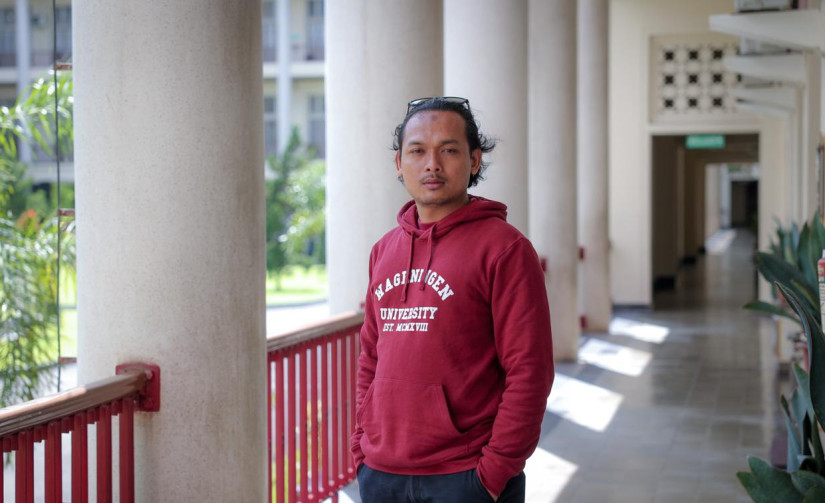
Economic hardship is not a barrier for those determined to change their circumstances and pursue a brighter future. This may best describe the story of Ahmad Rif’an Khoirul Lisan, 32. The man from Pleret, Bantul, Yogyakarta, has always believed that every struggle will eventually find its way.
Rif’an recalls being accepted into the Geography program at Universitas Gadjah Mada in 2012. The first person who opposed his decision to attend university was his own father. The reason was both simple and difficult: their family did not have enough money, while his six younger siblings were still young and required care and support.
His father worked as a freelance Quran teacher, while his mother was a homemaker. Both felt unable to finance their children’s education. They often even encouraged their children to start working immediately after graduating from high school.
However, his father’s request did not weaken the eldest son’s determination to pursue his dreams. For Rif’an, continuing his education was not merely a personal ambition. He wanted to improve his family’s circumstances and help his siblings achieve a better life.
From his school years until entering university, he had already been accustomed to taking on part-time jobs. He understood his family’s financial limitations and did not expect much support. Fortunately, Rif’an was a high-achieving student who had won numerous national awards.
The resistance from his family did not end there. For a time, Rif’an even felt as if he had lost the support of his own family because of his decision to continue studying at university.
Surviving as a Student
The early days of his studies at the Faculty of Geography at Universitas Gadjah Mada in 2012 were not easy for Rif’an. Without sufficient financial support from his family, he had to find ways to survive as a student. Fortunately, he received the Bidikmisi scholarship, which helped support his daily living expenses until graduation.
He became active in various campus organizations. For many students, organizations provide opportunities for learning and networking. However, Rif’an had a simpler reason: at least he could get meals during committee activities.
“I liked joining activities because I knew there would be food,” he recalled with a smile.
At certain times, he had to be extremely frugal just to afford meals. When he was very hungry, he searched for the cheapest food stalls around campus. With about Rp4,000 in pocket money, he would usually buy rice, vegetables, and a single fried snack.
“The important thing was that I could eat,” he said.
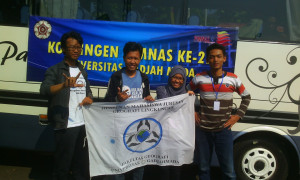
At that time, Rif’an did not even own a computer to complete his coursework. Instead, he found a solution by working at an internet café, earning a salary while also using the computers there.
One day, he mustered the courage to meet the Vice Dean for Student Affairs at the Faculty of Geography and explained his reason for working part-time at the internet café, despite the stigma that students who worked there would graduate late. After hearing his story, the lecturer personally gave Rif’an a used computer so he could complete his assignments more easily.
Even in the busy campus environment, Rif’an often felt that he was going through everything alone. Some of his friends may have thought he was unusual because he rarely joined them just to eat, but this was largely due to his financial limitations.
A Turning Point
A major turning point in Rif’an’s life came in 2014 when he was accepted into a leadership development dormitory program now known as Rumah Kepemimpinan. The program provided accommodation and a monthly allowance of around Rp500,000. This support became a significant milestone in his life. For the first time, he was able to save money and begin thinking about his future. With those savings, he also made his first trip abroad, taking a short visit to Kuala Lumpur with fellow dormitory residents.
Despite this progress, his relationship with his family still felt distant. On one occasion, he tried to invite his family to eat out using prize money from a competition he had won. However, his father chose not to come.
“Throughout my life before that, we had never eaten out together, and this was the first time I invited my family to a restaurant. I invited them to eat satay at Pak Pong,” he recalled.
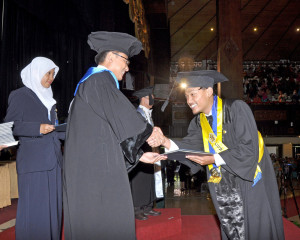
In his final semester, Rif’an applied to become an English mentor in Kampung Inggris Pare, Kediri. The program provided accommodation and training, but living expenses had to be covered independently. For nearly 10 months, he was in the program while completing his undergraduate thesis. He continued to live frugally, usually eating only once a day at a simple food stall that offered unlimited rice and noodles for around Rp4,000 to Rp5,000.
It was there that his English skills improved rapidly. His TOEFL score, which had previously been around 456, eventually increased to about 570. However, taking the TOEFL test presented another challenge. The Rp1 million he had brought to pay for the test was stolen shortly after he got off a bus in Kediri.
With almost no money left, his friends in Pare collected donations to help him register for the test, eventually raising about Rp800,000. With that amount, Rif’an was finally able to pay the TOEFL fee.
“My friends helped by collecting money. That’s how I was able to take the test,” he recalled.
In short, the test results ultimately led to his securing the Indonesia Endowment Fund for Education (LPDP) scholarship.
Dried Tempeh from His Mother
In December 2018, Rif’an departed for the United States to pursue his master’s degree at Arizona State University. At the time of his departure, his mother prepared something simple yet deeply meaningful: dried tempeh as travel provisions. Throughout his life before that, Rif’an had rarely received food prepared for him from home, making the moment particularly memorable.
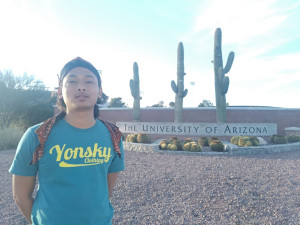
He carried the food with him on the long journey to the United States. Upon arriving there, he received assistance from the Indonesian student community through the Indonesian Students Association (PPI) in finding accommodation and adapting to the new environment. Even though his financial situation had significantly improved thanks to the LPDP scholarship, Rif’an continued to live modestly. He often cooked for himself and utilized the campus food bank to obtain groceries.
The COVID-19 pandemic eventually altered his study plans. After about 15 months in the United States, he returned to Indonesia and completed his master’s program remotely, graduating in 2020.
Pursuing Doctoral Studies
After returning from the United States, Rif’an briefly worked at the National Development Planning Agency (Bappenas) and is now a lecturer at Universitas Pembangunan Nasional Veteran Yogyakarta. However, his academic journey did not stop there. In 2024, he once again received the LPDP scholarship and continued his doctoral studies at Wageningen University & Research in the Netherlands, focusing on water resource management and agriculture.
For Rif’an, the academic journey he has pursued is not merely a personal achievement but also an opportunity to contribute to society.
“If I may share a message for anyone who is struggling, I always believe in one thing: Gusti mboten sare, God never sleeps,” Rif’an said.
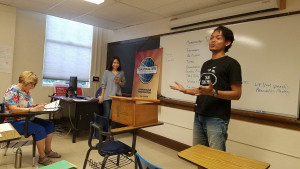
According to him, every effort and hardship a person experiences is never truly in vain.
“The journey may be long and sometimes feel very heavy. But as long as we keep trying, there will always be a path that opens,” he concluded.
Today, Rif’an is completing his doctoral studies at one of Europe’s leading agricultural research universities. Yet he continues to remember every twist and turn of his long journey, about dreams, the courage to overcome adversity, and the hope of contributing meaningfully to agriculture in Indonesia.
Writer: Astri Wulandari
Editor: Gusti Grehenson
Post-editor: Jasmine Ferdian
Photo: Firsto