


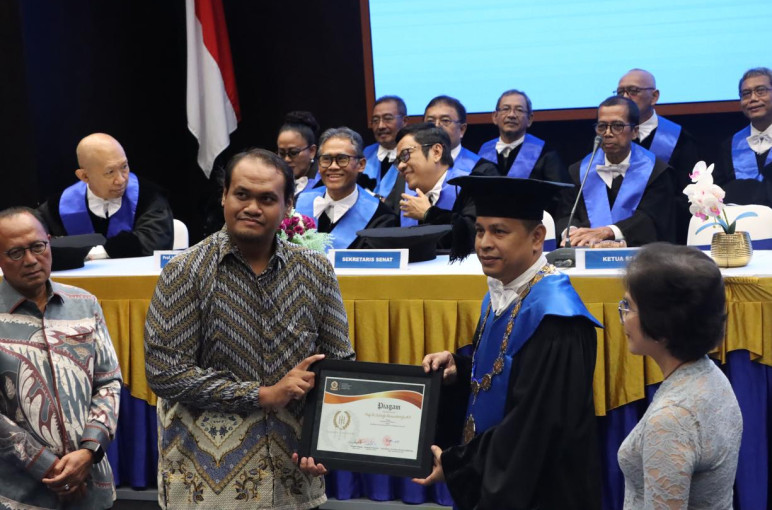
The Faculty of Engineering of Universitas Gadjah Mada (FT UGM) commemorated the 80th Higher Education for Engineering Day (HPTT) by holding an Open Senate Meeting at the SGLC on Friday (Feb. 13). The Dean of FT UGM, Professor Selo, stated that the transformation of the Faculty of Engineering is not solely grounded in research implementation, but also in strengthening institutional resilience and ensuring relevance to industry and societal needs.
This synergy is realized through the development of co-working spaces, a zero-waste-based sustainability commitment including the distribution of tumblers to freshmen and the strengthening of alumni networks through the Career Summit and KATGAMA Talk Series, international collaborations continue to be expanded to enhance global competitiveness.
He emphasized that FT UGM carries systemic consequences in building a sustainable academic culture.
“Every member of the academic community must realize that disorder arises from indifference. The ecosystem must move not because of regulatory compulsion, but because of shared awareness,” he stated.

Furthermore, Professor Selo explained that FT UGM continues to cultivate intellectual initiatives so that its eight-decade journey does not end as a ceremonial celebration.
He reaffirmed that the faculty is guided to become a foundation for national contribution. As part of documenting this journey, FT UGM launched several publications recording practices, ideas, and sustainability achievements within the campus environment.
Professor Selo elaborated on the launch of three books: Harmony in the Corridors of Knowledge: A Portrait of Sustainability at the UGM Faculty of Engineering Campus, Stories Behind the Green Walls of the Engineering Campus, and Waste Management Training Module.
These publications document various programs, best practices, and achievements of FT UGM in building a sustainable academic ecosystem.
The highlight of the 80th HPTT celebration continued with an oration by Sharlini Eriza Putri, Director of Econexus.ai, titled AI, Entropy, and Civilization.
According to her, rapid technological advancement has begun to erode the Earth, with resources gradually diminishing. Artificial intelligence (AI), which has become widespread and embedded in daily life, is believed to require a substantial energy supply as its use increases.
She further asserted that humanity’s efforts to survive may paradoxically lead to strategies that weaken its own resilience. The current crisis is not merely a conflict between humans and nature, but an internal struggle of human civilization against the reality it has created.
“As the younger generation, it is important for us to use AI wisely, for instance, by focusing on understanding the secrets of nature, magnificent phenomena, or local wisdom. We should also reduce excessive personal venting or relying on AI to complete academic assignments,” she emphasized.

The 80th Anniversary Open Senate Meeting of the Faculty of Engineering was concluded with the presentation of the Herman Johannes Award 2026 by KATGAMA to the late Professor Sukadji Ranuwihardjo, in the field of education and human resource development.
A solemn atmosphere marked the closing of the event. Representing the family, Professor Koentjoro expressed his deep gratitude to KATGAMA for the recognition. He remembered the late Professor Ranuwihardjo as a role model both within the family and in academia.
“He was truly an extraordinary person. I learned much from him about simplicity, generosity, and his steadfast and expansive heart. I am deeply grateful for this appreciation,” he concluded emotionally.
Author: Hanifah
Editor: Gusti Grehenson
Post-editor: Jasmine Ferdian
Photographer: Salwa