


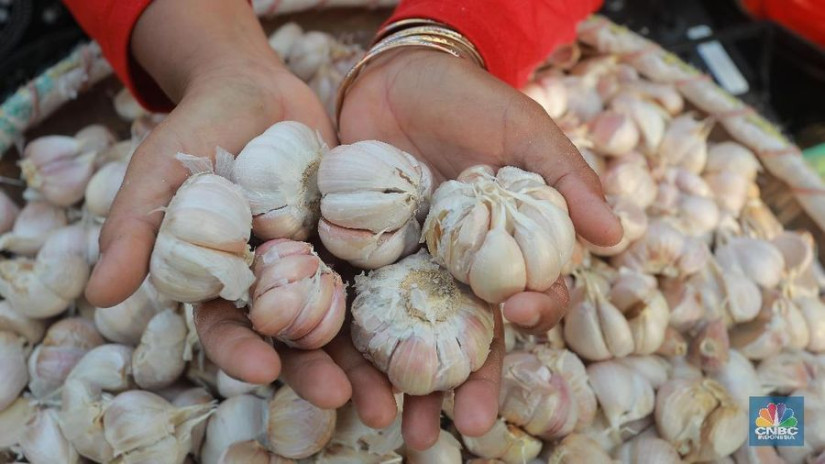
The target of achieving garlic self-sufficiency by 2029 has once again gained momentum within the national food security agenda. For years, garlic has been a commodity heavily reliant on imports, making it vulnerable to price volatility and shifts in global policy.
The Indonesian government has continued to encourage increased domestic production through various development programs. However, self-sufficiency should not be measured solely by the availability of supplies.
The sustainability of farming practices and farmers’ welfare are essential foundations for ensuring that the target can be sustained in the long term.
From an agricultural economics perspective, farmers’ decisions to cultivate garlic are strongly influenced by income certainty. Lecturer in Agricultural Socioeconomics at the Faculty of Agriculture, Universitas Gadjah Mada (Agriculture UGM), Dr. Hani Perwitasari, stated that price is a key factor determining farmers’ interest in a commodity.
When prices are perceived as unpromising, farming risks are considered too high to bear. This condition underscores the need for production-enhancement policies to be accompanied by price-protection mechanisms.
“The most important factor in encouraging farmers to develop a commodity is price. Therefore, the government must ensure favorable prices at the farm level,” said Dr. Perwitasari on Wednesday (Jan. 28).
Dr. Perwitasari explained that past garlic development programs offer valuable lessons for policy formulation. One obstacle arose when input assistance, such as seeds, did not arrive in accordance with the field’s planting schedules.
This mistiming delayed cultivation processes and ultimately affected yields. The situation underscores the importance of program planning that aligns with agricultural cycles.
“Assistance that does not arrive on time means seeds are not planted immediately, which ultimately affects production,” she said.
Beyond the timing of assistance, market certainty is another crucial factor in sustaining garlic farming. According to Dr. Perwitasari, farmers need clarity regarding the absorption of their harvests to avoid uncertainty after the production period ends.
Market analysis is therefore necessary to provide farmers with a clear picture of sales prospects from the outset. While financing support is relatively available, cultivation risks remain a challenge.
“Farmers need market guarantees so they are not confused about selling their harvests, because even when financing is available, they still face risks such as weather conditions and uncertain yields,” she explained.
Furthermore, the risks associated with garlic farming are influenced by the suitability of planting locations and market price fluctuations. When production increases without control mechanisms, prices may fall, harming farmers.
Dr. Perwitasari noted that under such conditions, higher production does not automatically translate into improved welfare. Price stability is key to preventing farmers from incurring losses during harvest.
“When production is abundant, prices should remain stable so that the law of supply and demand does not immediately drive down prices at the farm level,” she remarked.
Government policies, such as subsidies and technical assistance, also play a role in shaping the climate for garlic farming. However, the limited number of extension personnel means that farmers must remain proactive in accessing available support.
Meanwhile, import policies directly affect domestic price dynamics. Dr. Perwitasari emphasized that imports conducted without data-based calculations risk suppressing local products.
“If import channels are opened while domestic production is actually sufficient, prices will fall, and this condition discourages farmers from planting garlic,” she stressed.
In the long term, the success of garlic self-sufficiency should be assessed by the sustainability of farming operations and the conditions of farmers. High production without reasonable profits will be difficult to sustain and may reduce interest in planting in subsequent seasons.
Dr. Perwitasari highlighted the importance of data-driven approaches, multi-stakeholder collaboration, and attention to sustainable agricultural practices to maintain continuity. With such an approach, self-sufficiency will not merely stop at production figures.
“Self-sufficiency is successful when farmers feel prosperous, earn decent incomes, and can sustain their farming activities over time,” she concluded.
Author: Triya Andriyani
Post-editor: Rajendra Arya
Photograph: CNBC