


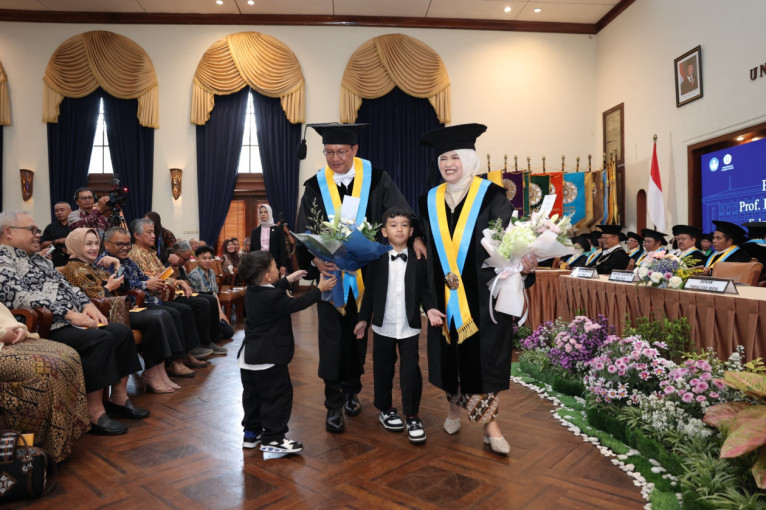
A married couple from the Faculty of Mathematics and Natural Sciences at Universitas Gadjah Mada (FMIPA UGM) was inaugurated together as Professors on Thursday (Sept. 4) at the UGM Senate Hall. The couple is Professor Edi Winarko, M.Sc., Ph.D., who was appointed Professor of Knowledge Engineering, and his wife, Professor Tutik Dwi Wahyuningsih, Ph.D., who was appointed Professor of Chemistry.
At the inauguration ceremony, both expressed their gratitude to colleagues and to each other for the support and motivation that enabled them to achieve the highest academic rank.
“My deepest gratitude goes to my wife, Professor Tutik Dwi Wahyuningsih, for her love, support, motivation, and understanding throughout my life and career,” said Professor Edi Winarko.
Professor Tutik Wahyuningsih conveyed a similar message to her husband.
“Finally, my deepest thanks go to my beloved husband, Professor Edi Winarko, who has always given his blessing, prayers, and full support at every step of my career journey. His support and understanding have been a source of strength that has allowed me to continue creating and contributing,” she said.
The inauguration of these two professors not only marks recognition of their academic achievements but also underscores FMIPA UGM’s contribution to interdisciplinary scientific knowledge, ranging from chemistry to artificial intelligence, with benefits for the future.
In his inaugural speech titled “Empowered AI Through High-Quality Data: The Importance of a Data-Centric Approach in Real-World Artificial Intelligence Applications,” Professor Edi Winarko highlighted a fundamental issue in the development of artificial intelligence, which is the paradigm shift from a model-centric to a data-centric approach.
He explained that for decades, advances in artificial intelligence have been driven by innovations in algorithms and model architectures.
“Throughout its development, progress in artificial intelligence has fundamentally been driven by a model-centric paradigm, where evolution is achieved through innovation in algorithms and model architectures,” he said.
This approach has produced numerous significant breakthroughs over the past decades, including Convolutional Neural Networks (CNN), Long Short-Term Memory (LSTM), and transformer architectures, which now form the foundation of modern AI models across various applications.
However, he emphasized that an excessive focus on models leaves fundamental limitations. In practice, many failures of AI systems are caused by inadequate data quality rather than weaknesses in the models themselves.
“The performance of AI systems is highly dependent on the quality of training data. Two identical models can produce vastly different outputs and quality when trained on different datasets,” he explained.
He illustrated this with a simple analogy of designing a high-performance racing car. Even if engineers perfect every component to a high standard of precision, the most advanced engine will not perform optimally without high-quality fuel.
Furthermore, he highlighted the operational gap between testing performance and real-world conditions as clear evidence of the limitations of current AI systems. Models that perform exceptionally well in testing often experience performance degradation when confronted with real-world data variability caused by distribution shift and domain drift.
In response to these challenges, the data-centric AI paradigm has emerged, placing data at the center of AI system development.
“Data-centric AI does not replace model-centric AI but complements it. Modern AI development requires both model engineering and data engineering to proceed in parallel,” he said.
In this approach, data is no longer viewed as a static resource but as an asset that must be continuously improved through ongoing processes of collection, labeling, and curation.
“Data is the primary foundation of artificial intelligence. Through a data-centered approach, more accurate and trustworthy AI systems can be built,” he stated.
At the end of his speech, Professor Edi Winarko emphasized that the future of artificial intelligence depends not only on sophisticated models but also on the ability to manage data systematically and sustainably, producing more robust and adaptive systems.
Meanwhile, in her inaugural speech titled “Pyrazoline as a Multifunctional Molecular Platform: Synthesis, Anticancer Activity, and Its Application as a Selective Chemofluorosensor,” Professor Tutik Wahyuningsih highlighted the potential of pyrazoline compounds as multifunctional molecular platforms with significant applications in healthcare and sensor technology.
She emphasized that organic synthesis is a fundamental foundation for the development of modern molecules.
“Organic synthesis is the process of constructing carbon-based organic molecules step by step through controlled chemical reactions,” she explained.
For her, this field is not merely technical but also requires a high level of creativity in molecular design. She likened it to architecture, which demands a deep understanding of interactions between atoms to achieve desired structures.
“Organic synthesis is often referred to as the architecture of the molecular world because it requires creativity in molecular design,” she added.
Furthermore, Professor Tutik Wahyuningsih explained that through organic synthesis, researchers can design and modify molecular structures to enhance biological activity, improve selectivity for target cells, such as cancer cells, and reduce toxicity to normal cells. This approach is crucial in developing more effective and safer drugs.
She focuses her research on heterocyclic pyrazoline compounds, which have ring structures containing heteroatoms such as nitrogen, oxygen, or sulfur. These structural characteristics provide unique electronic properties and enable various pharmacological activities.
“Pyrazoline is a heterocyclic compound with a five-membered ring containing nitrogen, which gives it various pharmacological activities, including antimicrobial, anticancer, anti-inflammatory, and antioxidant properties,” she explained.
In a broader context, she highlighted the ongoing challenges in effective cancer treatment, particularly the need for better therapeutic approaches. She explained that although chemotherapy remains the primary method in cancer treatment, it still faces significant challenges, including drug resistance due to DNA mutations and low selectivity, which remain major causes of treatment failure.
Through her research, Professor Tutik Wahyuningsih demonstrated that electron-donating substituents such as chloro, methoxy, and dimethylamino exhibit promising cytotoxic activity against various cancer cell lines, opening opportunities for developing drugs with fewer side effects.
Beyond its potential as a drug candidate, pyrazoline also shows promise as a chemofluorosensor. Its fluorescent properties enable sensitive and selective detection of specific substances.
“The natural fluorescence of pyrazoline makes it an attractive candidate as a fluorophore in chemofluorosensor systems,” she explained.
She added that this technology has broad applications, ranging from environmental monitoring to medical diagnostics. However, its development still faces several challenges.
“Pyrazoline derivatives hold promising prospects in the development of anticancer drugs and chemofluorosensors. However, challenges remain, including optimizing selectivity and understanding molecular interaction mechanisms,” she concluded.
Author: Zabrina Kumara
Editor: Gusti Grehenson
Post Editor: Zabrina Kumara
Photo: Firsto