


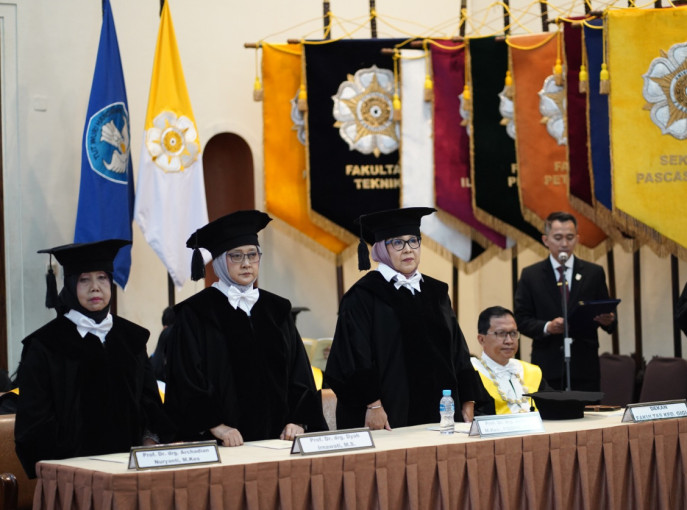
The Faculty of Dentistry at Universitas Gadjah Mada (FKG UGM) expanded its roster of active professors with the inauguration of three new professors at the Senate Hall, UGM Central Building, on Tuesday (Apr. 7). The three newly appointed professors are Professor Archadian Nuryanti, Professor Dyah Irnawati, and Professor Julita Hendrartini. Each delivered lectures on diverse topics ranging from biomedical technology and polymer biomaterials to oral health services in Indonesia.
Inaugurated as Professor of Biomedical Technology in Dentistry, Professor Archadian Nuryanti delivered her inaugural lecture titled “The Perspective of Biomedical Technology in Sustaining Life through Preventive Dentistry.” Her address emphasized that the field has evolved beyond disease treatment (tooth-centered care) toward continuous maintenance (life-centered care).
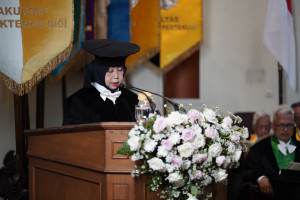
Professor Archadian outlined several transformations in preventive dentistry enabled by biomedical technology, including preventive diagnostic technologies that use saliva and the oral microbiome, as well as digital imaging and artificial intelligence. She also highlighted biomedical intervention technologies such as low-trauma precision ultrasonics and evidence-based bioactive and herbal agents.
In addition, she noted the emergence of behavior- and environment-based preventive technologies, including smart devices (IoT oral care), making prevention an integral part of everyday lifestyle.
Discussing the history of preventive dental care, Professor Archadian noted that traditional herbal medicine remains widely trusted by the public, while herbal remedies are now being developed in clinical settings. This development aligns with the rapid advancement of artificial intelligence (AI), which has the potential to support early prevention.
“However, every innovation has limitations that must be considered, as well as the readiness of medical professionals to collaborate. My message is that preventive actions to maintain health lie in the 3G principles: gerak (movement), gelak (laughter), and gaya (lifestyle),” she concluded.
Meanwhile, Professor Dyah Irnawati was inaugurated in the field of Polymer Biomaterials in Dentistry, delivering her lecture titled “The Journey of Polymer Biomaterials in Dentistry: From Conventional to Smart Polymers.”
Reflecting on its development, she explained that polymers began with natural rubber, evolved into synthetic polymethyl methacrylate (PMMA), and later into bisphenol A glycidyl methacrylate (bis-GMA). Across various branches of dentistry, these materials are widely used in silicone soft liners, resins, root canal fillers, waxes, and more.
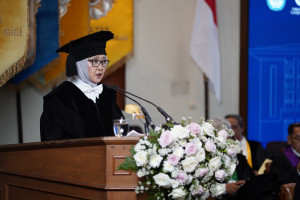
Professor Dyah highlighted significant advancements in the development of smart polymers, including antimicrobial polymers; shape-memory polymers responsive to temperature, light, and mechanical forces; pH-responsive materials; self-healing polymers capable of repairing themselves; and smart antimicrobial peptides.
“These developments indicate that polymers are no longer static materials but dynamic ones that can adapt toward intelligent biomaterials,” she said.
Professor Julita Hendrartini then delivered her inaugural lecture on Dental Policy, Management, and Financing. In her presentation titled “Addressing Inequality in Oral Health Services in Indonesia,” she emphasized that the implementation of the National Health Insurance (JKN) program does not automatically translate into real access to dental services. Data from the 2023 Indonesian Health Survey (SKI) show that oral health problems affect 56.9 percent of individuals aged over 3 years, yet only 11.2 percent seek treatment (Ministry of Health, 2024).
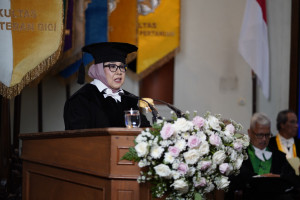
Inequality in dental services is further reflected in other data. Professor Julita reported that in 2023, Indonesia had 23,834 dentists and 3,243 specialists. However, this number is unevenly distributed, with 22.4 percent of Primary Health Care Facilities (FKTP) lacking a dentist. The issue is further compounded by data from AFDOKGI 2025, which estimates that dental schools produce approximately 3,500–4,000 graduates annually.
“The main issue is not the number of graduates, but the distribution and retention of dental health personnel. From a sociological perspective, placements tend to concentrate in urban areas,” she explained.
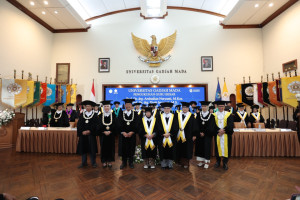
She proposed several strategic solutions to address this issue, including reforming the distribution of dental human resources through location-based needs mapping and providing incentives for underserved and remote areas (3T regions).
The Ministry of Health could also collaborate with academics to develop a dental health dashboard to detect early warning signs of service inequities, among other solutions.
“This inequality is the result of interactions among multiple factors. Increasing the number of graduates does not automatically resolve access issues in remote areas if incentive policies remain unchanged, infrastructure is limited, and career pathways are unclear,” she concluded.
Author: Hanifah
Editor: Gusti Grehenson
Post-editor: Jasmine Ferdian
Photo: Firsto