


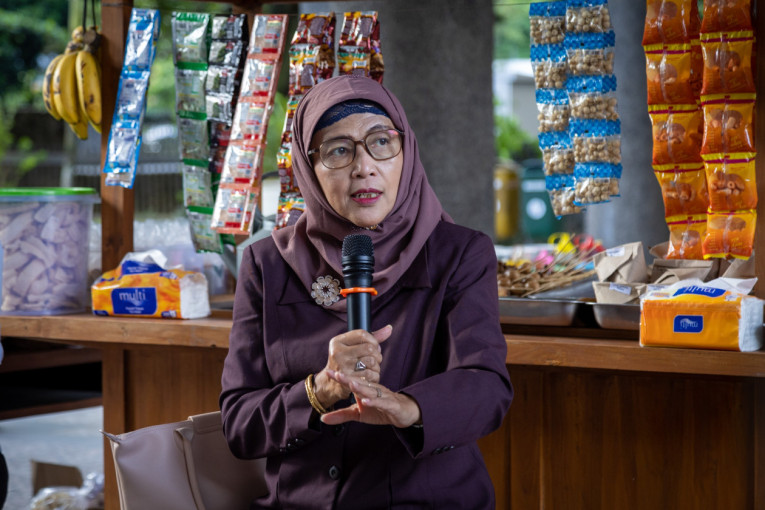
Professor of International Relations and Middle East observer at the UGM Faculty of Social and Political Sciences (Fisipol UGM), Professor Siti Mutiah Setyawati, believes that Indonesia’s decision to join the Board of Peace (BoP), initiated by the United States, will make it more difficult for the country to act as a mediator to end the Iran vs. US-Israel war. Therefore, she urged the government to review the decision carefully from the perspective of foreign policy and global diplomatic dynamics.
Although the BoP claims to promote peace in Gaza through the involvement of several countries, Setyawati noted a fundamental issue in its membership composition. Palestine, as a party directly involved in the conflict, has not been included in the forum.
“The Board of Peace claims to create peace in Gaza, but Palestine is not included as a member, making it difficult to imagine how peace can be built without involving the parties in conflict,” she emphasized on Thursday (Mar. 5) during the Pojok Bulaksumur Discussion.
Professor Siti explained that the BoP’s organizational structure raises questions about the governance of international diplomacy. She noted that international organizations are generally represented by states through their official governments.
However, the leadership pattern within the BoP appears to differ from common multilateral diplomatic practices. She stressed that this condition may affect the forum’s legitimacy in carrying out its peace mission.
“In international law, organizations are usually represented by states, whereas leadership in the BoP appears highly personal, raising questions about the governance of international diplomacy,” she added.
In addition, Professor Siti explained that Indonesia’s position in the BoP could create perceptions of partiality in the Middle East conflict. She said that perceptions of neutrality are crucial for successful peace diplomacy. When a country is perceived as belonging to a particular bloc, its chances of being accepted as a mediator become smaller.
“A mediator must remain neutral. When Indonesia joins the BoP, whose members include the United States and Israel, it will be difficult for other parties such as Iran to accept Indonesia as a mediator,” she said.
She further added that Indonesia’s diplomatic steps must take into account its strategic position within the global political landscape. A country’s diplomatic capacity is strongly influenced by its position in the international power structure. She explained that developing countries need to be cautious when engaging in forums related to major conflicts among global powers. Diplomatic initiatives must take into account both international perceptions and a country’s ability to play a credible role in peace processes.
“Within the global power structure, Indonesia still belongs to the group of developing countries, so it must realistically assess its diplomatic capacity in major conflicts such as those occurring in the Middle East,” she said.
She also emphasized that the government’s attention should be directed toward the safety of Indonesian citizens in the Middle East region. Escalating conflict poses risks to thousands of Indonesians who work and live in the Gulf region. She said the government needs to prioritize protection measures and evacuation plans for citizens located in conflict zones. Protecting citizens is a primary responsibility of the state during international crises.
“The most urgent matter is actually ensuring the safety of Indonesians in the region, as the number of Indonesian citizens in the Gulf is very large and their safety must be the top priority,” she stressed.
Regarding the ongoing conflict in the Middle East, Professor Siti believes that tensions between Iran and the United States stem from a long historical background. Relations between the two countries deteriorated after the Iranian Revolution in 1979, which was followed by the hostage crisis at the United States Embassy in Tehran. The incident marked the beginning of worsening diplomatic relations between Iran and Western countries. Political narratives that developed afterward have also influenced global perceptions of Iran.
“Since the Iranian Revolution in 1979, relations between Iran and the United States have remained tense, and various political narratives have shaped global perceptions of Iran,” she said.
The prolonged conflict between the two countries has also influenced geopolitical dynamics in the Middle East region. In many cases, relations between Iran and Western countries have been marked by deep mistrust. This situation is also related to various economic sanctions and international political pressure imposed on Iran. Such conditions make conflicts in the Middle East difficult to resolve in the short term.
“In the experience of international relations, conflicts like this often last for a very long time and can continue for years depending on the dynamics of the powers involved,” she concluded.
Author: Triya Andriyani
Post-editor: Zabrina Kumara
Photo: Donnie