


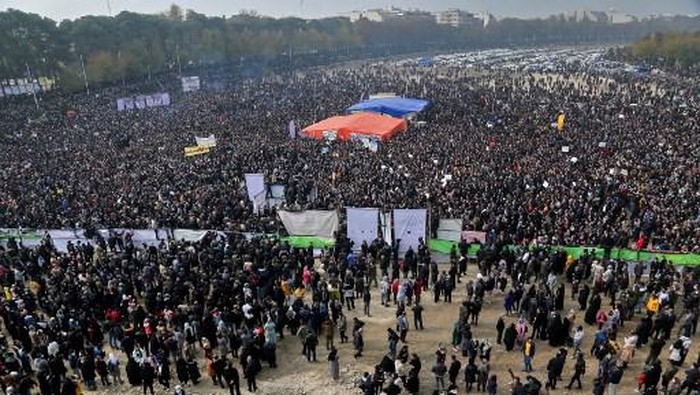
The escalation of protests swept across Iran throughout January 2026 has been reported as the most critical phase in the country’s domestic history since the 1979 Revolution. State media reported that at least 3,117 people, both civilians and security forces, were killed during the unrest. This phenomenon reflects the accumulation of multidimensional and systemic tensions, rooted in extreme economic depression, asset freezes by Western countries, prolonged international sanctions, and repressive policies adopted by the authorities in response to demonstrators.
Responding to the violence by security forces that resulted in thousands of deaths within a short period, former Head of the Center for Security and Peace Studies at Universitas Gadjah Mada (PSKP UGM), Dr. Ahmad Munjid, stated that the casualties indicate a fragile legitimacy of the regime.
“Any regime will act blindly when facing an existential threat. That is what is happening now. They are exerting every effort to maintain their position. The tactic employed is to constantly blame external actors, namely the United States and Israel,” he explained on Friday (Jan. 23).
Although foreign intervention is a tangible geopolitical reality, Dr. Munjid argued that such a narrative would not resolve the core problems.
“The ruling regime in Iran cannot continue to deflect responsibility by placing all the blame on foreign intervention. That will never solve the problem,” he emphasized.
According to Dr. Munjid, the Iranian regime must urgently formulate solutions to address the primary economic crisis and democratic demands, which are key determinants of national stability. However, tensions in Iran have begun to subside.
Street demonstrations, arrests, and killings have ceased; the main issue, namely economic hardship, remains entirely unresolved.
“Demonstrations could erupt again at any time. The Iranian people need food and need to live normal lives,” he said.
Protest Movement
Dr. Munjid observed fundamental similarities between the January 2026 demonstrations and the events of 1979. Both were marked by massive protest movements reflecting widespread public disappointment and anger toward the ruling regime.
“The public is angry due to economic collapse, rampant elite corruption, and an authoritarian regime that responds to protests with extreme brutality,” he noted.
He explained that the current economic crisis facing Iran is far more complex and severe. Iran’s economic capacity is reported to be operating at only 50 percent due to prolonged economic sanctions, the impact of the pandemic, and deteriorating global conditions.
He added that the situation worsened following a US–Israel military attack on Iran’s nuclear facilities during the 12-day war, which triggered a surge in staple food prices of more than 70 percent.
This situation, Dr. Munjid said, has been further aggravated by disruptions to public utilities, including water and electricity services. The monetary sector has also recorded its worst-ever devaluation, with the Iranian rial depreciating to as low as 1.4 million rials per US dollar following the unrest.
“This extraordinary economic crisis has sparked fierce protests by traders at the Grand Bazaar. They closed their shops because economic activity had ceased, and took to the streets to demonstrate. Instead of listening to public aspirations, unfortunately, the Iranian regime responded with brutality. Electricity and internet networks were shut down. Thousands were killed, tens of thousands injured, and tens of thousands more arrested,” he explained.
Nevertheless, Dr. Munjid also noted concrete differences between the two crises, particularly in terms of mass mobilization. According to him, the 1979 movement demonstrated greater public consolidation through coordination among opposition leaders.
“In 1979, public forces were relatively more consolidated. Several opposition leaders coordinated their efforts. There was a prominent opposition figure capable of unifying the movement across leftist, rightist, and professional groups, namely Ayatollah Ruhollah Khomeini. In contrast, current demonstrators are uncoordinated, and there is no visible opposition leader who is widely accepted and capable of uniting the public,” he elaborated.
In addition, sociological tensions have been exacerbated by a widening gap in aspirations between the aging theocratic elite and an increasingly progressive younger generation. Dr. Munjid argued that strict control by religious institutions has, in fact, triggered mass alienation.
“In fact, Iran’s theocratic regime has never truly reached all segments of Iranian society. The tighter the religious regime’s control, the more Iranians distance themselves from religion,” he concluded.
Author: Aldi Firmansyah
Editor: Gusti Grehenson
Post-editor: Jasmine Ferdian
Photograph: AFP