


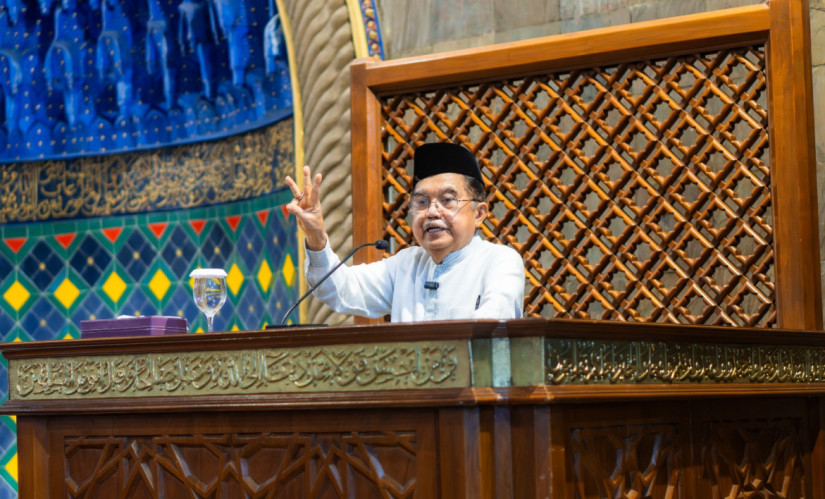
Former Vice President of Indonesia for the 2004–2009 and 2014–2019 terms, Drs. Muhammad Jusuf Kalla delivered a lecture during the Ramadan Public Lecture (RPL) session at the Campus Mosque of Universitas Gadjah Mada on Thursday (Mar. 5). In his lecture, he stated that most conflicts in Indonesia have been caused by government injustice. This is reflected in the fact that 9 of 15 major conflicts in Indonesia since independence were triggered by injustice.
“Conflicts in Indonesia occur because of government injustice that later develops into religious conflicts, socio-political issues, territorial disputes, and even ideological conflicts,” said Jusuf Kalla.
Based on his experience, of the 15 conflicts, only three were resolved peacefully, while the remaining 12 were settled through military operations. He said that resolving conflicts peacefully requires knowledge, logic, and courage. Understanding the internal causes of conflict, studying the characteristics and attitudes of the communities involved, and providing peaceful explanations to the conflicting parties are among the steps used to achieve reconciliation.
In conflicts between countries in the Southeast Asian region, Indonesia has played a significant role in peacebuilding, including those involving Cambodia and Thailand, the Philippines–Moro conflict, Cambodia and Vietnam, and the Rohingya and Myanmar conflict. This role aligns with Indonesia’s constitution, the 1945 Constitution of Indonesia, which mandates that Indonesia help maintain world order based on independence, lasting peace, and social justice.
“Every peace effort in global conflicts can be achieved by understanding the problem and reaching an agreement that offers a win-win solution,” said Jusuf Kalla.
Jusuf Kalla emphasized that wars today are essentially wars of technology. Technology plays an important role in a nation’s power and progress. From the perspective of higher education, university students must have a strong motivation to pursue knowledge, particularly to support technological development.
“With the knowledge we possess, we must be able to use and master technology well for the advancement of the nation,” he said.
He also advised students and lecturers to enhance technological research capabilities for the sake of peace and national progress. Furthermore, those who aspire to serve in government, at the central or regional level, should always act fairly so that national unity in Indonesia is not undermined.
“Advancing technological development and knowledge, along with a government that acts fairly, can strengthen the national economy and reduce the occurrence of conflict,” he advised.
In closing, he added another important aspect, besides mastery of science and technology: becoming an entrepreneur. Hard work, honesty, and the ability to generate new ideas play a crucial role in building national progress.
“Business, entrepreneurship, and knowledge are important in encouraging better mastery of technology,” Jusuf Kalla concluded.
Author: Jesi
Editor: Gusti Grehenson
Post-editor: Jasmine Ferdian
Photo: Committee Documentation