


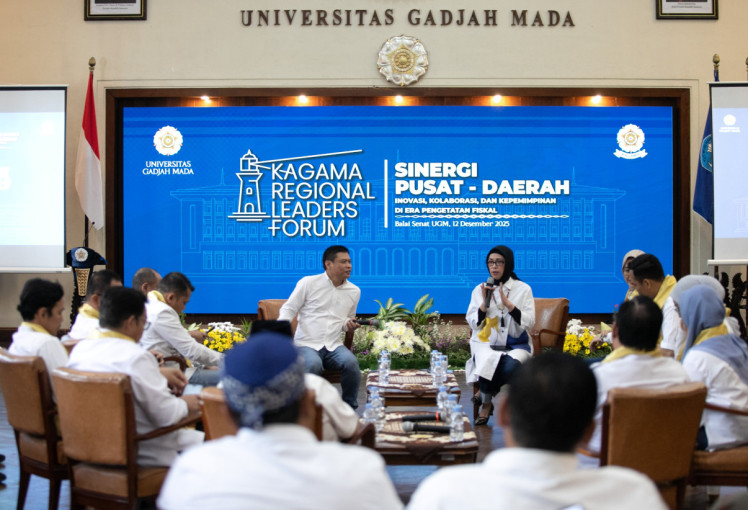
The Coordinating Minister for Human Development and Cultural Affairs, Professor Pratikno, underscored the role of leaders in safeguarding environmental quality amid fiscal tightening. Professor Pratikno emphasized that the world is moving toward zero-emission and clean energy targets, making it imperative for every region to prioritize green development.
“The dream of the global community is a pristine natural environment, and that is what we still have today,” said Professor Pratikno in a video message at the Kagama Regional Leaders Forum, held for the first time on Friday (Dec. 12) at the Senate Hall of Universitas Gadjah Mada (UGM).
He reaffirmed Indonesia’s commitment to peaking emissions by 2030 and stressed that achieving this target requires the participation of all regions. On the occasion, the coordinating minister reminded areas that have yet to be dominated by skyscrapers of their strategic role in future climate change mitigation.
Chair of Kagama, Dr. (H.C.) Mochamad Basuki Hadimoeljono emphasized that Indonesia is currently facing two major challenges: the increasing frequency of natural disasters across several regions and a fiscal tightening regime at the regional level. Both conditions, he noted, test the quality of leadership among regional heads.
The alumnus of UGM’s Geological Engineering Program said that leaders’ creativity and innovation often emerge precisely when they are confronted with major problems and must formulate appropriate solutions.
“A person’s creativity in facing problems is not about how difficult the problem is, but about how we respond to it,” he said.

Dr. Hadimoeljono also stressed that collaboration is key to addressing various challenges, particularly in disaster management and interregional development.
He noted that while each region often feels it has developed the best innovations and practices, in other areas, it can, in fact, be far more progressive. According to him, the forum serves as a platform for sharing experiences, exchanging ideas, and ensuring that policy innovations do not operate in isolation.
“Collaboration is seen as a pathway to collectively enhance regional capacity and generate greater impact for society,” he said.
The Governor of the Special Region of Yogyakarta, Sri Sultan Hamengkubuwono X, delivered a profound message on the importance of morality in leadership, particularly in facing fiscal challenges, social fragmentation, geopolitical disruption, and ecological pressures.

According to Hamengkubuwono X, leadership cannot rely solely on technical competence but must be rooted in inner clarity, ethics, and moral awareness. Quoting Tembang Keling by Sri Sultan Hamengkubuwono I, the Governor of Yogyakarta stressed that good intentions without inner clarity can misdirect public policy.
“A leader who relies excessively on personal will while ignoring moral signals will be trapped in symbolic correctness without substantive wisdom,” he asserted.
Hamengkubuwono X also linked transformative leadership to a foundation of civilizational values articulated by great thinkers, including Sukarno, Franz Magnis-Suseno, Jansen H. Sinamo, Komarudin Hidayat, and Nelson Mandela.
In his view, a nation can endure only if its leaders possess a strong value framework, uphold moral integrity, and foster inclusive public dialogue. Contemporary leadership, he added, must be able to translate long-term vision into policies that are flexible toward innovation and change.
“People-centered governance must not be extinguished by the pursuit of power, but should remain present through the courage to make difficult decisions with honesty and collaboration,” he explained.
Author: Ika Agustine
Editor: Gusti Grehenson
Post-editor: Salma
Photographer: Donnie Trisfian