


In former conflict zones, trauma, distrust between groups, and memories of loss can persist for decades and even be passed down to subsequent generations. This shows that peacebuilding cannot focus solely on the absence of violence; it must also account for the lived experiences of affected communities.
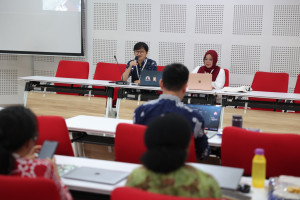
This was highlighted by Dr. Geger Riyanto, an anthropologist from the University of Indonesia (UI), during a plenary session titled “The Issue of Peacebuilding” at the UGM CHSS Writing and Academic Capacity Building Workshop, held at the Faculty of Cultural Sciences at Universitas Gadjah Mada (FIB UGM) on Monday (Oct. 19).
Geger began his presentation by discussing Johan Galtung’s concepts of negative and positive peace. Negative peace refers to the absence of direct violence, while positive peace encompasses social justice, equitable power relations, and the fair distribution of resources. However, applying positive peace as an ideal standard risks overlooking the experiences of people who continue to bear the consequences of conflict.
“People who have lost siblings, parents, or other relatives to violence cannot simply be expected to forgive those responsible within just a few years. Therefore, the idea of fully realized positive peace can become an unrealistic expectation and may even come across as patronizing to those living in conflict-affected situations,” he explained.
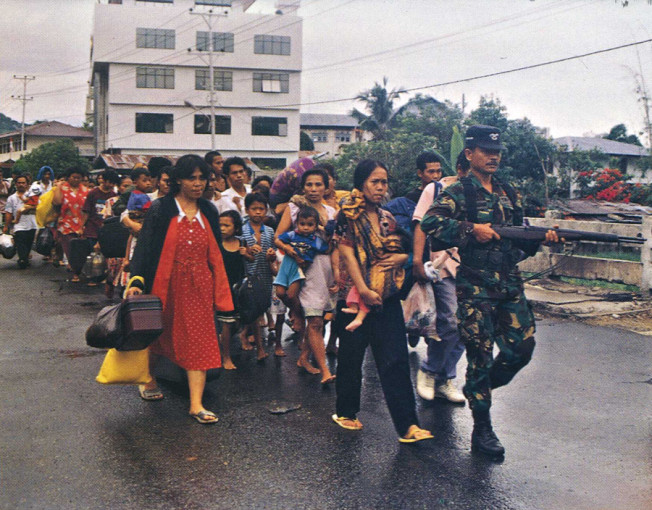
To illustrate this issue, Geger recounted the story of Marlin, a Christian woman from Halmahera who was repeatedly displaced during the North Maluku conflict of 1999–2000. She lost loved ones, witnessed violence, and had to flee through the forest to survive. At a gathering of displaced people in 2002, Marlin challenged a Muslim young man’s statement that the conflict in Maluku was not a matter of religion.
“Do not say that Islam does not teach hatred. It was Muslims who stormed my village, wanted to kill me because I am a Christian, and chased us through the forest. I experienced that violence myself,” Geger quoted Marlin as saying during his presentation.
Muslim communities had also experienced similar suffering. He cited the case of Hamid, a young man who lost his younger brother in an attack and whose house was burned down. These experiences fueled Hamid’s anger toward the group he held responsible, eventually leading him to attempt retaliation by burning a church. The stories of Marlin and Hamid illustrate how loss and fear can perpetuate cycles of intergroup violence.
In Ambon, the effects of the conflict were also evident in residential segregation along religious lines. Geger described an individual whose motorcycle broke down in a predominantly Christian village but who chose to keep pushing it until reaching a Muslim village because he did not feel safe stopping there. The use of religious symbols to mark territorial boundaries further illustrates how trauma shapes people’s perceptions of places and other groups.
This distrust persisted even after the conflict subsided. A 2019 survey by Henry Kapotutu involved 450 high school students in Ambon. About 89% of respondents who grew up without directly experiencing the conflict had heard stories about it from their families. Accounts of losing family members, displacement, and fear of other groups also influenced how younger generations viewed people of different religious backgrounds.
According to Geger, these conditions challenge the assumption that peace follows a predictable roadmap. He criticized the liberal peace approach, which emphasizes democratization, the rule of law, and free markets, when implemented through a top-down process without sufficient attention to local contexts.
In Indonesia, for example, decentralization intended to strengthen democracy can also intensify political and resource competition, exacerbating tensions in certain regions.
Post-conflict communities sometimes choose local mechanisms to restore communal life. These may include reintegrating former combatants through economic activities or avoiding discussions of past violence. Such practices demonstrate that peacebuilding involves compromises and contradictions that do not always align with idealized theories.
“Peace must be understood through the experiences of the people who live through it. We cannot assume that there is one clear roadmap for restoring relationships within a community, because each community has its own experiences, wounds, and ways of moving forward after conflict,” he said.
Strengthening Academic Capacity and Inclusivity
The plenary session was part of the UGM CHSS Writing and Academic Capacity Building Workshop, a three-year program running from 2026 to 2028. Managed by the Association for Asian Studies (AAS) with funding from the Swedish International Development Cooperation Agency (Sida). It supports academics and researchers from conflict and post-conflict regions in Asia, particularly those from underrepresented groups in academia.
In her opening remarks, Dr. Mimi Savitri, Vice Dean for Research, Community Service, Cooperation, and Alumni Affairs at UGM’s Faculty of Cultural Sciences (FIB UGM), said the workshop was expected to provide a space for improving publication quality while broadening the exchange of experiences and academic networks.
“We hope this workshop will be more than just an opportunity to revise manuscripts for publication. It should also give participants space to share experiences, learn from one another, and build friendships and academic relationships. By strengthening research and giving greater visibility to underrepresented voices, their work can contribute to a deeper understanding of conflict, inclusivity, and peacebuilding,” she said.
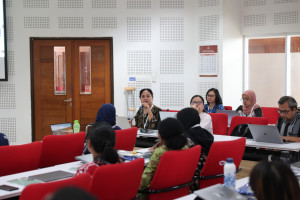
Meanwhile, Professor Wening Udasmoro from CHSS UGM explained that the program includes academic fellowships, writing workshops, regional symposia, and capacity-building activities. Participants include women academics, people with disabilities, queer communities, early-career lecturers, postgraduate students, and academics from underrepresented institutions.
The program focuses not only on academic writing but also on providing opportunities to attend international conferences, expand cross-border collaboration, and engage with communities through art, literature, and dialogue forums.
“Knowledge production should begin with local knowledge, rather than relying solely on mainstream perspectives or top-down approaches. Grassroots communities must also have opportunities to produce their own knowledge. Through this program, we aim to build a strong academic ecosystem in which we can support one another, expand collaboration, and create an impact for individuals, communities, and society,” she said.
Through activities running until 2028, UGM CHSS is expected to strengthen publication capacity, expand regional academic networks, and create space for underrepresented groups to share their perspectives. The workshop’s discussion of peace also underscored the importance of connecting academic theory with communities’ lived experiences as they confront conflict and rebuild their lives together.
Author: Zabrina Kumara
Editor: Gusti Grehenson
Post-editor: Jasmine Ferdian
Photos: Wikipedia, Firsto