


Maggots, the larvae of the Black Soldier Fly (BSF), are a type of fly commonly used to decompose organic waste into compost. Beyond their ability to break down waste, these larvae also have potential as a new economic resource, serving as a protein raw material for animal feed. This is particularly relevant as national feed production currently exceeds 21 million tons per year, with very high protein demand. The feed industry faces major challenges in meeting protein raw material needs.
“Maggots offer a sustainable solution because they can convert organic waste into animal feed protein with economic value,” said Dr. Muhsin Al Anas, a lecturer at the Faculty of Animal Science, Universitas Gadjah Mada (UGM), during the Batch 2 Waste Processing Workshop at the faculty on Wednesday (Dec. 17, 2025).
In his explanation, Dr. Al Anas stated that BSF larvae not only serve as feed raw materials but also as feed additives and supplements that can improve digestive health and livestock immunity.
“Through the development of BSF-based feed pellet technology, livestock productivity can be increased while reducing dependence on imported feed ingredients,” he explained.
Furthermore, Dr. Al Anas elaborated that innovation in maggot farming also plays an important role in integrated waste management.
Waste from households, the poultry industry, and Integrated Waste Processing Facilities (TPST) can be used as larval growth media, producing derivative products in the form of larval flour and oil that have been developed as research-based functional feed.
Rima Amalia Eka Widya, CircuLife Project Coordinator, stated during the workshop that active community participation in waste management is essential to create sustainable environmental solutions with a tangible impact.
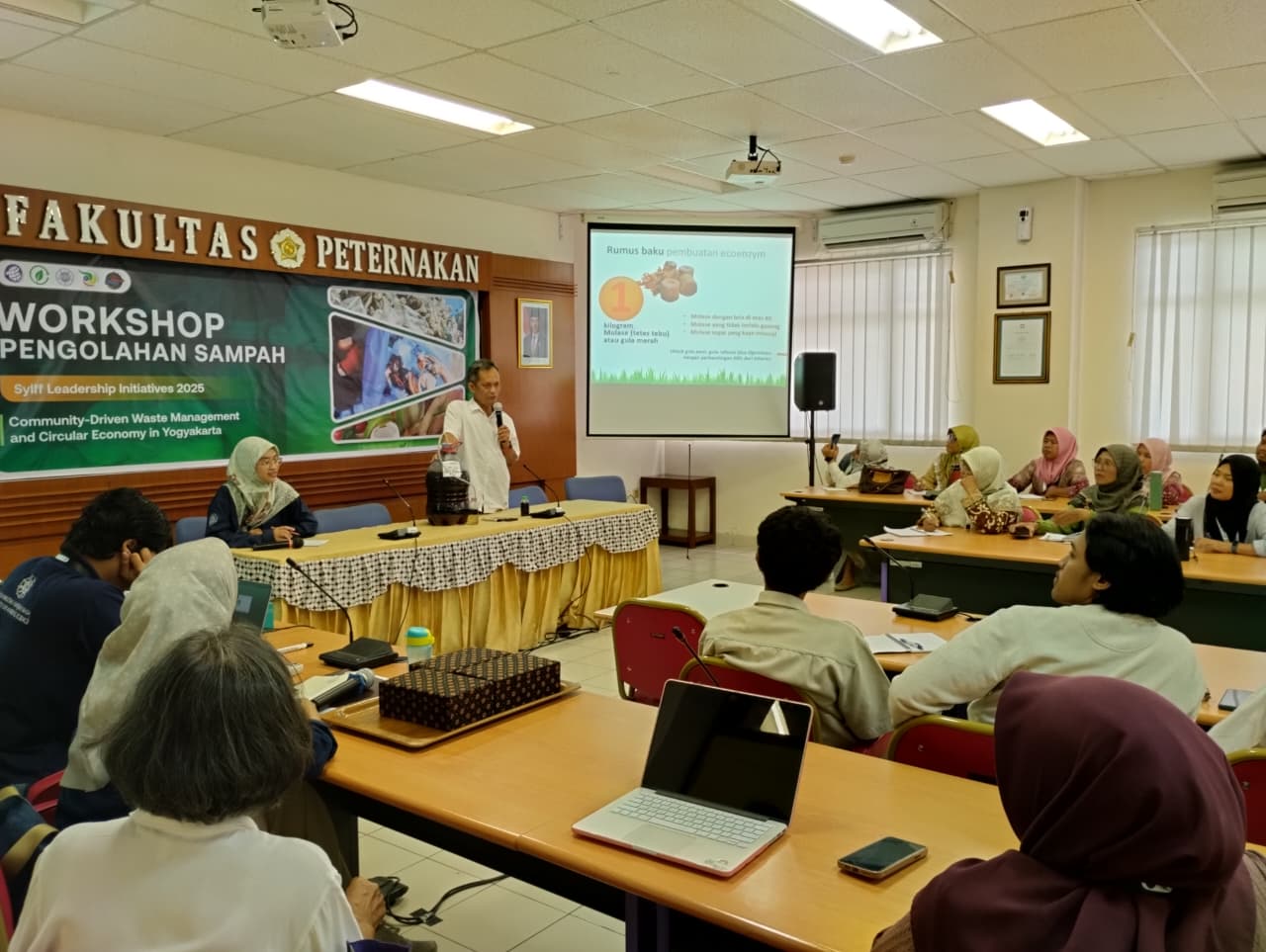
The first workshop session presented material on organic waste processing using ecoenzymes, delivered by Sarwa Sigid from the Ecoenzyme Nusantara Community.
In this session, participants gained an understanding of how to use household organic waste to produce environmentally friendly, practical, and easy-to-apply products at the community level.
Through the Waste Processing Workshop, Animal Science UGM hopes participants will not only gain knowledge but also be able to independently implement organic waste-processing practices in their respective environments.
Reporter: Animal Science UGM/Satria
Author: Agung Nugroho
Post-editor: Lintang Andwyna
Photograph: @aliansizerowaste.id