


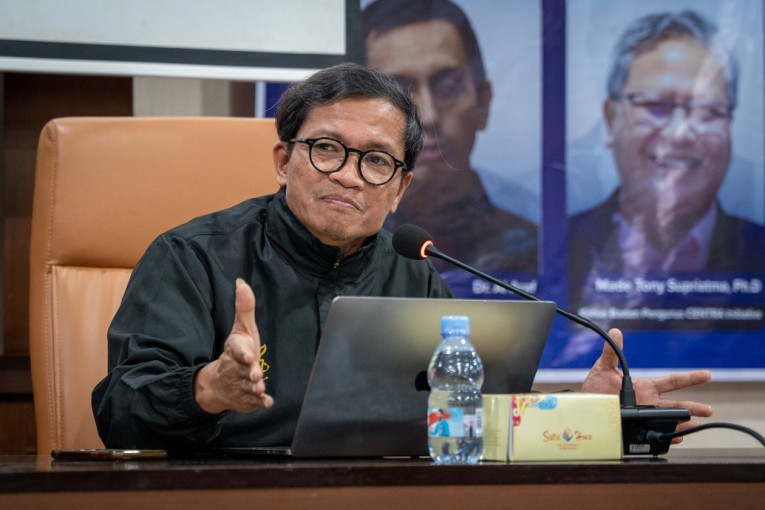
Recent political developments in Indonesia have shown a growing tendency toward military dominance. The planned revision of Law No. 34/2004 on the Indonesian National Armed Forces (TNI), along with the resurgence of discourse on the dual function of the armed forces, reflects a push by certain military groups to expand their role in the civilian sphere.
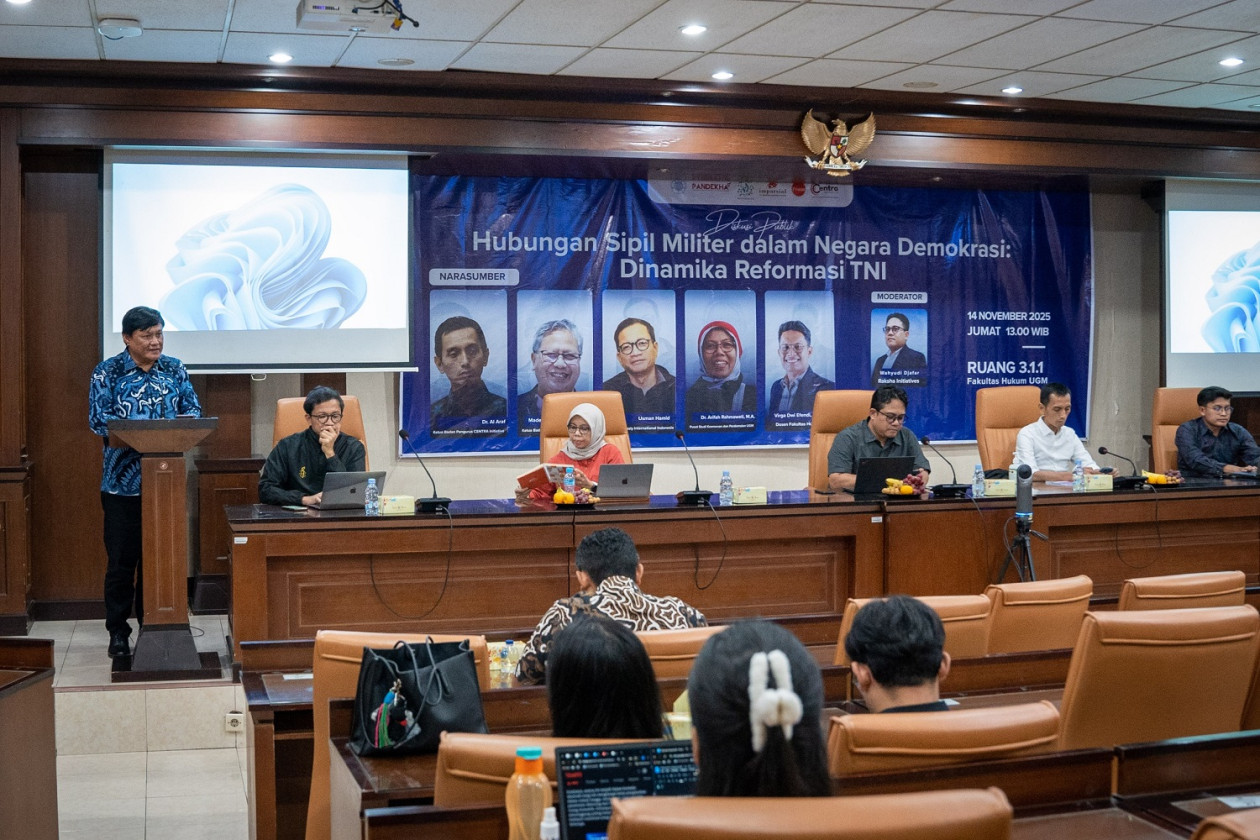
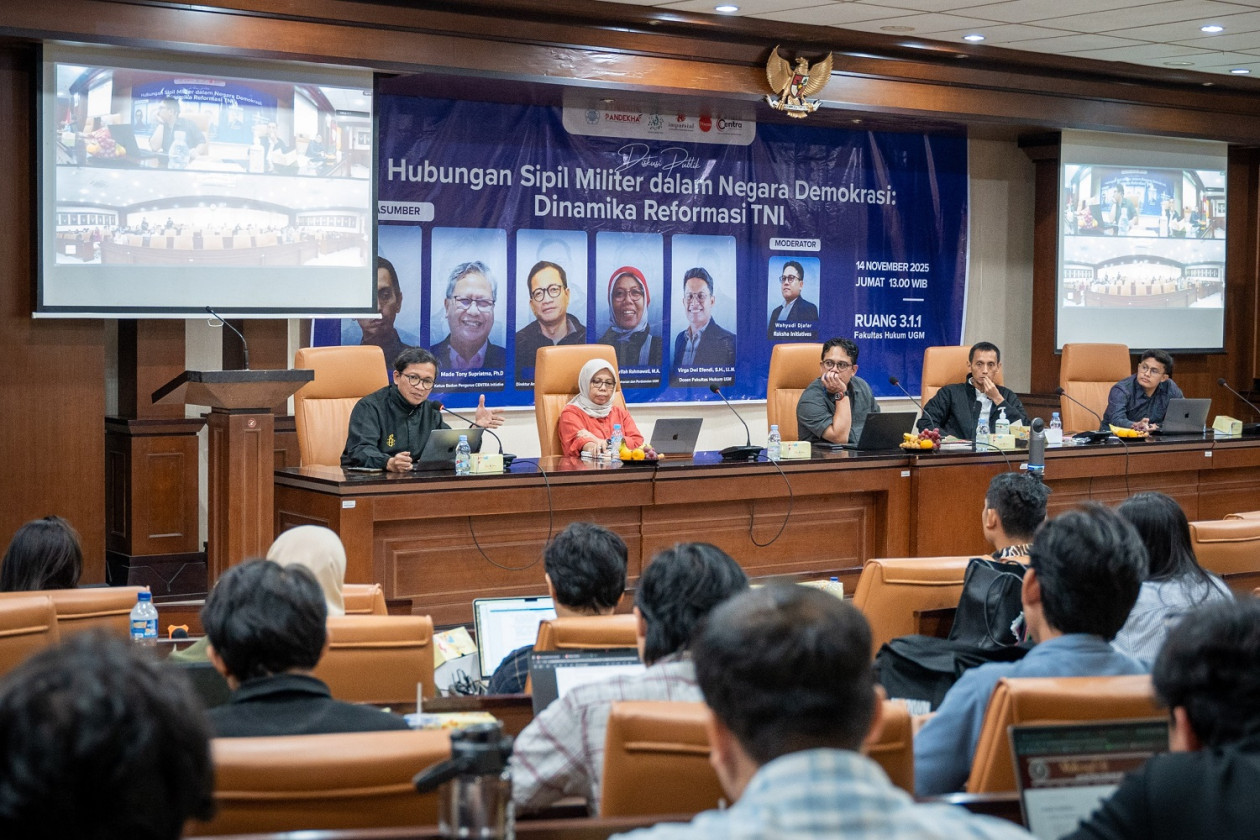
These issues emerged prominently during a Public Discussion and the Launch of the Special Edition of PRISMA Journal titled “Hubungan Sipil-Militer dalam Negara Demokrasi: Dinamika Reformasi TNI” (Civil-Military Relations in a Democratic State: Dynamics of TNI Reform).
The event was organized by the Civil Society Coalition in collaboration with Centra Initiative, Imparsial, Raksha Initiatives, PRISMA, and the Center for Democracy, Constitution, and Human Rights Studies (PANDHEKA) at the Faculty of Law, Universitas Gadjah Mada (FH UGM), on Friday (Nov. 14).
Usman Hamid, Executive Director of Amnesty International Indonesia, highlighted key arguments presented in the PRISMA Journal. Speaking at the discussion, he raised concerns about the failures of transitional justice and the resurgence of military influence in Indonesia.
According to Hamid, four issues consistently arise in civil-military relations: civilian control, political neutrality, military professionalism, and accountability.
“Gradually, the military has regained public trust, even surpassing law enforcement institutions. Ironically, this condition is often used to justify expanding the military’s role beyond its core function,” he said.
Hamid explained that each of these four issues has historical and structural roots that the military may use to legitimize involvement in political affairs. In his view, feudal cultural traditions, insufficient military funding, and competition with the police over security roles all contribute to military intervention in politics.
He also highlighted the government’s efforts to “rewrite history,” a move that risks obscuring past human rights violations such as the Tanjung Priok incident and military operations in Papua.
“As young people, this is what we must challenge. We cannot allow the next generation to grow up with distorted historical narratives that deny justice,” he stated.
From a gender perspective, Arifah Rahmawati, a researcher at the UGM Center for Security and Peace Studies (PSKP UGM), drew attention to the use of violence by military personnel.
Empirical data from several regions indicate cases of sexual exploitation by members of the armed forces that have caused generational trauma and remain unresolved through transitional justice mechanisms.
She added that the failure of civil-military relations programs since 1978 demonstrates how the military often operates beyond its proper domain, a condition reinforced by culturally and institutionally constructed masculine identities.
Meanwhile, FH UGM lecturer, Virga Dwi Efendi, noted that weak oversight and the ineffective functioning of checks and balances allow the military to exceed boundaries that should remain under civilian authority.
Regulations on dual positions, he argued, are becoming increasingly crucial during the transition toward an ideal democracy. He emphasized that the TNI’s involvement in presidential priority programs (such as the Makan Bergizi Gratis/MBG Task Force) illustrates a shift in focus from national defense to non-military domains.
“This conflict of authority may arise because internal TNI mechanisms tend to be resolved through compromise, making military decisions less constrained compared to decisions in general courts. This situation creates opportunities for arbitrary actions by security forces,” Efendi explained.
Made Tony Supriatna, a Visiting Fellow at the ISEAS-Yusof Ishak Institute, also highlighted the trend of remilitarization and the growing securitization of state policies, both of which have significantly altered the military’s role.
He argued that the concept of subjective civilian control (a professional military and civilian authorities jointly shape policy) has shifted. One indicator, he noted, is the plan to establish around 750 new battalions and a large-scale expansion of military structure.
“These changes risk turning the military into a new political bloc with substantial influence across multiple sectors. The military now has a presence in nearly all aspects of governance, forming an entrenched power bloc that becomes a new political legacy,” he said.
A similar perspective was shared by Dr. Al Araf, Chair of the CENTRA Initiative’s Governing Board. He emphasized that failures to regulate civil-military relations can push democracies toward security states and covert authoritarianism.
Drawing on Indonesia’s New Order experience, he noted how civilian authorities once used the military to reinforce political control, leading to activist abductions, violence, and human rights violations.
“Our task is to prevent the re-emergence of dominance in civilian and governmental spaces. We should not wait until it happens to finally acknowledge the problem,” Dr. Al Araf said.
He stressed that democracy is dynamic and can regress when military power expands, especially when the political system lacks effective checks and balances.
“The reconsolidation of military strength through the TNI Law revision, economic-political policies, and the broadening of military roles in public sectors suggests that Indonesia’s democratic trajectory has been moving backward in recent years,” he stated.
Vice Dean for Research, Community Service, and Information Systems at FH UGM, Dr. Heribertus Jaka Triyana, shared similar concerns in his opening remarks.
He observed a growing push from some military actors to reassert full involvement in civilian domains, while democratic civilian control (an oversight function that the House of Representatives should exercise) has not been working effectively.
“This is what we must reflect upon in shaping the future of civil–military relations. We are navigating a state-building process in which the military remains a significant actor shaping ongoing political dynamics. We hope this discussion yields constructive outcomes for follow-up action,” he concluded.
Authors: Hanifah and Lintang
Editor: Agung Nugroho
Post-editor: Rajendra Arya
Photographer: Donnie Trisfian