


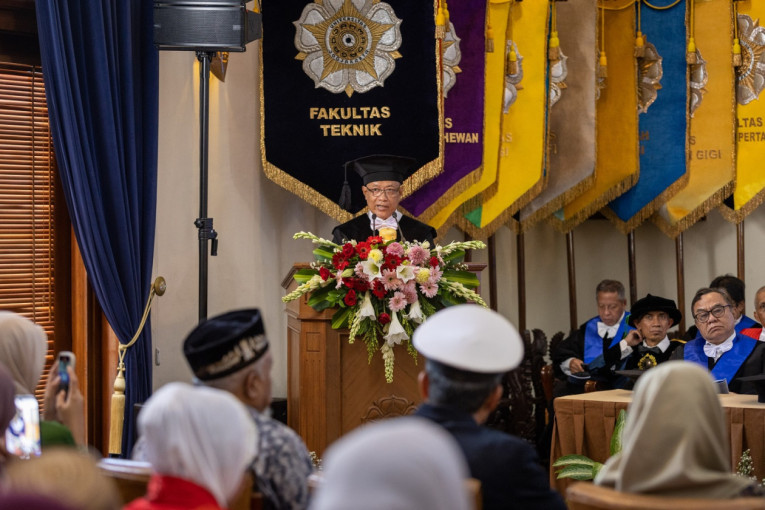
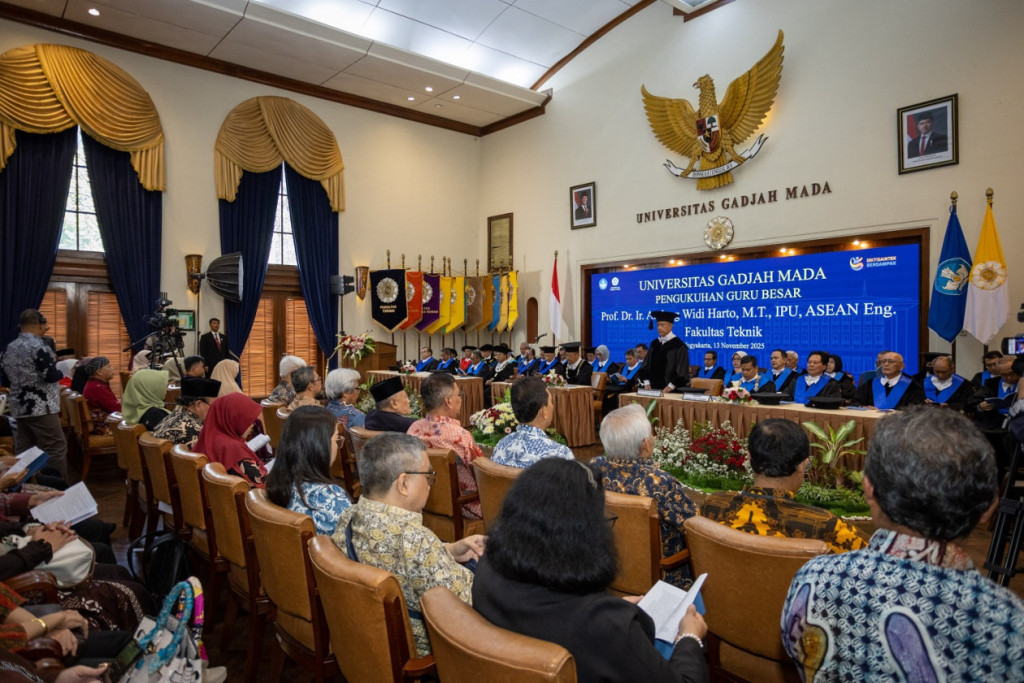
Dr. Andang Widi Harto has been officially inaugurated as Professor of Advanced Nuclear Power Reactor Engineering at the Faculty of Engineering, Universitas Gadjah Mada (FT UGM). In his inaugural address titled “Strategic Aspects of Developing Nuclear Energy System Technology in Indonesia: The Role of Nuclear Engineering in Advancing Nuclear Reactor Technology,” he discussed the strategic role of nuclear power plants (PLTN) and their potential as thermal energy sources.
Professor Andang Widi Harto expressed concern that global energy systems (especially Indonesia’s) remain dominated by fossil fuels, resulting in rising emissions and carbon dioxide levels worldwide.
“It is necessary to take steps to reduce fossil fuel use, one of which is through the development of nuclear and renewable energy technologies,” he stated at the UGM Senate Hall on Thursday (Nov. 13).
Professor Harto noted that mitigation measures are essential for reducing CO₂ emissions, including reducing reliance on fossil fuels. He emphasized that nuclear power plants have proven capable of producing large-scale, continuous, and affordable electricity. He also believes that, in the future, nuclear technology can be used to generate thermal energy for various applications.
“Unfortunately, energy providers in Indonesia still face several challenges, including low per-capita energy consumption, the dominance of fossil energy resources, limited support for competitive industries, and the demands of achieving net-zero emissions,” he explained.
He went on to highlight that although Indonesia has yet to build nuclear power reactors for electricity generation, it has long applied nuclear technology in non-energy sectors. With three existing research reactors, Indonesia has developed nuclear regulations, a nuclear regulatory and supervisory body, nuclear research institutions, and higher education programs dedicated to nuclear studies.
In addition, Indonesia’s natural resources hold strong potential as nuclear fuel.
“Considering Indonesia’s existing conditions, three stages of nuclear technology development are recommended: an initial stage to meet projected electricity demand and achieve NZE targets; a transitional stage focusing on research and development; and finally, an independent and sustainable stage centered on adopting new technologies,” he concluded.
Chair of the UGM Board of Professors, Professor M. Baiquni, stated that Professor Harto is one of 542 active professors at UGM. At FT UGM, he is among 88 active professors out of a total of 100 faculty members.
Author: Salwa
Editor: Agung Nugroho
Post-editor: Rajendra Arya