


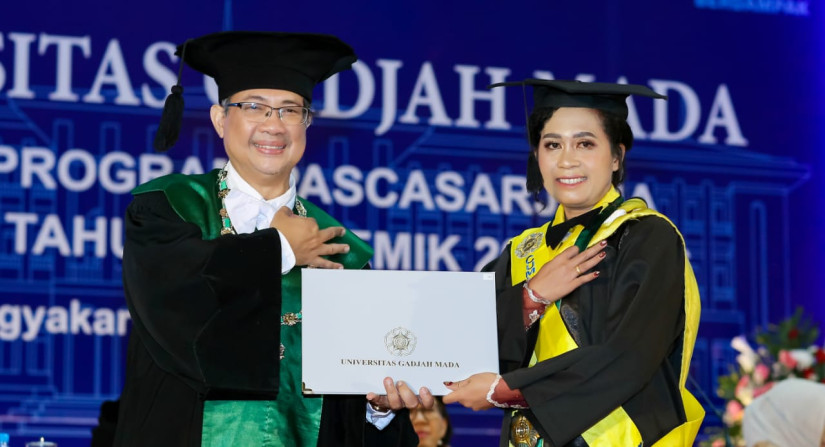
Feelings of pride and gratitude were expressed by Merlins Renatasia Waromi, 35, after being named Universitas Gadjah Mada (UGM)’s fastest graduate at the specialist doctor level. The woman from Serui, Yapen Islands Regency, Papua Province, completed her studies in just 3 years, 2 months, and 16 days at the Graduation Ceremony of the Postgraduate Program Period II of the 2025/2026 Academic Year, held on Wednesday (Jan. 21), considering that the average study period of 118 specialist graduates is four years.
Waromi said she was deeply grateful to be recognized as the fastest graduate in the specialist doctor program, despite having taken a three-month maternity leave.
“I am truly grateful to have completed my education in such a short time. At the beginning of my studies, I had to take a three-month maternity leave. When I calculated it, if I had not taken that leave, it might have been just over two years,” she said cheerfully on Wednesday (Feb. 4).
As a graduate of the microbiology specialist program, Waromi shared that she completed her undergraduate medical education and professional doctor training at Cenderawasih University in Jayapura.
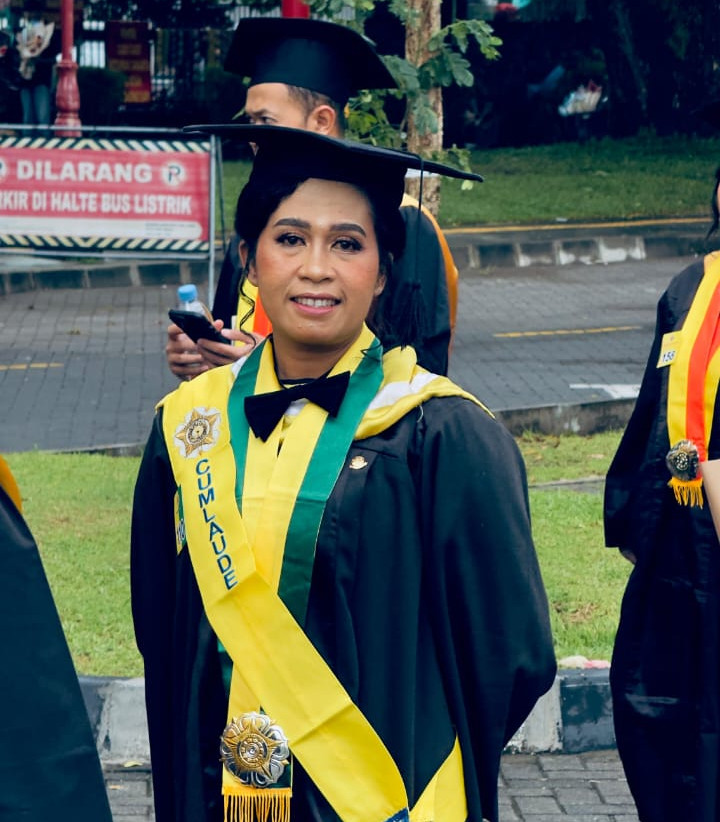
Her decision to pursue specialty education at UGM was influenced by the fact that many Papuans feel comfortable and even consider Yogyakarta a second home. This assumption, she said, was proven once she arrived in the city, where the people of Yogyakarta are known for their warmth and hospitality toward newcomers.
“For us Papuans, Yogyakarta feels like a second home,” she said.
According to Dr. Waromi, her opportunity to continue specialist education was closely tied to cooperation between UGM, partner universities, and local governments in Papua.
The collaboration between the West Papua Provincial Government and UGM enabled her to pursue her studies through a specialist doctor scholarship for Indigenous Papuans (OAP), funded by the Special Autonomy (Otsus) scheme. She noted that the scholarship opens up wide opportunities for local youth to pursue various specialist fields.
“UGM is one of the state universities that has established many cooperation agreements or MoUs with regions in Eastern Indonesia. This creates opportunities for us to continue our education at UGM. We are sponsored by local governments based on these MoUs,” she explained.
Regarding her choice of clinical microbiology as a specialty, Waromi said it stemmed from her fascination with bacterial and fungal growth media. The diverse, visually appealing colors visible to the naked eye sparked her initial curiosity about the field. In addition, she noted that infectious diseases are among the most common conditions in medicine, and microbiology plays a crucial role in their diagnosis.
“Indonesia is one of the countries with the highest burden of infectious diseases in the world. That is why I chose this specialty,” she said.
During her three years of study at UGM, Waromi acknowledged several challenges, particularly differences in educational quality standards compared with her previous university. She felt that there remains a significant gap between higher education standards in Eastern Indonesia and those at UGM. As a result, she had to adapt extensively, including to advancements in technology and scientific knowledge.
To overcome her limitations in understanding course materials, Waromi learned to set aside feelings of insecurity and self-doubt. Whenever she did not fully grasp the lessons, she actively sought references through the library or by asking fellow students, nurses, medical staff, and lecturers.
“I am a sociable person and not afraid to ask questions. Through this process, I was able to find solutions to the difficulties I faced,” she recalled.
For her research, Waromi examined the profile and antimicrobial susceptibility patterns of bacteria causing catheter-associated infections in hospitals. Her study focused on catheter-associated urinary tract infections (CAUTIs), which occur with indwelling urinary catheters, particularly those in place for more than two days.
“My research found that the incidence of CAUTI at Dr. Sardjito Hospital is quite high. The risk factors include decreased levels of consciousness and a history of surgery among patients,” she explained.
Regarding her tips for completing specialist studies more quickly, Waromi said she consistently prepared a list of targets and timelines for her tasks.
“When I feel overwhelmed, I take a short break before refocusing. If my tasks fall behind schedule, I make sure to catch up,” she said.
In closing, Waromi encouraged students pursuing specialist and subspecialist education to let go of insecurity, remain disciplined, and build self-confidence. She believes that there are no unintelligent students, only students who have not yet encountered the right teacher or learning method.
“Never feel inferior. Instead, be more diligent so you can adapt to the environment of your educational institution,” she advised.
Author: Leony
Editor: Gusti Grehenson
Post-editor: Jasmine Ferdian
Photographs: Merlins Waromi