


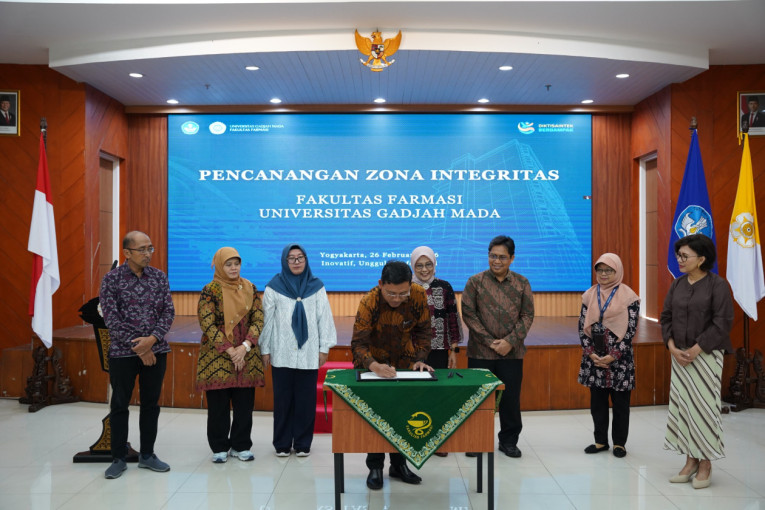
The Faculty of Pharmacy, Universitas Gadjah Mada (Pharmacy UGM) has demonstrated its commitment to realizing clean, service-oriented governance and becoming an excellent and competitive higher education institution.
This was marked by the declaration of the Integrity Zone (ZI) toward a Corruption-Free Area and a Clean and Serving Bureaucratic Area on Thursday (Feb. 26) at the Auditorium of the Advanced Pharmaceutical Sciences Learning Center (APSLC), Pharmacy UGM.
The Dean of the Faculty of Pharmacy, Professor Satibi, stated that all leaders and members of the faculty are committed to establishing clean, transparent, and accountable university governance through the integrity zone declaration.
“We are ready to deliver professional, honest, and effective public services. By upholding the values of integrity, ethics, and dedication, we are determined to build an environment free from corruption and to realize a clean and service-oriented bureaucracy,” he said.
UGM Rector, Professor Ova Emilia, expressed support for the integrity zone declaration as part of the university’s commitment to creating organizational governance that is flexible, dynamic, adaptive, agile, accountable, and transparent. She noted that addressing future challenges cannot rely solely on traditional strategies.
“Good governance alone cannot stand on its own to respond to those challenges,” she said.

The Rector hopes that through this declaration, Pharmacy UGM will continue to strengthen its commitment to achieving a clean, corruption-free bureaucratic environment.
“We greatly appreciate this initiative and hope it is not merely a slogan but a genuine commitment and responsibility moving forward. I welcome and commend the declaration of the integrity zone toward a corruption-free area and a clean, service-oriented bureaucracy,” she stated.

Professor Satibi added that Pharmacy UGM will implement this culture of integrity in daily work practices, such as maintaining courteous greetings, adhering to attendance discipline, complying with regulations, and using digital systems to strengthen robust, accountable governance.
“This commitment is also reflected in environmental management, certainty of service hours, and professional, ethical public services,” he concluded.
Author: Leony
Editor: Gusti Grehenson
Post-editor: Rajendra Arya
Photo: Donnie