



Universitas Gadjah Mada (UGM) conducted monitoring and evaluation of the 2026 Computer-Based Written Test (UTBK) for the National Selection Based on Test (SNBT) at several test locations on Saturday (Apr. 25).
The activity began at Balairung UGM before continuing to two test sites on campus. During the visit, university leaders directly observed the implementation of the computer-based examination rooms. The monitoring covered equipment readiness, supervisory systems, and participants’ condition during the test. This activity was carried out to ensure that the entire UTBK process adhered to established standards and prevented cheating and proxy test-takers.
The implementation of UTBK SNBT 2026 at UGM took place on April 21–25 and April 27, 2026, with a total of 15,502 participants. The test was conducted in two sessions per day with a capacity of 1,452 participants per session. A total of 14 locations and 44 examination rooms were prepared to support the implementation across various units and faculties. The average attendance rate of participants reached 97.97 percent during the examination period. Overall, the UTBK at UGM proceeded in an orderly manner, supported by adequate facilities and infrastructure.
UGM Rector, Professor Ova Emilia, stated that this year’s UTBK implementation showed improvements compared to previous years. Various mitigation efforts were continuously undertaken to anticipate potential obstacles during the examination.
One of the main concerns was preventing cheating, including proxy test-taker practices that had drawn public attention. UGM tightened inspection procedures before participants entered the examination rooms and ensured that personal belongings were not placed near them during the test.
“With current technological developments, the potential for cheating can become more varied, so we have strengthened supervision even before the examination begins,” she said.
Professor Ova Emilia added that improvements to the implementation system are continuously made as part of ongoing evaluation. Experiences from previous implementations serve as the basis for formulating better strategies. UGM also ensured that every stage of the examination was conducted in accordance with established standards. This step was taken to maintain the credibility of the national selection process.
“We see that this year’s implementation is improving because various corrective measures are consistently carried out,” she added.
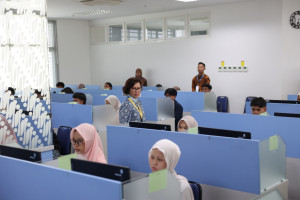
In line with this, UGM Vice Rector for Education and Teaching, Professor Wening Udasmoro, emphasized that the intake capacity for new students through the SNBT pathway at UGM this year is around 2,800 seats, or approximately 30 percent of the total admission capacity. She stated that this number has remained relatively stable from year to year and has not experienced any significant increase. Information circulating about a large surge in admissions was considered inaccurate.
“UGM has never drastically increased its admission numbers as reported. Those figures are incorrect and need to be clarified,” Professor Udasmoro asserted.
She also stressed the importance of building integrity in the education process from the outset. Efforts to prevent cheating must be accompanied by collective awareness from all parties. According to her, organized cheating practices remain a challenge in the national selection system. Therefore, the commitment to upholding honesty must continue to be strengthened.
“The most important thing is to build awareness that education must be carried out honestly from the very beginning,” she said.
Director of the Directorate of Education and Teaching at UGM, Professor Gandes Retno Rahayu, explained that implementing a computer-based UTBK requires optimal system readiness. Two main concerns are system stability and network connectivity during the examination. UGM ensured that the system used had been updated to minimize potential vulnerabilities that could be exploited for cheating.
“We ensure that the system used is more secure and controlled to better support the examination process,” she said.
Professor Rahayu added that infrastructure readiness is also supported by server and network systems that have undergone multiple stages of testing. The system is designed with backup mechanisms to maintain service continuity in the event of disruptions. In addition, coordination with the central committee continues to ensure the smooth implementation of the examination. These efforts are part of UGM’s commitment to maintaining the quality of UTBK implementation.
“System stability and connectivity are key to ensuring the examination proceeds without obstacles,” she added.
In addition, UGM ensured that the UTBK implementation remained inclusive for all participants. Gandes stated that participants with disabilities this year were facilitated according to their respective needs. For the implementation at UGM, the facilitated participants included those with hearing and physical disabilities, while participants with visual impairments were accommodated centrally at another university in accordance with the central committee’s policy. This arrangement was made to ensure that the support provided could be delivered more optimally.
“We ensure that every participant receives support according to their needs so they can take the examination properly,” she concluded.
Author: Triya Andriyani
Post-editor: Rajendra Arya
Photo: Firsto