


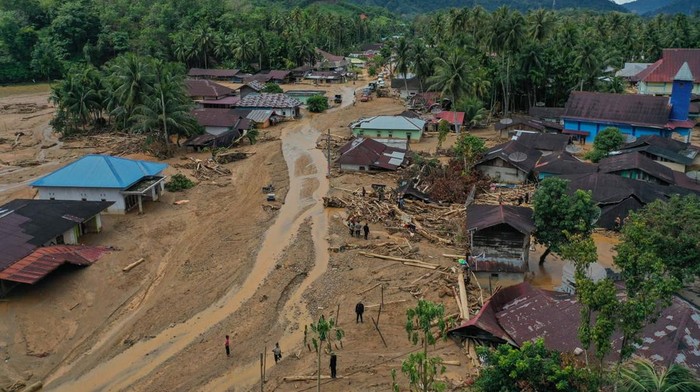
A series of flash floods and landslides that have occurred consecutively in Aceh, North Sumatra, and West Sumatra highlights the region’s high geological vulnerability, exacerbated by environmental degradation and global climate change. These conditions have made geo-hydrometeorological disasters in Sumatra increasingly frequent and far-reaching in their impacts.
Responding to the situation, Professor at the Faculty of Engineering, Universitas Gadjah Mada (FT UGM), Dwikorita Karnawati, emphasized that post-disaster temporary housing (hunian sementara/Huntara) and permanent housing (hunian tetap/Huntap) policies in Sumatra must be designed to prevent the recurrence of disasters, rather than merely restoring conditions to their pre-disaster state.
Moreover, she warned that, according to forecasts from the Meteorology, Climatology, and Geophysics Agency (BMKG), rainfall potential may persist until March–April 2026, meaning the risk of subsequent flash floods and landslides remains very high.
Therefore, post-disaster housing policies must not end at the emergency response phase but be integrated into long-term rehabilitation and reconstruction, including comprehensive environmental recovery.
Hazard-Prone Zones Hold Disaster Memory
Professor Karnawati explained that many affected areas are located in alluvial fan zones, landforms created by deposits from past flash floods. Geologically, these areas are active zones that retain a “disaster memory” and remain prone to recurrence over the course of decades.
“If these areas are redeveloped as permanent settlements, the disaster risk is not eliminated, but instead passed on to future generations,” she stressed on Tuesday (Dec. 16).
She added that environmental damage in upstream areas and river basins accelerates erosion and increases the volume of debris carried during extreme rainfall.
This condition shortens the recurrence interval of flash floods, which can now occur within 15–20 years, or even sooner if environmental restoration is not carried out promptly.
Permanent Housing Must Be in Safe Zones
Based on these considerations, Professor Karnawati asserted that areas previously affected by flash floods are unsuitable for permanent housing (Huntap), particularly for long-term settlements. Such areas should be designated as red zones and allocated for environmental conservation and rehabilitation.
To prevent recurring disasters, the professor recommended that flash flood-affected areas be officially designated as red zones and prohibited from permanent housing development.
Permanent housing construction must be firmly directed to safe zones determined through environmental geological risk mapping, and accompanied by mandatory environmental restoration measures, especially in upstream river basin areas, as a key prerequisite to prevent similar disasters from recurring.
These safe zones must be located outside active riverbanks, maintain a safe distance from steep slopes, and still consider access to raw water sources and other basic services.
Meanwhile, hazard-prone areas may still be used for temporary housing (Huntara) under strict time limits and transitional conditions, not as permanent residences, for a maximum of three years, and subject to stringent requirements.
These include the availability of reliable early warning systems, the preparation and testing of emergency response plans, strengthening the capacity of local governments and communities, clearing debris materials in upstream areas, establishing buffer zones in the form of green belts, and constructing adequate and sustainable river embankments.
Mitigation as a Strategic Decision
Professor Karnawati emphasized that post-disaster settlement planning is a long-term strategic decision that determines public safety.
“If post-disaster development ignores geological characteristics and disaster memory, recovery efforts may instead create new disasters in the future,” she concluded.
She reaffirmed that Huntara and Huntap policies must be grounded in disaster science, risk mitigation, environmental recovery, and intergenerational responsibility, ensuring recovery efforts are not only swift but also safe and sustainable.
Author: Leony
Editor: Gusti Grehenson
Post-editor: Salma
Photograph: Antara