


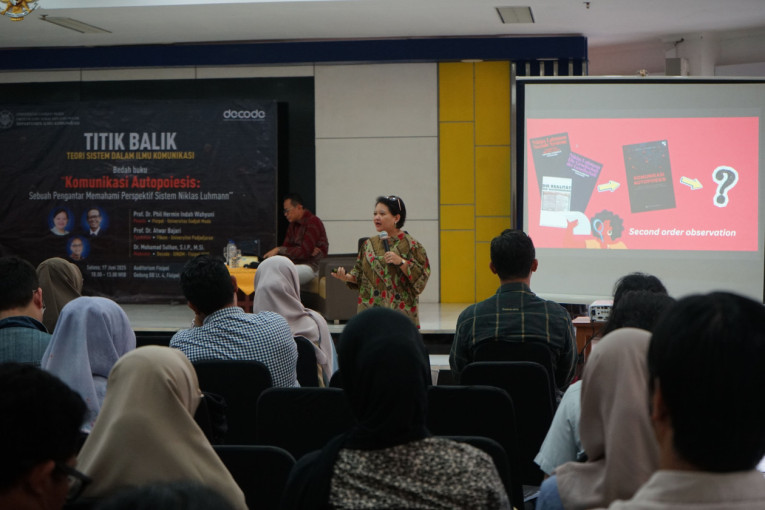
Professor Hermin Indah Wahyuni, a Professor of Communication Science at Universitas Gadjah Mada (UGM), has published a book introducing Niklas Luhmann’s theory as a new perspective in communication studies. Borrowing a term from biology, autopoiesis describes the process of cells developing on their own. In the context of communication, cells will not grow if communication fails.
The advancement of human civilization will be determined by how communication is conducted today.
“Only communication can communicate, and only communication drives communication,” said Professor Wahyuni during her book launch and discussion titled “Turning Point: Systems Theory in Communication Science”, held on Tuesday, Jun. 17, 2025, at UGM’s Faculty of Social and Political Sciences (Fisipol UGM).
Professor Wahyuni explained that Niklas Luhmann, a German sociologist, introduced the theory of systems and social order.
Building upon Talcott Parsons’ systems theory, Luhmann aimed to address various social issues and changes.
His development of the theory, now known as Luhmann’s systems theory, asserts that systems are formed not through mutual agreement, but through differentiation.
“The absence of difference means no interaction, and without interaction, a system will never form,” she stated.
Further elaborating, Professor Wahyuni noted that Luhmann’s theory offers a unique perspective on information and communication systems, known as autopoietic communication.
Traditionally, communication science has been viewed as a “bridge” connecting pieces of information. The autopoiesis theory challenges this viewpoint by offering a critique.
This theory, she said, is fascinating because it detaches from the actor-based perspective that has dominated the field.
“Luhmann shifts the focus; he wants to redefine society not as people, but as communication. There is no society without communication,” she said.
Although sociology and communication are closely related, Professor Wahyuni emphasized that Luhmann stands out as a sociologist who does not merely treat communication as a connector.
Luhmann illustrates how social and political sciences often become entangled in the actor-centric paradigm, including communication.
For instance, corruption-related news typically centers on the actors involved rather than the systems that enable it.
“Understanding Luhmann isn’t easy because his theory doesn’t describe the past; it anticipates the future. It depends on whether our society is future-oriented or not,” she added.
Luhmann wrote that modern society does not communicate through media, but through systems.
He argued that the differentiation between communication by media and communication through systems lies in who controls the system.
This perspective refutes the belief that people must distinguish between true and false messages, as all information is, by nature, manipulated and shaped by systems.
Professor Atwar Bajari, a Professor of Communication Science at Universitas Padjadjaran, expressed his appreciation for Professor Wahyuni’s book Autopoietic Communication: An Introduction to Understanding Niklas Luhmann’s Systems Perspective.
He acknowledged the difficulty in producing an accessible introduction to Luhmann’s complex theoretical framework.
“It’s extraordinary that Professor Wahyuni, after a decade of dedication to understanding Luhmann, has managed to write an introductory book on such a complex theory. Hopefully, this book will serve as a gateway for applying Luhmann’s theory in current and future research,” Professor Bajari remarked.
Author: Tasya
Editor: Gusti Grehenson
Post-editor: Lintang Andwyna