


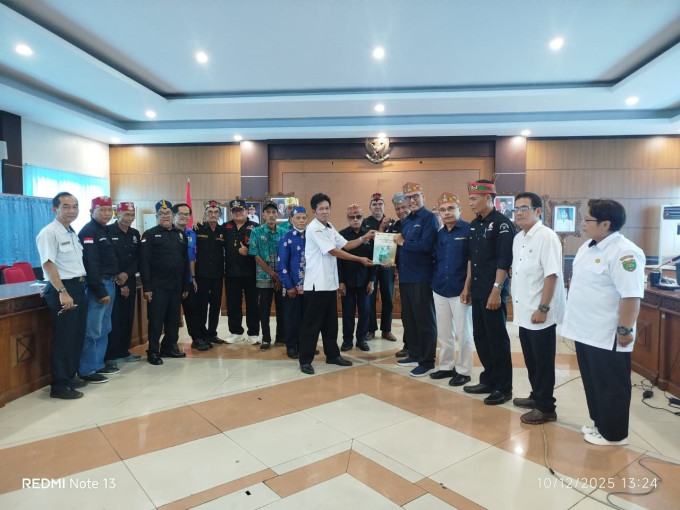
The Center for Tourism Studies of Universitas Gadjah Mada (Puspar UGM), in collaboration with the East Barito Regency Office of Culture, Tourism, Youth, and Sports (Budparpora), has contributed to the preparation of the Regional Cultural Policy Framework (Pokok Pikiran Kebudayaan Daerah/PPKD). This official regional document outlines factual conditions and key challenges in advancing cultural development in East Barito Regency, along with recommendations, work stages, and performance indicators.
Bertha, Head of the Culture Division at the Budparpora, representing the Regent of East Barito, stated that the PPKD serves as a foundation for establishing policy and legal frameworks to preserve local cultural heritage. Although the drafting process was conducted within a relatively short timeframe, it was carried out optimally and in accordance with applicable regulations.
Bertha explained that the drafting team was selected based on expertise and commitment to cultural issues. Under the Regent Decree of East Barito Regency Number 180/331/HUK/2025 on the Drafting Team and Resource Persons for the PPKD, a total of seven drafting teams, six secretariat members, and 24 resource persons were appointed, comprising Damang (customary leaders) from each district, mantir, cultural figures, and representatives of community organizations.
In practice, Bertha explained that data collection on Cultural Advancement Objects (Objek Pemajuan Kebudayaan/OPK) was conducted using standardized forms to document the current conditions and developments of 11 OPK across 10 districts. Data collection teams conducted field visits and interviews.
“The data collection activities were carried out in several stages, including coordination and socialization on how to complete the forms, field surveys by visiting OPK sites and interviewing Damang and cultural figures, as well as processing and analyzing field data,” she said on Thursday (Dec. 18) during the final presentation of the PPKD at the East Barito Regent’s Office.
The final presentation was attended by 10 Damang customary leaders and mantir representing the ten districts, namely Pematang Karau, Dusun Tengah, Paku, Karusen Janang, Paju Epat, Dusun Timur, Benua Lima, Awang, Raren Batuah, and Patangkep Tutui.
Representatives of cultural practitioners, the East Barito branch of the Indonesian Archipelago Arts and Culture Committee, the Regional Arts Council, the Indonesian National Youth Committee, the Dayak Youth Forum, Gerdayak, Batamad East Barito, Karang Taruna, and the drafting team were also present. From Puspar UGM, Dr. Destha T. Raharjana and Wijaya attended the event.
Dr. Raharjana, as a member of the drafting team, explained that at least 120 cultural elements were identified across 11 OPK in East Barito Regency.
These include two types of manuscripts, 11 forms of oral tradition, 17 customary practices, 20 rituals, 7 types of traditional knowledge, 15 elements of traditional technology, 12 forms of art, 8 languages, 4 traditional games, 8 traditional sports, and 20 cultural heritage sites or buildings. He noted that the overall condition of these OPK varies.
“Some are well maintained, some are poorly maintained, and most are not maintained. For the manuscript OPK, difficulties were found in tracing their existence because ownership is private. These manuscripts are passed down through generations, meaning only a few people are aware of them. Similarly, ritual objects cannot be documented as they are considered sacred,” Dr. Raharjana explained.

Other findings indicate that each OPK faces similar challenges, including threats from modernization and globalization that reduce younger generations’ interest in learning about them. Many communities still lack awareness of proper preservation practices, and there is limited digital-based documentation for protection.
Physical deterioration, inadequate maintenance, and insufficient security of OPK were also identified. In the case of artistic OPK, the absence of a single, integrated database containing inventories of studios, communities, works, and supporting facilities remains a major issue.
“In addition, regulatory support for the protection and preservation of customs and traditions is still limited, compounded by constraints in funding support for programme implementation,” he added.
Another member of the drafting team, Wijaya, added that the 11 OPK in East Barito hold a unique position. Despite their limitations, they continue to exist and develop, while some have yet to receive adequate attention due to issues such as social environment, limited human resources and regeneration, budget support, governance, and digital data infrastructure.
Therefore, addressing these challenges requires crucial strategic steps focused on protection, development, utilization, and capacity building.
The steps include leveraging technology through web-based or simple application systems containing comprehensive databases of videos, photos, philosophies, and narratives behind each cultural object and artwork, making cultural heritage easily accessible to the public.
To attract younger generations, creative cultural content competitions on social media should be organized, alongside collaborations with local influencers or ‘cultural ambassadors’ to promote regional arts and culture through platforms they actively use.
Wijaya also emphasized the need to encourage the East Barito Regency Government to formulate a regional regulation (Perda) on the preservation of customs and culture at the village and district levels.
In practice, this should be accompanied by training in documentation, independent funding mechanisms, and youth engagement, including structured and continuous training for art instructors and studio managers to advance and standardize cultural arts while creating sustainable funding sources.
This can be achieved through souvenir production or partnerships with local souvenir makers, in which a portion of sales profits is transparently allocated to the development and guidance of cultural objects.
“I believe that integrating cultural values into local content education from early childhood education through senior high school, while utilizing digital technology for cultural preservation, is essential,” he concluded.
Author: Agung Nugroho
Post-editor: Rajendra Arya
Photographs: Puspar UGM