


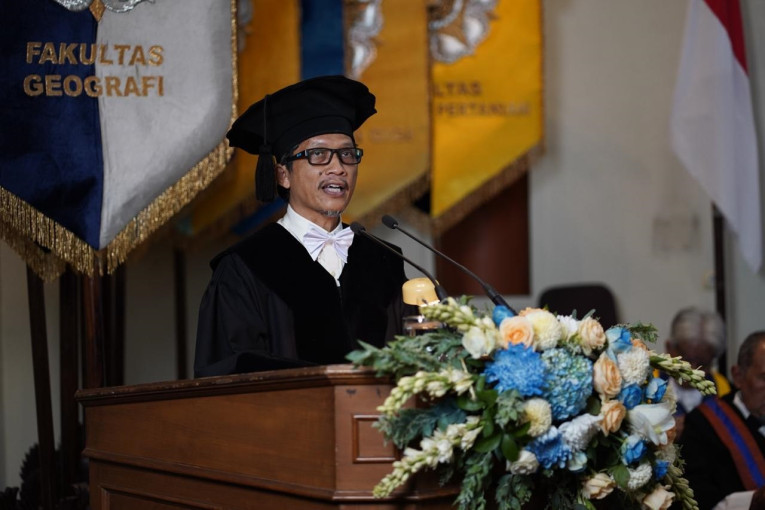
Dr. Luthfi Muta’ali, a lecturer at the Faculty of Geography, Universitas Gadjah Mada (Geography UGM), was inaugurated as Professor of Regional Development in a ceremony held at the UGM Senate Hall on Tuesday (Feb. 10). During the inauguration, Professor Muta’ali delivered a speech titled Regional Development from a Geographical Perspective: Integrating Space, Environment, and Social Justice.
In his speech, he emphasized that regional development fundamentally extends beyond quantitative economic metrics. From a geographical perspective, development must be understood as an ethical integration of living space, environmental carrying capacity, and the equitable distribution of justice for all communities in responding to complex global challenges.
“Regional development cannot be understood solely from the perspective of economics and infrastructure; it must unify space, people, and the Earth as a single moral and policy entity. True regional development is not about expanding the sphere of power, but about expanding the space of justice for all beings,” he said.

Professor Muta’ali views the concept of regional development as occupying a critical position among the major branches of geography, functioning as a bridge that integrates physical, human, environmental, and policy geography into a cohesive scientific discourse.
He reiterated that, in the context of Indonesia’s development, this paradigm reinforces the view that regional progress should not rely solely on quantitative economic growth metrics but must reflect a harmonious balance between centers and peripheries, humanity and the environment, and science and policy.
“Geography must provide an ethical foundation for national development related to spatial awareness, communal responsibility, and accountability to the planet that sustains us,” he explained.
In the Indonesian context, Professor Muta’ali stated that the geography of regional development is not merely an academic discipline but a national discipline that embodies the existence and sovereignty of the archipelagic territory.
Authentic regional development requires territorial awareness and a deep understanding of collective space that guides progress. This awareness, he noted, continues to evolve amid challenges of inequality, urbanization, and ecological crises.

Professor Muta’ali reminded that development in Indonesia is not solely infrastructure or economic growth but also a cultural initiative that instills national principles within spatial configurations. The archipelagic region represents national identity and unity.
“This is undoubtedly one of the responsibilities borne by scholars of regional development geography in Indonesia to maintain a harmonious balance among three fundamental aspects: territory as a source of prosperity, the environment as the foundation of life, and humanity as a reservoir of wisdom. The harmony of these three elements will realize people-oriented regional development in Indonesia,” he added.
Author: Agung Nugroho
Post-editor: Jasmine Ferdian
Photographer: Firsto Adi