


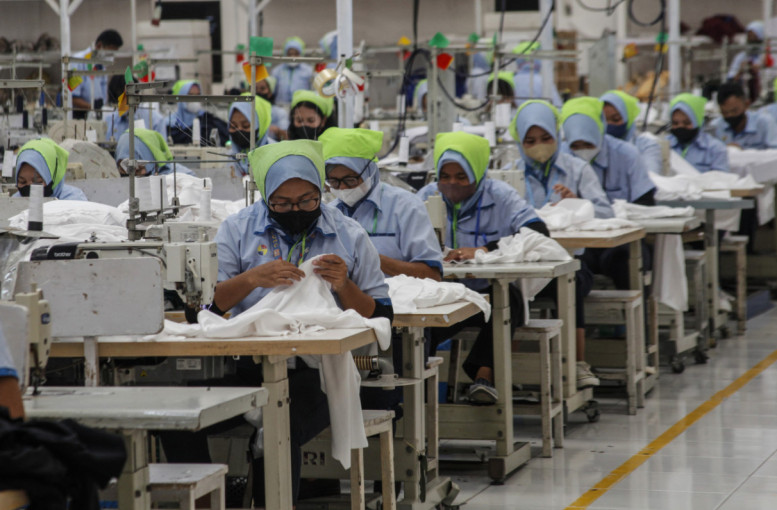
Citing data from Kemenaker RI, a total of 88,519 workers were laid off between January and December 2025 and classified as participants in the Job Loss Insurance (JKP) program. The risk of layoffs in 2026 is expected to expand further as job applications remain stalled across several sectors. Meanwhile, data from BPS Indonesia in 2026 showed that approximately 57.70 percent, or 85 million workers, of the total workforce of 147.91 million are engaged in informal employment.
On the employer side, more than 90 percent of businesses are micro, small, and medium enterprises (MSMEs). Amid shrinking job opportunities, widespread layoffs, and stalled recruitment in several sectors, communities are not only losing sources of income but also facing a high risk of social disintegration.
Amid shrinking job opportunities, widespread layoffs, and stalled recruitment in several sectors, communities are not only losing sources of income but also facing a high risk of social disintegration.
Lecturer at the Department of Social Development and Welfare, Universitas Gadjah Mada (UGM), Dr. Hempri Suyatna, stated that the wave of layoffs occurring in the country is largely an impact of global economic conditions that have also affected Indonesia. However, he argued that layoffs become far more socially destructive when the state fails to anticipate and mitigate their accompanying impacts.
“Layoffs are not merely about losing a job, but also about losing access to basic needs such as food, education, and health care. If this is allowed to continue, it will give rise to social frustration and negative patterns within society,” said Dr. Suyatna on Monday (Feb. 9).
He emphasized that social development, which in this context serves to address rising layoffs in Indonesia, should be inclusive and side with the public, particularly vulnerable groups. Dr. Suyatna criticized the prevailing development model in Indonesia for being overly oriented toward economic growth and infrastructure, while neglecting its social impacts.
“Development should not benefit only elite groups. When productive land continues to be converted into property and commercial centers, marginalized communities become increasingly excluded. This is a structural problem that must be addressed seriously,” he said.
Regarding social protection, Dr. Suyatna observed that the state has not been sufficiently present for those affected by layoffs, especially workers in the informal sector. Several employment protection schemes were deemed ineffective in distribution and still operate within a framework of formal employment, thereby excluding large marginalized and unprotected groups.
“Farmers, fishers, and informal workers remain outside the reach of effective protection. This shows that our social policies are still exclusive and have yet to reflect the realities of Indonesia’s labor structure,” he asserted.
He also warned that layoffs have cascading effects that extend beyond economic aspects, threatening social cohesion and public mental health. Rising social frustration, crime rates, and suicide cases are real risks when the state fails to provide adequate employment opportunities and social protection.
“This is not an individual problem, but a social crisis. When avenues for survival become increasingly limited, people are pushed toward extreme actions,” he explained.
Dr. Suyatna added that budget reallocation must be carried out with clear alignment and commitment. He cautioned that reallocation should not merely involve shifting budget lines, but must also be accompanied by productive policy direction oriented toward social justice.
“The government needs to review ineffective policies or budget allocations and redirect them to sectors that are truly needed by the public, particularly social protection and job creation,” he added.
Furthermore, he stressed the need for a paradigm shift in how layoffs are perceived. As long as layoffs are defined solely as industrial issues, individual problems, or matters of economic efficiency, the state will continue to overlook their broader social consequences.
“Layoffs must not be treated merely as industrial issues. Their impacts touch psychological, social, and humanitarian dimensions. Therefore, development must be carried out through an inclusive paradigm with genuine alignment toward marginalized groups,” Dr. Suyatna concluded.
Author: Zabrina Kumara Putri
Editor: Gusti Grehenson
Post-editor: Jasmine Ferdian
Photograph: Antara