


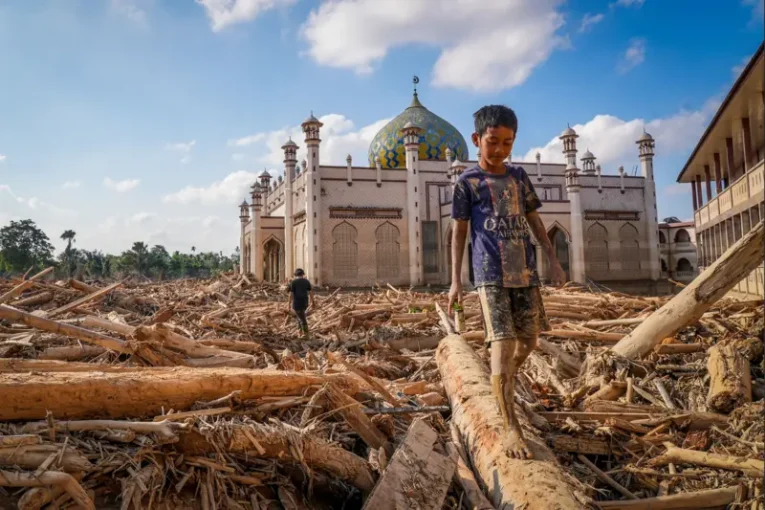
A series of flash floods and landslides that struck North Sumatra, West Sumatra, and Aceh recently has raised public concern. Beyond the growing death toll and increasingly widespread infrastructure damage, the succession of disasters underscores the escalating threat of multi-hazard events while exposing the limitations of existing disaster management mechanisms that remain focused largely on emergency response alone.
Professor of Environmental Geology and Disaster at Universitas Gadjah Mada (UGM), Professor Dwikorita Karnawati, said the series of flash floods and landslides in North Sumatra, West Sumatra, and Aceh represents a tangible manifestation of Indonesia’s geological vulnerability.
These consecutive events, which claimed nearly 990 lives, were further exacerbated by environmental degradation and climate change. She assessed that this combination of impacts has triggered cascading geohydrometeorological disasters whose intensity and scale far exceed those of previous events.
According to her, Indonesia is naturally situated in an active tectonic zone, prone to multiple hazards. Moreover, global warming and ongoing environmental damage have increased the frequency of extreme rainfall, with increasingly shorter return periods.
“Scientific data show that 2024 was the hottest year in modern recorded history, with a global temperature anomaly reaching +1.55 degrees Celsius above pre-industrial levels. The decade from 2015 to 2024 has also become the hottest ten-year period ever experienced by the Earth,” she explained on Saturday (Dec. 13).
She noted that records from the Meteorology, Climatology, and Geophysics Agency (BMKG) also indicate a significant surge in extreme weather events, rising from 2,483 incidents in 2020 to 6,128 incidents in 2024.
In western Indonesia, including Sumatra, the upward trend in annual rainfall has become increasingly pronounced, in line with projections that northern Indonesia will become wetter in the coming decades. This reality, she said, reinforces the risks of flash floods, debris flows, and landslides in areas with steep topography and land-use changes.
“Extreme rainfall that was once rare is now occurring repeatedly. This is what causes flash floods in Sumatra to arrive with far greater destructive force,” Professor Karnawati added.
According to her, the characteristics of current disasters differ from those of typical single-hazard events. Geological and hydrometeorological dynamics mutually trigger and intensify one another, compounded by environmental degradation, meaning that a single event can set off a chain of subsequent disasters.
“Extreme rainfall that was once rare is now occurring repeatedly. This is what causes flash floods in Sumatra to arrive with far greater destructive force,” Professor Karnawati added.
Professor Karnawati explained that the series of flash floods, landslides, and infrastructure damage across the three provinces has generated multidimensional impacts that cannot be addressed through regular disaster management mechanisms.
The system established in 2007 was not designed to confront multi-hazard disasters arising from the increasingly complex challenges of climate change and severe environmental degradation.
“During the rainy season, the potential for subsequent flash floods remains very high. Just as rehabilitation begins, extreme rainfall can occur again and force affected areas back into the emergency response phase,” she explained.
She assessed that this situation requires a more robust disaster management system, particularly for long-term prevention and mitigation, so that the Build Back Better principle can be truly realized in the recovery of affected regions.
Therefore, she said, recovery efforts require special mechanisms that operate swiftly, tactically, and on a large scale, separate from routine procedures, to prevent emergency response from causing additional casualties. Strengthening cross-sector coordination is also essential to maximize disaster handling efforts.
“This disaster is a multi-hazard event with causes and impacts that reinforce one another,” she said.
Professor Karnawati also noted that Indonesia once had an effective model in the BRR NAD–Nias agency, established after the 2004 tsunami, which was specifically formed to accelerate reconstruction by operating under an integrated mandate and authority.
“With damage on this scale, routine mechanisms no longer seem adequate. We need a cross-sector institution capable of working in an integrated and rapid manner,” she explained.
Furthermore, she recommended that the government immediately prepare a comprehensive assessment in collaboration with technical ministries, the National Disaster Management Agency (BNPB), regional governments, academics, and disaster-focused communities. According to her, this assessment must incorporate climate change factors, environmental degradation, and hydrometeorological hazard projections.
With these additional factors included, reconstruction and rehabilitation needs can be formulated accurately and holistically. She emphasized that establishing a special institution or agency is not merely an administrative decision, but a strategic step to ensure the state’s full presence in rebuilding North Sumatra, West Sumatra, and Aceh amid climate change that continues to heighten disaster risks.
“Recovery must be designed to anticipate extreme events that may recur,” Professor Karnawati concluded.
Author: Cyntia Noviana
Editor: Gusti Grehenson
Post-editor: Salma
Photograph: Antara