


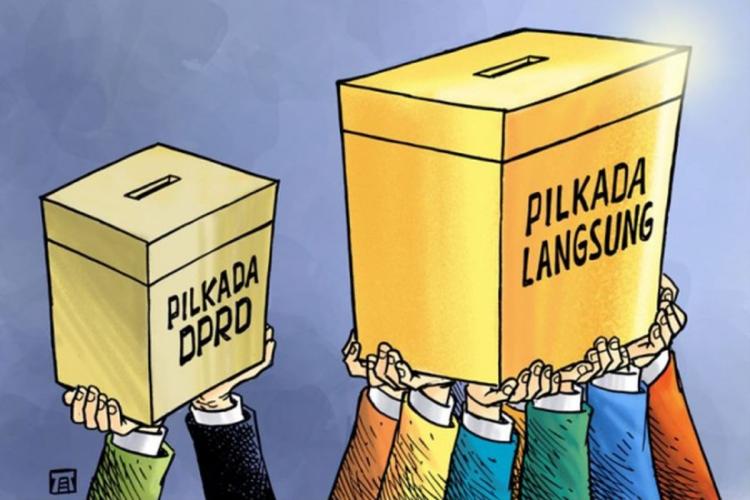
The government’s and House of Representatives’ discourse on restoring the mechanism for electing regional heads (pilkada) through Regional Legislative Councils (DPRD) is considered likely to weaken popular sovereignty and trigger democratic backsliding.
This view was expressed by Alfath Bagus Panuntun El Nur Indonesia, a lecturer in the Department of Politics and Government at the Faculty of Social and Political Sciences, Universitas Gadjah Mada (Fisipol UGM).
According to him, revoking citizens’ direct voting rights would only empower political elites and distance the public from decision-making processes.
“Even with direct local elections, public aspirations are often ignored, let alone if pilkada authority is handed over to DPRD. This would further exclude society from our socio-political system,” the lecturer said on Tuesday (Jan. 20).
He explained that although DPRD members are elected through general elections, in practice, they are not entirely free from party elite interests.
“In reality, DPRD representatives are unable to detach themselves from the interests of party elites rather than purely serving the public. This policy would only alienate citizens and strengthen elite dominance,” he emphasized.
Addressing arguments that the high cost of pilkada justifies reverting elections to the DPRD, Alfath argued that ballooning budgets stem not from democratic procedures but from distorted political practices.
“Candidates incur massive expenses from securing party nominations, campaign financing, logistics, and vote-buying practices. These costs can increase further when re-voting occurs, or disputes are brought before the Constitutional Court,” he explained.
He identified three fundamental problems underlying Indonesia’s electoral democracy: weak political leadership capacity, low public political literacy, and the absence of programmatic politics as a dominant norm.
He noted that political dowries and money politics significantly contribute to the high cost of local elections.
“Political dowries at the nomination stage and vote-buying during campaigns create a cost spiral. Pilkada becomes expensive not because of its procedures, but because of informal practices that are tolerated and difficult to prosecute,” he said.
Alfath also criticized campaign finance reports, arguing that they fail to reflect actual conditions on the ground. He suggested that such reports are better described as unexamined rather than unqualified. For this reason, he asserted that abolishing direct pilkada is not the solution.
“Eliminating direct local elections treats the symptoms, not the disease,” he stressed.
He called for comprehensive reforms in political financing, including greater transparency in campaign funding, reforms to internal party candidate recruitment, and strict enforcement of anti-money politics laws.
Alfath also opened the possibility of increasing state funding for political parties, provided public accountability is strengthened.
“If the state increases party financing, social and public accountability must also be enhanced. The use of these funds must be clear, for example, for political education and cadre development,” he said.
Should regional heads be elected by DPRD, Alfath warned of a shift in accountability. Regional leaders would no longer be accountable to citizens, but rather to party elites and parliamentary factions.
This, he cautioned, could heighten the risks of elite capture and post-election policy transactions. Alfath underscored the importance of civil society in preventing democratic regression amid plans to return pilkada to DPRD mechanisms.
“Civil society must redirect the debate from the cost of democracy to a more fundamental question: who benefits from this change?” he said.
Even if direct pilkada is maintained, Alfath emphasized the urgency of implementing three key reform agendas.
First, strict limits and real-time audits of campaign financing. Second, reforms in party governance and candidate recruitment. Third, impartial and firm law enforcement against money politics.
“Without reforms in these three areas, direct local elections will remain costly and fragile in terms of democratic legitimacy,” he concluded.
Author: Jelita Agustine
Editor: Gusti Grehenson
Post-editor: Salma
Illustration: antikorupsi.org