


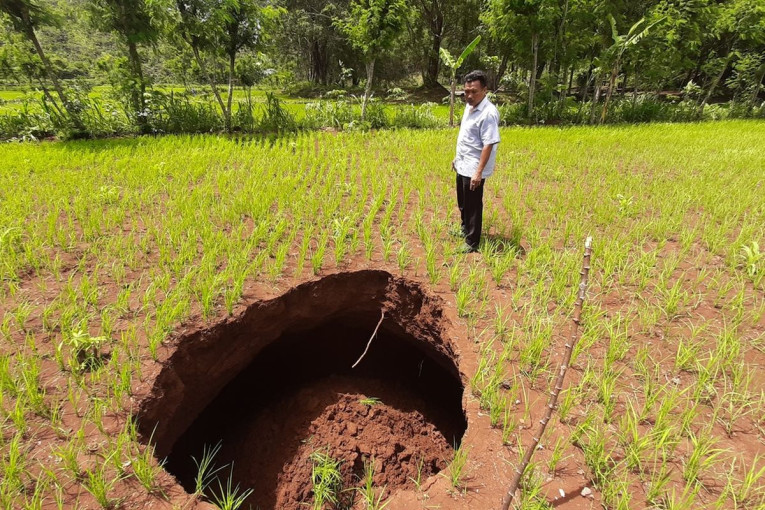
Sinkhole phenomena have been discovered in several locations in Gunungkidul Regency, Yogyakarta. The first sinkhole appeared at a resident’s house on January 7, 2026, measuring 2 meters by 5 meters with a depth of 4 meters. Several days later, approximately 12 kilometers away, a second sinkhole emerged in open farmland, smaller in size at around 3 meters by 4 meters with a depth of about 3 meters. The emergence of these sinkholes is suspected to be related to the fact that residential areas in Gunungkidul are situated within a karst mountain region. A similar phenomenon previously occurred in West Sumatra following landslides and flash floods.
Professor of Geological Engineering at Faculty of Engineering Universitas Gadjah Mada (FT UGM), Professor Wahyu Wilopo, explained that a sinkhole is a phenomenon involving the vertical collapse of the ground surface, forming a hole of varying depth. Such collapses may be caused by cavities formed through natural processes, rock dissolution, or mining activities. The dissolution process can intensify when there is a higher volume of water.
“Sinkholes are natural processes that can be accelerated by human activities and natural factors. Nearly all sinkhole phenomena are triggered by heavy rainfall,” Professor Wilopo said on Friday (Feb. 20).
According to Professor Wilopo, the occurrence of sinkholes is also influenced by the fact that approximately 8 percent of Indonesia’s land area consists of karst regions. As a result, ground surface collapses in the form of holes frequently occur due to natural factors as well as the impact of human activities.
Professor Wilopo outlined several signs that may indicate the formation of a sinkhole, enabling faster mitigation efforts. First, the appearance of cracks on the ground or rock surface forming circular, semicircular, or quarter-circle patterns. Second, the ground or rock surface subsides compared to surrounding areas. This condition is more noticeable during rainfall, as rainwater tends to accumulate in one location. Third, the emergence of numerous small holes that may gradually enlarge.
“If these signs are identified, residents should immediately report them to the authorities and avoid approaching the area,” he explained.
Professor Wilopo stated that large-scale sinkholes can have significant impacts on both the environment and human life. Environmental impacts include changes in topography, loss of flora and fauna ecosystems due to collapse, groundwater contamination, and erosion. In terms of human activities, sinkholes pose safety threats and may necessitate the relocation of settlements if they occur in residential areas.
Furthermore, Professor Wilopo emphasized the importance of increasing vigilance and ensuring the safety of residential areas. Communities are encouraged to conduct neighborhood patrols, particularly after heavy rainfall, to monitor potential signs of sinkholes or hydrometeorological disasters.
“Let us remain vigilant about our surroundings, especially during the rainy season,” he concluded.
Author: Jesi
Editor: Gusti Grehenson
Post-editor: Zabrina Kumara
Photo: Kompas.com