


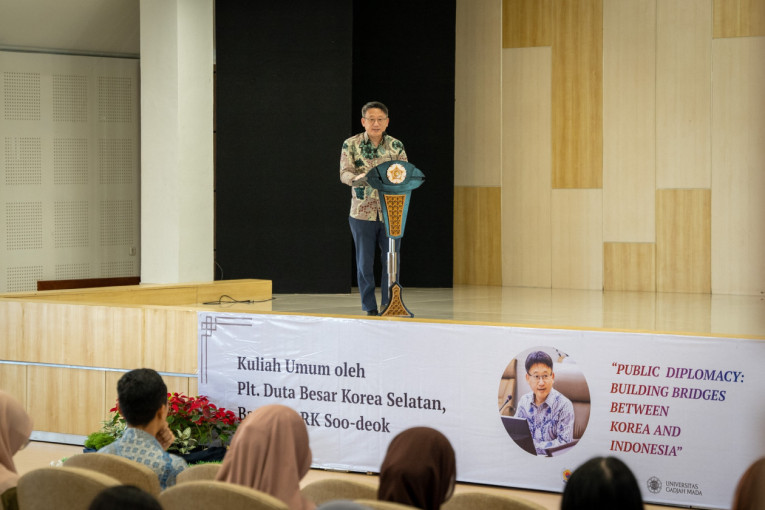
The Acting Ambassador of the Republic of Korea to Indonesia, Park Soo-deok, emphasized that Indonesia is the only Southeast Asian country to maintain a special strategic partnership with South Korea.
“Indonesia is the only country in Southeast Asia that has a special strategic partnership with Korea,” he said.
Park delivered this statement during a public lecture titled “Public Diplomacy: Building Bridges between Korea and Indonesia”, organized by the Korean Language and Culture Study Program at the Faculty of Cultural Sciences, Universitas Gadjah Mada (FIB UGM), last Friday (Nov. 14). The event was attended by dozens of students from various disciplines.
In his presentation, Park explained that the special relationship established more than 50 years ago is built on the shared fundamental values upheld by both countries.
“We share four values, including democracy, the rule of law, human rights, and the usefulness of international multilateralism,” he noted.
Beyond modern principles, Park also highlighted the traditional values embedded in both cultures.
“We also share traditional values, such as cooperation. In Indonesia, it is known as gotong royong, while in Korea it is referred to as sanggu sangjo,” he added.
In the economic sector, Park stressed that South Korea is one of Indonesia’s largest investors and views Indonesia as a potential global economic engine. He expressed optimism that Indonesia could become one of the world’s top five economies by 2030. In the education sector, he described student exchanges as a key pillar of bilateral relations.
“Each year, nearly 200 Indonesian students are selected to study in Korea with support from the Global Korea Scholarship (GKS),” he said.
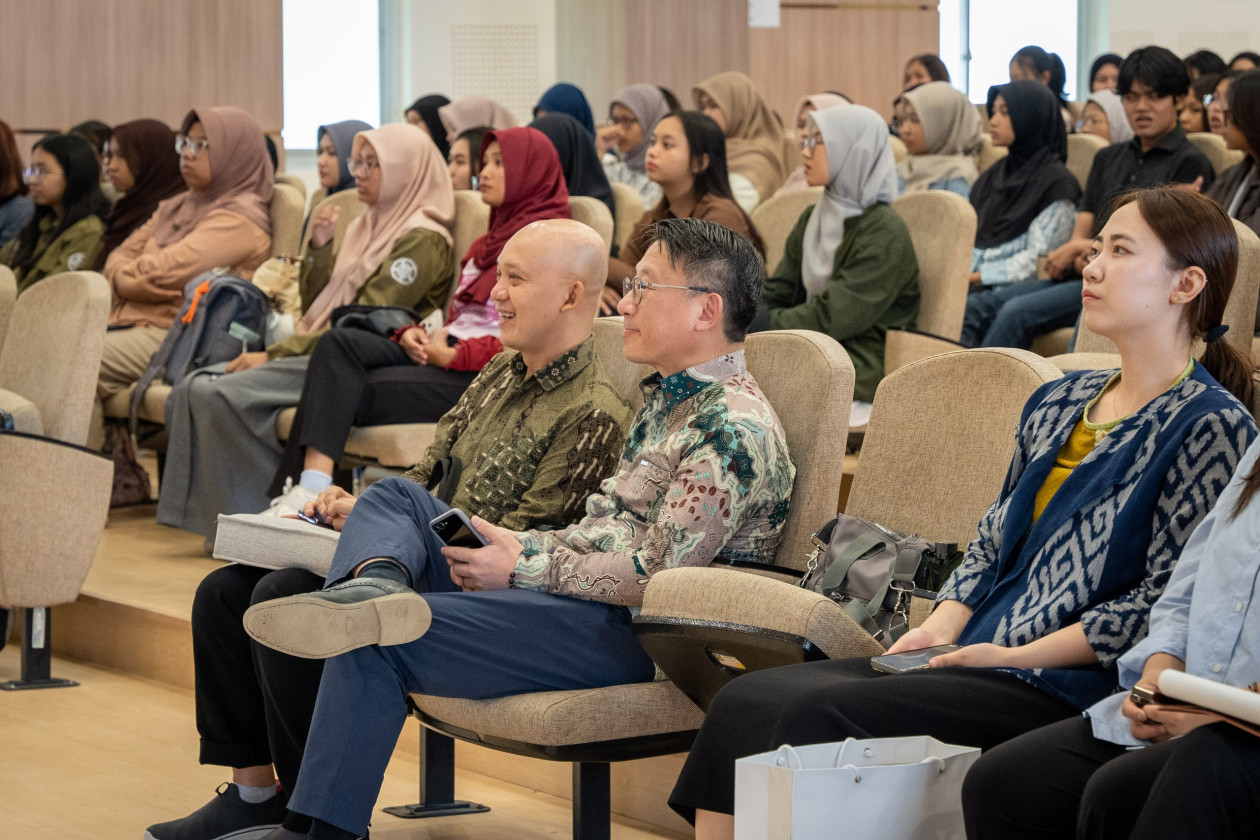
In the same session, a diplomat from the South Korean Embassy, Lee Seo Yeon, elaborated on South Korea’s public diplomacy strategies. Lee stated that popular culture, such as K-pop and K-drama, plays a significant role in building a positive national image.
“Positive cultural experiences will naturally lead to positive perceptions of Korea,” she said.
Lee added that exposure to Korean popular culture has had a direct impact on the tourism sector. She cited rising tourist numbers after the pandemic, influenced in part by viewers of Korean dramas and films on digital platforms.
“As people watch Korean dramas, they enjoy Korea’s world, and the number of individuals who watch Korean cinema on their own has also increased,” she explained.
Concluding the lecture, Park praised the Korean language proficiency of Indonesian students, including UGM students. He noted that when he attended a Korean student contest at Lotte Shopping Mall in Jakarta last June, he was impressed by the high levels of language mastery demonstrated by the participants.
“I truly appreciate it and would like to express my full commitment to supporting them,” he said.
As additional information, this public lecture marks the opening of the 2025 Korean Days series. Head of the Korean Language and Culture Study Program at UGM, Dr. Achmad Rio Dessiar, explained that this activity is expected to strengthen the study program’s relationship with the South Korean Embassy.
“This close relationship will serve as a foundation for facilitating collaboration, particularly in scholarship programs and revitalizing our long-inactive journal,” he said.
Author: Aldi Firmansyah
Editor: Triya Andriyani
Post-editor: Rajendra Arya
Photographer: Donnie Trisfian