


Indonesia has not yet fully achieved sovereignty in the health sector. In addition to its continued reliance on imported pharmaceutical raw materials and medical devices, the country is currently facing three major health-related challenges: the threat of future pandemics, the impacts of climate change, and the artificial intelligence (AI) revolution. In response to these challenges, the Indonesian Ministry of Health has committed to pursuing a national health transformation by leveraging technology.
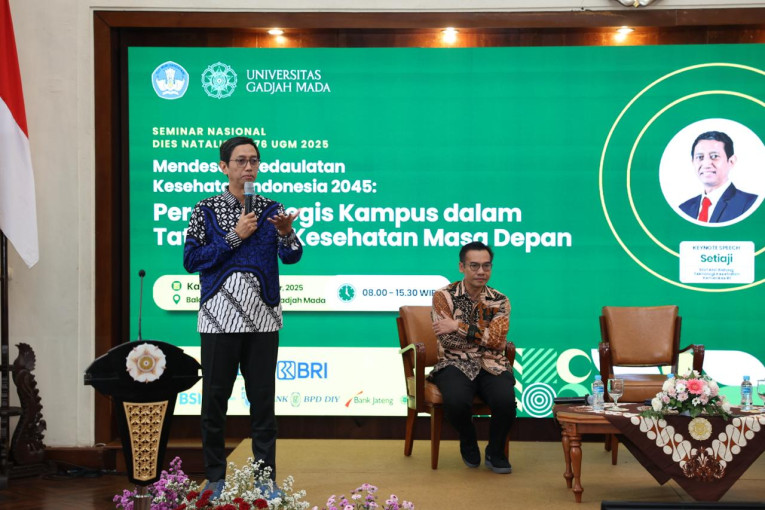
“These three issues are our shared challenges. The question then is how we can ensure the realization of health sovereignty. There are many aspects we must focus on, starting with whether our human resources are strong enough to ensure that AI is not used merely to generate reports, but rather to utilize data for auditing purposes in the interest of national digital sovereignty,” said Setiaji at the UGM Senate Hall on Thursday (Nov. 27), when he delivered the keynote address at the national seminar titled Designing Indonesia’s Health Sovereignty 2045: The Strategic Role of Universities in Future Health Governance.
With Indonesia’s large population, Setiaji noted that the country faces both risks and opportunities in achieving health data sovereignty. Health data, he emphasized, is a critical instrument in the health sector, yet much of it is scattered across various platforms, with some even stored overseas.
“As a result, many foreign parties use our health data for research. When they succeed in developing products and sell them back to Indonesia, Indonesians gain nothing. That is why I find the theme of this seminar compelling. It raises the issue of health data sovereignty so that Indonesian society can ultimately become healthier,” he explained.
In efforts to realize health sovereignty, Setiaji also highlighted another issue related to health data, specifically the data analysis practices used in many hospitals.
In reality, he said, a significant number of hospitals do not use health data to assess metrics such as doctors’ service time or patient waiting times, but instead focus primarily on visitor numbers and revenue.
Based on existing data, he continued, Indonesia can already determine how many people are ill, but it remains unable to answer how many patients successfully recover.
“A major question going forward is that the data we have should be able to show how many people have recovered after receiving treatment,” he explained.
In fact, health data is collected through various means, including hospital records, health facilities, and medical technologies. Ideally, such data should help doctors conduct more accurate analyses.
“This is precisely the challenge the country faces in managing its existing health data,” he added.
UGM Vice Rector for Research, Business Development, and Partnerships, Dr. Danang Sri Hadmoko, stated that the government needs to position health sovereignty as one of the main pillars in strengthening national resilience and independence.
“I believe the health sector is required to become more resilient, more responsive, equitable, sustainable, and globally competitive in the future,” he said.
Dean of the Faculty of Dentistry (FKG UGM) and Chair of the 76th UGM Anniversary Committee, Professor Suryono, emphasized that concrete steps are needed to establish an Indonesian health system that is more sovereign in addressing global challenges, more resilient in the face of uncertainty, and more equitable in delivering services to all citizens.
Professor Susi Ari Kristina from the Faculty of Pharmacy (Pharmacy UGM) also highlighted the importance of forecasting in health sciences as a strategy to address medicine shortages.
“What we experienced previously, and perhaps are still experiencing now, is a problem that we respond to reactively. Ideally, we should be able to act preventively through better planning and management. One method we can apply is forecasting,” Professor Kristina explained.
In addition to Professor Susi Ari Kristina, several other speakers took part in the seminar, including Professor Agustina Dwi Wijayanti from the UGM Faculty of Veterinary Medicine (FKH UGM), Dean of the Faculty of Social and Political Sciences (Fisipol UGM) Dr. Wawan Mas’udi, Professor Panagiotis from Aristotle University of Thessaloniki, Greece, and Dr. Dian Kesumapramudya Nurputra, a pediatric health sciences lecturer at the Faculty of Medicine, Public Health, and Nursing (FK-KMK UGM).
Author: Salwa
Editor: Agung Nugroho
Post-editor: Salma
Photographer: Firsto Adi