


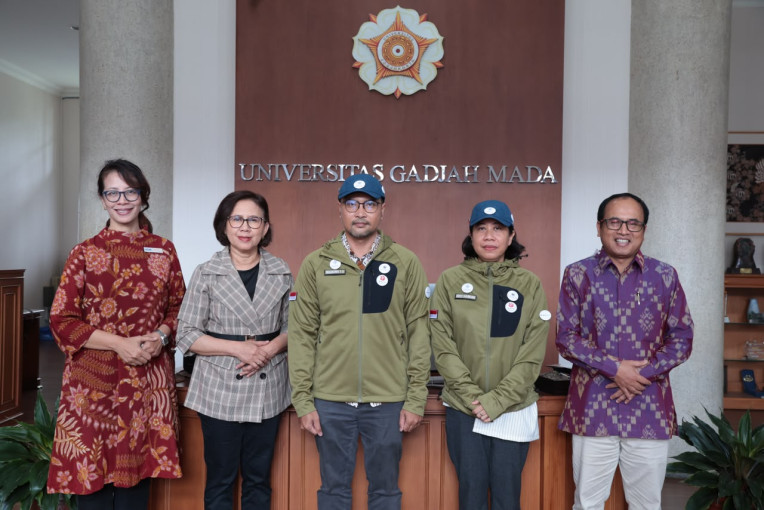
Universitas Gadjah Mada (UGM) is strengthening research in global climate change. This time, two researchers from the Department of Geological Engineering, Faculty of Engineering (FT UGM), will participate in a research expedition to Antarctica with Indonesia’s National Research and Innovation Agency (BRIN) and Ukraine’s National Antarctic Scientific Center (NASC).
Nugroho Imam Setiawan and Esti Handini are scheduled to undertake the assignment from November 23 to December 29, 2026. Before their departure, UGM Rector Professor Ova Emilia formally sent off the expedition team in the UGM Rector’s Guest Room on Thursday (Nov. 19).

UGM’s participation in the expedition reflects its contribution to climate change research. Climate change has far-reaching consequences for human life and the planet’s overall condition. Therefore, research in Antarctica is essential to understanding environmental changes and the mitigation measures and governance strategies needed.
“UGM is proud to be the only university participating in this Antarctic expedition. This marks the culmination of a long journey that UGM has undertaken to contribute to research related to climate change,” she said.
Ova hopes that the research findings will contribute to the sustainability of the planet and human life. As the world’s largest archipelagic country, Indonesia is among the nations potentially facing significant climate change.
Therefore, Indonesian polar researchers are important for broadening global understanding of environmental changes.

Adding to Ova’s remarks that UGM is the only university involved in the Antarctic expedition, Esti Handini explained that she and Nugroho Imam Setiawan secured the opportunity through a research proposal submission process.
“UGM was invited to submit research proposals for potential collaboration on research in Antarctica. Fortunately, our proposal was among those approved for funding, allowing us to join the expedition ship to Antarctica,” Esti explained.
Although both researchers have backgrounds in Geological Engineering, their research topics differ.
“Although we both come from the field of geology, our research topics are actually somewhat different. Our proposal includes team members specializing in volcanology and magmatology,” she said.
Esti will focus on subduction processes and the magmatic rock formations produced in Antarctica. The aim is to understand the magma plumbing system and compare magmatic processes in Antarctica with subduction systems in Indonesia, extending from Sumatra to East Nusa Tenggara.
“Our research focuses on examining the subduction processes occurring there and the resulting magmatic rocks. We want to understand how the magma systems in the region formed and then compare them with the subduction systems found in Indonesia,” Esti explained.
Differences in Earth’s crust and rock composition across regions can produce distinct geological resource characteristics and eruption types. The research findings are expected to improve understanding of geological resources and mitigate geological disasters.

Meanwhile, Nugroho Imam Setiawan will investigate how metamorphic rocks respond to glaciation in Antarctica and compare these findings with metamorphic rocks in tropical regions, particularly Indonesia.
“I am studying the response of rocks, particularly metamorphic rocks, to glaciation and will compare the findings with those from tropical regions. We will examine how metamorphic rocks in polar regions respond to these processes compared with those found in Indonesia,” Nugroho explained.
The research expedition will last approximately one month. The expedition is scheduled to depart from Punta Arenas, Chile, on December 1, 2026, and return to the same location on December 26, 2026. Before the voyage, the team will also coordinate diplomatically with the Embassy of the Republic of Indonesia in Santiago and make technical preparations aboard the Noosfera research vessel.
During the expedition, the researchers will conduct fieldwork in the Antarctic Peninsula region and visit Ukraine’s Vernadsky Research Base.

For Nugroho, this expedition marks his second research trip to Antarctica. However, the research locations and focus differ from his previous expedition with a Japanese team approximately ten years ago. Differences in geological conditions and regional characteristics can lead to new discoveries and broaden understanding of geological dynamics in polar regions.
Through its participation in this international expedition, UGM hopes to strengthen cross-border research collaboration and enhance Indonesia’s scientific contributions to understanding global environmental change.
Knowledge gained from Antarctica is expected to provide valuable insights into climate change challenges and geological dynamics that also affect the sustainability of Indonesia’s regions. Supported by PT Bukit Asam, Indonesia’s Ministry of Foreign Affairs, and BRIN. Nugroho appreciates the support provided by these organizations.
Author: M. Aidil Syahputra
Editor: Gusti Grehenson
Post-editor: Jasmine Ferdian
Photos: Donnie