


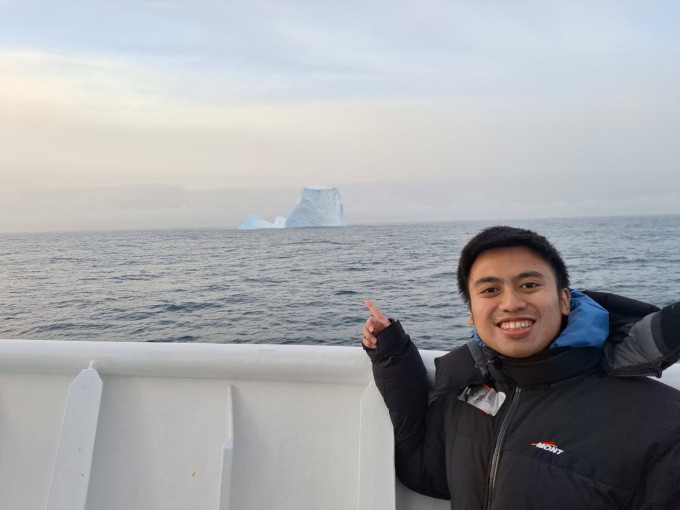
Undertaking a research journey to Antarctica is a rare experience for Indonesian scientists. This unforgettable opportunity was experienced by Ezra Timothy Nugroho, an alumnus of the Biology Study Program at Universitas Gadjah Mada (Biology UGM). At just 25 years old, he participated in a 57-day scientific expedition to Antarctica, which took place from January 2 to February 27, 2026.
His involvement began during his master’s studies at the Institute for Marine and Antarctic Studies at the University of Tasmania, Australia. He explained that the opportunity to join the expedition came from his supervisor, who invited him to return to East Antarctica, specifically the Cook Region, to collect samples.
The sampling was conducted to continue his master’s thesis research and to serve as a foundation for his doctoral (PhD) studies. In his research, he examines ancient DNA from seafloor sediments, with a focus on the Southern Ocean and Antarctica.
The expedition he joined was part of an international research voyage studying marine ecosystems and sediments in East Antarctica. He noted that the activity aimed to better understand marine environmental dynamics and climate change in polar regions that have experienced relatively minimal human intervention.
“My thesis research focuses on sedimentary ancient DNA, particularly DNA obtained from seafloor sediments, with a focus on the Southern Ocean and Antarctica,” he said in an interview on Tuesday (Mar. 31).
During his time in Antarctica, he had to adapt to various extreme conditions. Over the 57-day expedition, he lived aboard a research vessel while facing high waves in the Southern Ocean and temperatures dropping to minus three degrees Celsius. These conditions posed a particular challenge for a researcher from a tropical country.
“As an Indonesian who has never experienced cold weather, this was a unique challenge for me,” he said.
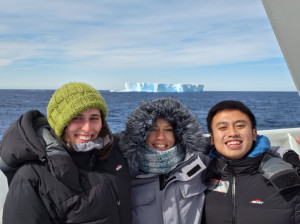
In addition to adapting to the weather, he explained that adjusting to life on a research vessel for nearly two months was also challenging. Limited space, tightly scheduled activities, and the need to maintain physical fitness throughout the research were among the difficulties encountered during the expedition. Nevertheless, he was grateful to have successfully completed the entire series of activities.
“Overall, everything went smoothly. I was able to complete all expedition activities well,” he recalled.
Amid these extreme conditions, he and the research team successfully collected marine sediment samples using the coring method, which involves extracting seafloor sediment layers with a hollow cylindrical tube inserted vertically into the sediment. This sampling is a crucial component of the research aimed at identifying genetic changes in marine organisms preserved in the sediment. He described the moment of directly observing the retrieved samples as the most memorable experience of the expedition.
“When we were finally able to see the sediment we collected ourselves from the seafloor, it was truly memorable,” he said.
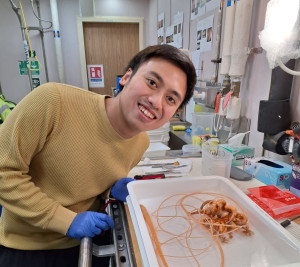
In addition to sample collection, he gained firsthand experience observing Antarctic ecosystems he had previously studied only in theory. Expansive ice formations and wildlife such as whales, seabirds, and penguins became part of daily life during the expedition. He directly observed the activities of various species living in this extreme environment, including whales, seabirds, and penguins.
This experience strengthened his scientific perspective on the importance of polar regions as research sites. He explained that Antarctica is a relatively untouched environment, meaning that environmental changes occurring there reflect the Earth’s natural ecosystem dynamics.
“Polar regions are largely untouched by humans, so any environmental changes that occur are truly natural, without human interference,” he explained.
Furthermore, he emphasized that the research findings are not only relevant to polar regions but also have implications for other areas, including Indonesia. By understanding patterns of genetic change and how marine organisms respond in extreme environments, this research can serve as a reference for anticipating environmental changes in tropical regions.
“If environmental changes occur there, we can predict future effects and how marine animals will adapt. This knowledge can later be applied if similar environmental changes occur in Indonesia,” he said.

Looking ahead, he plans to continue his research at the doctoral level using the collected samples. Through DNA analysis of marine sediments, he hopes to trace genetic changes in marine organisms, particularly mollusks, in response to environmental shifts. These findings are expected to help predict how marine ecosystems will adapt to climate change in the future.
“Hopefully, this research will contribute to future studies in understanding and predicting genetic changes in marine animals,” he concluded.
Author: Cyntia Noviana
Editor: Gusti Grehenson
Post-editor: Jasmine Ferdian
Photo: Courtesy of Ezra