


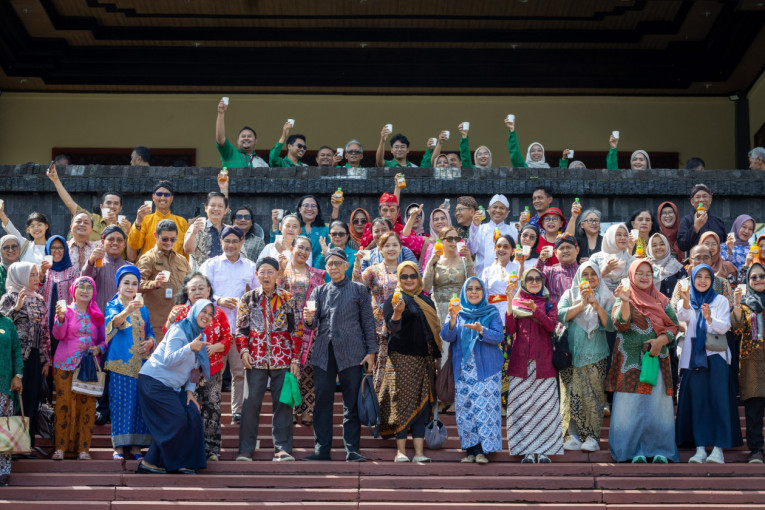
Universitas Gadjah Mada (UGM), in collaboration with the Yogyakarta Regional Indonesian Jamu Council, organized the Simultaneous Jamu Drinking Movement to commemorate National Jamu Day 2026 at Grha Sabha Pramana (GSP) UGM on Monday (May. 25).
The event, attended by members of the university community, healthcare workers, jamu communities, and the general public, was held in a lively atmosphere. Participants enthusiastically joined the series of activities wearing traditional attire while bringing various types and blends of jamu (traditional herbal drink).
UGM Vice Rector for Research, Business Development, and Cooperation, Dr. Danang Sri Hadmoko, stated that jamu holds an important place in Indonesian society and has long been closely connected to everyday life experiences. He recalled his childhood memories of regularly drinking jamu prepared by his parents. According to Dr. Hadmoko, such simple experiences demonstrate that jamu has grown as an integral part of Indonesian culture.
“I still remember that when I was a child and had little appetite, my parents gave me jamu. That was how I first became familiar with jamu. It is a simple memory, but it shows that jamu has long been part of our society’s daily life,” he remarked.
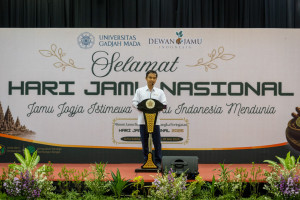
Dr. Hadmoko explained that UGM possesses strong potential to advance jamu research, supported by the diversity of academic disciplines across its 18 faculties, two schools, and various research centers. He emphasized that jamu development should be viewed not solely from a medical perspective but also from cultural, environmental, and raw-material sustainability perspectives.
“Jamu is not merely a matter of laboratories or medical research. It is a cultural heritage that lives within society. Indonesia possesses extraordinary biodiversity, geodiversity, and cultural diversity. The combination of these three elements forms an important foundation for the development of jamu culture in Indonesia,” he explained.
Furthermore, Dr. Hadmoko noted that various faculties at UGM have contributed to the development of jamu, including the Faculty of Pharmacy, the Faculty of Medicine, Public Health, and Nursing, the Faculty of Cultural Sciences, the Faculty of Agriculture, and the Faculty of Agricultural Technology. According to him, interdisciplinary collaboration is an important step toward building a stronger and more sustainable jamu industry in Indonesia.
“Our current challenge is how to ensure jamu is increasingly accepted as part of efforts to maintain public health. Therefore, strong research, standardization, and policy advocacy are needed so that jamu can gain broader trust and utilization,” said Dr. Hadmoko.
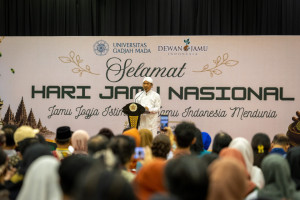
Chair of the Yogyakarta Indonesian Jamu Council, Professor Nyoman Kertia, highlighted the importance of jamu as part of disease prevention efforts in society. He mentioned that various diseases, such as diabetes, gout, hypertension, and even cancer, can actually be prevented through healthy lifestyles, one of which includes consuming jamu. According to Professor Kertia, the culture of drinking jamu needs to be continuously revived so that people do not rely entirely on medical treatment only after becoming ill.
“Do not wait until you are sick before going to the hospital. The most important thing is prevention within society. Jamu has a role in maintaining fitness and helping prevent diseases. Therefore, the culture of drinking jamu must continue to be strengthened,” he stated.
Professor Kertia also pointed out that Indonesia possesses extraordinary biodiversity, yet the country still depends heavily on imported pharmaceutical raw materials. He considered this condition a shared challenge in developing the potential of local herbal plants. According to him, the development of jamu would not only improve public health but also support the economy and environmental sustainability.
“We have extraordinary biological wealth, yet we still import many medicinal ingredients. In fact, the plants around us hold enormous potential for public health. If jamu development progresses well, the benefits can extend to health, the economy, and the environment,” he said.
Following the welcoming remarks, participants gathered at the Pancasila Field of GSP UGM for a collective jamu drinking session. The atmosphere was warm and enthusiastic, with participants dressed in traditional attire in line with the event theme.
The Simultaneous Jamu Drinking Movement served as a collective invitation to revive the habit of consuming jamu as part of a healthy lifestyle while preserving Indonesia’s cultural heritage amid modern society.
Author: Triya Andriyani
Post-editor: Rajendra Arya
Photo: Donnie