


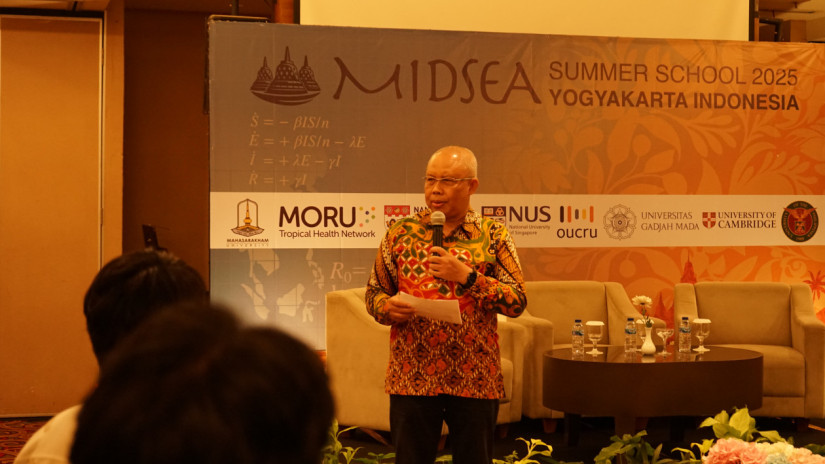
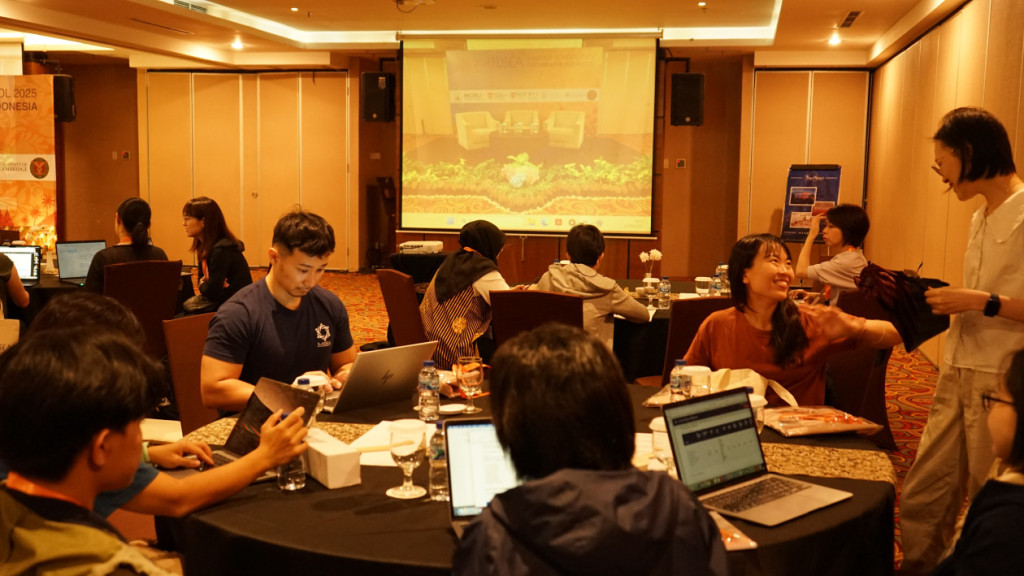
The Department of Mathematics, Faculty of Mathematics and Natural Sciences, Universitas Gadjah Mada (FMIPA UGM), in collaboration with Modelling Infectious Diseases in South East Asia (MIDSEA), officially opened MIDSEA Summer School 2025 on Monday (Jun. 23) in Yogyakarta.
This activity serves as an international scientific forum bringing together academics, researchers, and policymakers from various countries.
It aims to strengthen research capacity and collaboration in infectious disease modeling, particularly in Southeast Asia.
The program is designed to encourage knowledge exchange, joint training, and the utilization of data-driven approaches to support public health policies.
Dean of FMIPA UGM, Professor Kuwat Triyana, stated that UGM strongly supports strategic collaboration to strengthen regional resilience against infectious disease threats through science and data approaches.
“We hope this activity not only expands academic insight but also results in tangible partnerships in combating infectious diseases based on mathematical modeling,” Professor Triyana said.
Head of the Department of Mathematics, Dr. Nanang Susyanto, also emphasized the importance of mathematics in supporting decision-making in the health sector.
He also introduced various research and education programs currently being carried out by the Department of Mathematics.
He hopes for sustainable collaboration with the participants.
“We believe that mathematical modeling is not just an analytical tool, but a crucial foundation in designing more resilient and responsive public health policies,” Dr. Susyanto stated.
The main representative from the MIDSEA initiative, Professor Alex Cook of the National University of Singapore (NUS), also presented the program’s vision.
He explained that MIDSEA aims to build a network of cross-country researchers who use mathematical models to inform decision-making in public health.
“MIDSEA strives to build a solid and interconnected network of researchers by making mathematical models the basis for formulating more effective public health policies in Southeast Asia,” Professor Cook revealed.

The atmosphere of the Summer School opening was further enlivened by a traditional Gambyong dance performance by the Surakarta Style Javanese Arts Unit (UKJGS) UGM.
This reflected the rich culture and hospitality of Yogyakarta as the host. The dancers’ graceful, expressive performance received a warm welcome from the international participants.
The presence of this artistic element serves as a reminder that science and culture can go hand in hand in building global collaboration.
“We want to introduce local culture as part of the spirit of cross-country knowledge exchange,” Dr. Susyanto explained.
The series of activities for MIDSEA Summer School 2025, including seminars, workshops, and panel discussions to be held over the next few days, is expected to serve as a platform for robust research capacity development and closer cross-country scientific collaboration.
This activity is also part of UGM’s ongoing efforts to promote innovation and science-based solutions for future global health challenges.
Author: Triya Andriyani
Post-editor: Afifudin Baliya
Photographs: FMIPA UGM/Fathan Rasyid R