


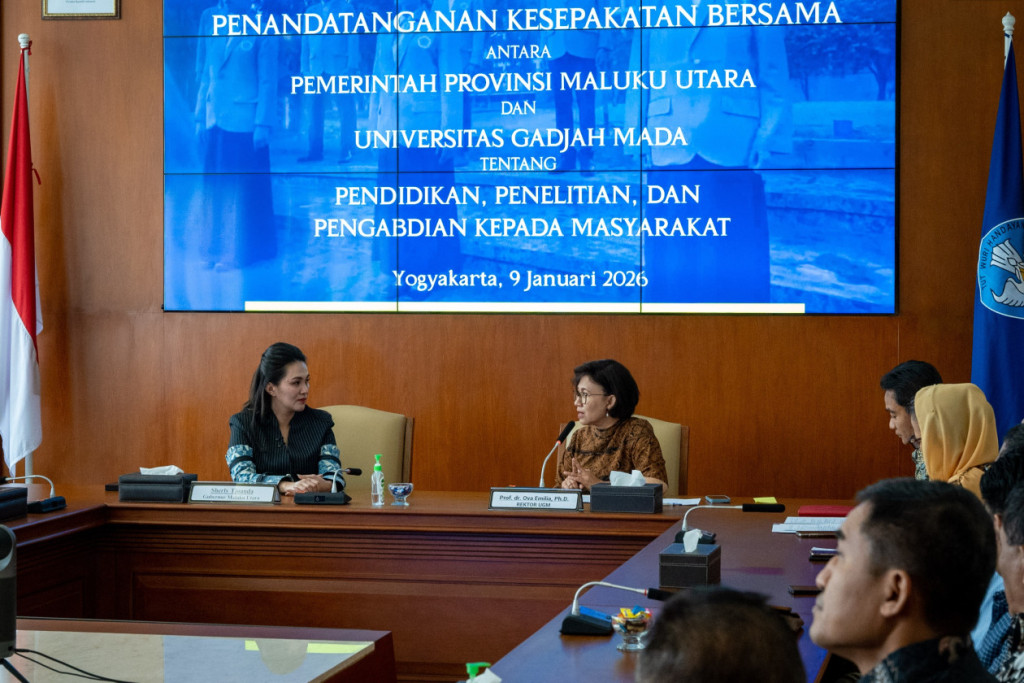
Universitas Gadjah Mada (UGM) has established a partnership with the North Maluku Provincial Government through a Memorandum of Understanding (MoU) to strengthen education, research, and community service. The MoU was signed by UGM Rector, Professor Ova Emilia, and North Maluku Governor, Sherly Tjoanda, at UGM on Friday (Jan. 9). The collaboration aims to support regional development by strengthening human resources, applied research, and strategic sectors. On this occasion, both parties shared their views and expectations regarding the future direction of the cooperation.
UGM Rector, Professor Ova Emilia, stated that UGM closely follows developments in North Maluku Province. UGM’s involvement through the Community Service Program (Kuliah Kerja Nyata/KKN) has been ongoing for a considerable period across various regions.
Currently, 18 student groups are carrying out community service (KKN) activities in several districts, including Obi, South Morotai, Kiri Island, and Rau Island. The presence of students is considered an essential part of the university’s role in accompanying and supporting local communities.
“For us, KKN is a learning process that shapes students’ character so they can understand real issues on the ground,” said the rector.
Professor Emilia emphasized that student learning does not stop at mastering theory in the classroom. Direct engagement with communities is an essential part of developing social awareness.
Students are encouraged to recognize the real challenges communities face, including development issues in island regions. This process is believed to foster a sense of responsibility in educated individuals.
“Students learn to understand national issues firsthand and contribute according to their academic expertise,” she explained.
Furthermore, Professor Emilia noted that cooperation with local governments aligns with UGM’s mission.
UGM upholds the principles of people orientation, independence, and sustainability in every collaboration. Programs are designed in consultation with local partners and tailored to regional needs, including the development of the agricultural sector and food security.
UGM also opens opportunities for affirmative programs and interdisciplinary education to support these needs.
“We are ready to support the strengthening of agriculture and food provision in line with regional development needs,” said Professor Emilia.
UGM Vice Rector for Research, Business Development, and Partnerships, Dr. Danang Sri Hadmoko, added that North Maluku is a favored destination for KKN students. The selection process is conducted rigorously, taking into account mental readiness and competencies.
In addition to KKN, UGM has developed research and innovation collaborations aligned with regional potential across the agricultural, marine, and industrial sectors. The scope for collaboration is considered very broad and can be further developed with the regional government.
“This cooperation opens opportunities to strengthen research and community service with a direct impact on society,” emphasized Dr. Hadmoko.
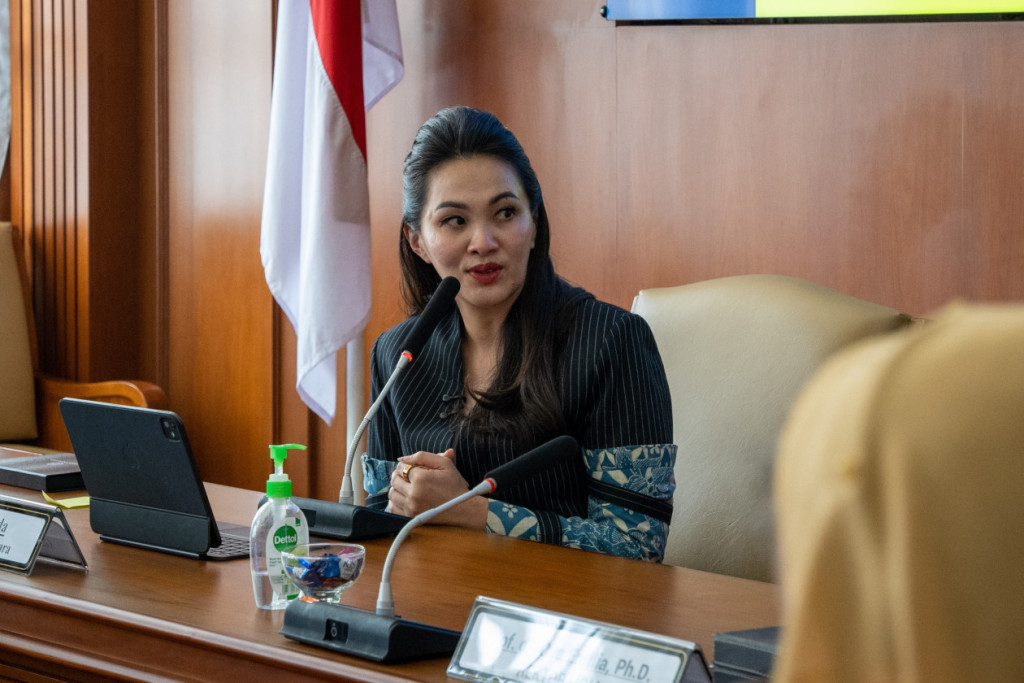
North Maluku Governor Sherly Tjoanda regarded UGM as a strategic partner in regional development.
According to her, collaboration with higher education institutions plays a vital role in improving the quality of human resources.
She recalled her experience accompanying UGM KKN students on Galu-Galu Island, which had a tangible impact on the community. Several student outputs have even been utilized in regional government programs.
“The presence of UGM students brings real benefits and leaves a lasting impression on the community,” said Tjoanda.
She further explained that North Maluku has recorded the highest economic growth rate nationally, reaching 39 percent. However, this growth has not yet been fully inclusive or evenly distributed.
A major challenge remains the readiness of local human resources to meet industrial demands. Industrial zones in Central Halmahera, for example, employ around 100,000 workers, while local workers are estimated to number only about 30,000.
“Strengthening the capacity of local human resources is a crucial task so that communities can play a greater role,” she stated.
Tjoanda also highlighted North Maluku’s significant potential in downstream nickel processing and the electric vehicle battery industry. The province contributes around 50 percent of Indonesia’s nickel production, while Indonesia supplies approximately 40 percent of global nickel demand.
In the future, North Maluku plans to develop battery industries up to high-value-added products, including electric vehicle batteries. Strengthening education, research, and academic collaboration is considered essential to support this direction.
“We want to prepare an education and research ecosystem together with UGM so that this great potential can be managed sustainably,” said Tjoanda.
On the same occasion, she drew attention to the issue of food supply for industrial areas.
Currently, around 80 percent of food needs are still sourced from outside North Maluku. This situation means that the region’s economic potential has not been optimally utilized.
She believes that the agricultural, fisheries, and local MSME sectors have great potential to become the leading suppliers.
“We want local farmers and fishers to be involved so that economic circulation can be enjoyed by the people of North Maluku,” she asserted.
Author: Triya Andriyani
Post-editor: Rajendra Arya
Photographer: Donnie Trisfian