


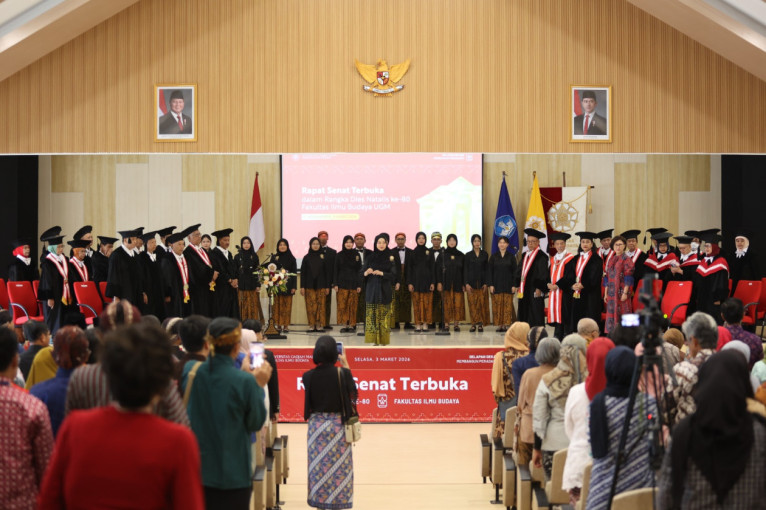
The Faculty of Cultural Sciences Universitas Gadjah Mada (FIB UGM) held an Open Senate Meeting to commemorate its 80th anniversary on Tuesday (Mar. 3) at the Poerbatjaraka Building Auditorium. Carrying the theme “Eight Decades of Building Civilization,” the faculty has recorded numerous achievements and contributions in the development of the humanities.
According to the report delivered by the Dean of the FIB UGM, Professor Setiadi, the Anthropology, Archaeology, and English Literature Study Programs at Universitas Gadjah Mada have secured the number one national ranking. The Anthropology program is ranked 101–170 globally, while the Archaeology and Anthropology programs are ranked 151–200 worldwide in the QS World University Rankings by Subject 2025. In addition, in 2025, the ranking institution EduRank placed the Literature field at the Faculty of Cultural Sciences UGM in first place among 68 literature education providers in Indonesia.
Furthermore, FIB UGM has produced 169 interdisciplinary research titles, equivalent to 201 percent of the initial target of 84 titles. The publication citation rate of FIB UGM lecturers also increased sharply from 50 citations in 2022 to 381 citations in 2025. In the same year, five journals at the faculty, Deskripsi Bahasa, Bakti Budaya, Lembaran Antropologi, Gama JTS, and Lembaran Sejarah, successfully obtained international indexing in the Directory of Open Access Journals (DOAJ).
In the area of student exchange programs, the faculty successfully welcomed 150 international students at all levels, exceeding the initial target of 100. Over the past four years, FIB students have also secured 23 international, 224 national, and 48 regional achievements.
Professor Setiadi noted that these accomplishments are the result of the collective efforts of the entire academic community and not merely temporary successes.
“These achievements represent the peaks of hard work built upon the scholarly foundations established by our teachers. We should express our gratitude to the elders, senior members, and founders of this faculty,” he said.
Meanwhile, the Rector of UGM, Professor Ova Emilia, expressed appreciation for the achievements attained by the academic community of FIB UGM. According to Professor Ova, the 80th anniversary offers an opportunity to reflect on the faculty’s long journey in educating the nation’s finest students.
“Since its establishment in 1946, resilience, adaptation, and innovation have become the answers to the Faculty of Cultural Sciences’ determination in facing pressures across different eras, including economic and political crises, as well as the challenges of changing times. This demonstrates the faculty’s strength in producing alumni whose innovative works bring meaningful impact to the nation,” she said.
Professor of Anthropological Linguistics at UGM, Professor Suhandano, also delivered a scientific oration titled “Language Studies and Their Challenges in the Digital Era.” In his speech, Suhandano explained the evolution of linguistics over time and how the discipline is being tested by changes in the way people communicate in today’s digital era.
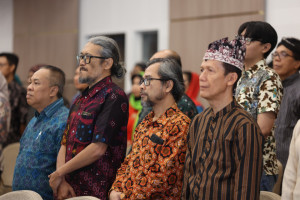
According to him, the digital era has brought noticeable changes in how people use language. Conversations on social media often involve individuals who do not know each other, resulting in looser norms, distinct linguistic styles, and frequent use of emoticons. One of the major challenges in the virtual era, he noted, is that language is often used to manipulate truth and shape public opinion through online buzzers.
“Public opinion that has already been formed is sometimes difficult to change, but scientific language studies must not submit to that opinion,” he reminded.
Suhandano further emphasized that language influences how people perceive the world. Therefore, language studies should contribute to solving real problems in society, such as analyzing how mass media language frames climate change, which ultimately shapes public concern for the environment.
“Language studies today face many challenges, but behind those challenges lie opportunities for progress,” he said.
Author: Leony
Editor: Gusti Grehenson
Post-editor: Zabrina Kumara
Photo: Firsto