


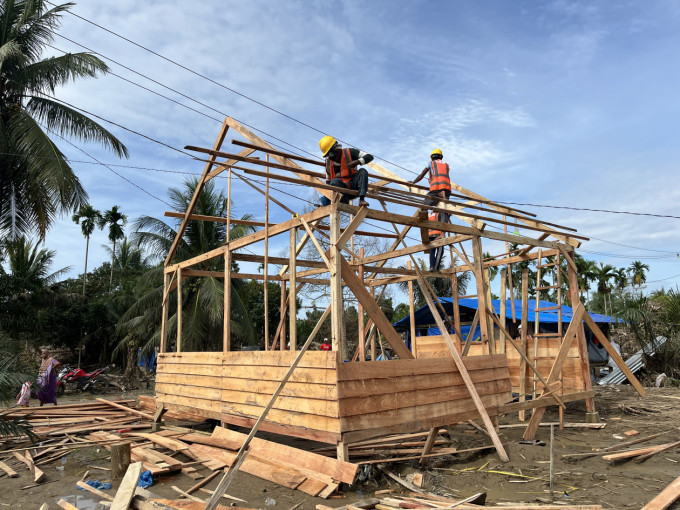
Universitas Gadjah Mada (UGM) is constructing 100 temporary housing units (Hunian Sementara/Huntara) for residents affected by flooding in North Aceh. Each Huntara measures 6 x 6 meters and is equipped with two bedrooms, a multifunctional room, and a terrace to support family life during the transition period.
A disaster expert and Professor of Geological and Environmental Engineering at UGM, Dwikorita Karnawati, expressed her appreciation for the progress of Huntara’s construction for communities affected by flash floods and landslides in Aceh.
The development of these temporary shelters marks a crucial step in the post-disaster rehabilitation and reconstruction phase, ensuring evacuees can promptly move into more decent living conditions.
However, the physical construction must be accompanied by serious attention to safety and security, especially given the continued high risk of secondary disasters.
“The progress of the Huntara development deserves appreciation. However, what is far more important is ensuring that all residents, evacuees, and workers involved in the rehabilitation and reconstruction phases are in safe conditions and receive adequate logistical support,” said Professor Karnawati on Tuesday (Jan. 6).
Professor Karnawati emphasized that the houses and infrastructure being built must be located in genuinely safe areas. This is critical considering the still-high risk of landslides, flash floods, and subsequent flooding.
“The Huntara must be ensured to be safe from the threats of landslides and flash floods,” she stated.
Safety considerations, she added, should not apply only to temporary housing but must also be a primary concern in the planning and construction of permanent housing (Hunian Tetap/Huntap).
Without disaster risk–based planning and careful consideration of environmental conditions, Huntap development could create a cycle of recurring disasters.
According to Professor Karnawati, to ensure such safety, permanent disaster prevention and mitigation efforts must be carried out in parallel with the rehabilitation and reconstruction phases.
The first, non-negotiable step is environmental restoration, which must be prioritized because it requires a long-term commitment, potentially spanning years.
“If environmental recovery is unsuccessful, disaster recurrence intervals may become shorter, with far more severe magnitudes,” she explained.
Additionally, she emphasized the importance of conducting comprehensive inspections in upstream river areas as part of flash flood prevention efforts. This includes identifying vulnerable zones, such as accumulations of landslide sediment or fallen rock debris, that could block river flows from upstream areas.
When triggered by prolonged high rainfall, these vulnerable zones could develop into disasters.
“Without adequate monitoring in upstream areas, the threat of flash floods often comes suddenly and is difficult to detect from downstream. In fact, early signs can be identified sooner through technology-based inspections,” Professor Karnawati added.
The implementation of multi-hazard early warning systems in each vulnerable watershed (Daerah Aliran Sungai/DAS) area is also a critical aspect of providing timely alerts to surrounding communities.
Furthermore, Professor Karnawati stressed that disaster education and literacy for communities must be conducted systematically, routinely, and sustainably. Disaster education should become an integral part of building community resilience in disaster-prone areas.
“Disaster literacy is the fundamental foundation to ensure that mitigation efforts are truly capable of saving lives,” she emphasized.
For Professor Karnawati, post-disaster rehabilitation and reconstruction are not merely about rebuilding quickly, but about building back better by constructing safer, more resilient, and more sustainable conditions than before the disaster.
“Every post-disaster development must be based on lessons learned from previous events, thorough risk analysis, and comprehensive environmental recovery, so that communities do not become victims again in future disasters,” she concluded.
Author: Jesi
Editor: Gusti Grehenson
Post-editor: Rajendra Arya
Photograph: UGM Tangguh Team