


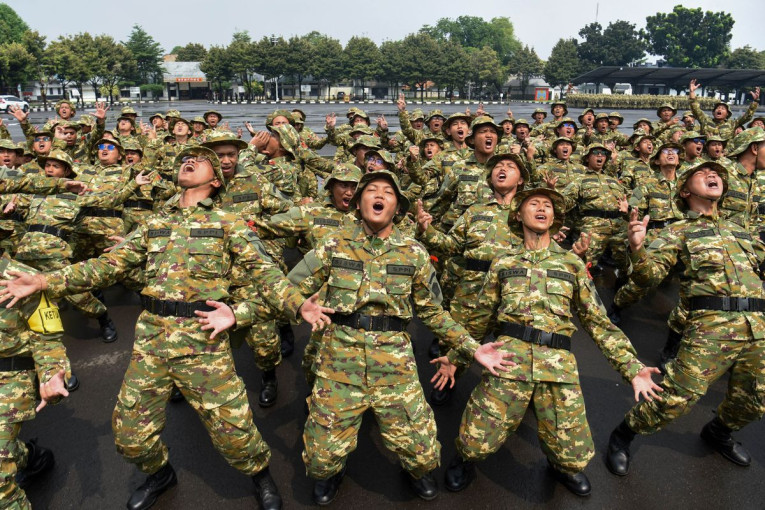
Another tragic incident has occurred during the training program for managers of the Merah Putih Village Cooperative (KDMP). A participant in the military-style training program has died, bringing the total number of fatalities during the basic military training (latsarmil) to five.
Dr. Subarsono, M.Si., M.A., a lecturer and researcher at the Department of Public Policy and Management, Universitas Gadjah Mada, said that basic military training for KDMP managers, including marching drills, flag ceremonies, running exercises, and firearms handling, is far removed from the actual responsibilities of cooperative managers. According to him, the primary role of a cooperative manager is to implement the strategic policies established by the cooperative board through day-to-day operational management.
“They are responsible for managing staff, overseeing cash flow, ensuring sales targets are met, and regularly reporting business performance to the board for the benefit of cooperative members,” he said on Sunday (Jun. 28).
According to Dr. Subarsono, the training should instead focus on cooperative governance, leadership, and human resource management; digital financial management; entrepreneurship and business model innovation; strategic planning; and marketing, particularly e-marketing.
Nevertheless, Dr. Subarsono acknowledged that basic military training is not entirely without value. It can contribute to building discipline. However, he emphasized that the operational meaning of discipline differs across professions and sectors.
In the context of cooperatives, Dr. Subarsono explained that discipline means managers submit reports on time, uphold transparency and accountability, refrain from using cooperative facilities for personal gain, provide products and services that meet members’ and customers’ needs, and avoid selling illegal goods.
“In the military, discipline may be interpreted differently, for example, attending morning roll call on time, obeying superior officers’ commands, and performing marching drills correctly,” he explained.
Dr. Subarsono outlined several significant implications of subjecting cooperative managers to military-style training. First, he warned that it could undermine democratic principles within cooperatives.
In his view, adopting military approaches in civilian programs, particularly within KDMP, is inappropriate because cooperatives are civilian organizations founded on democracy, member participation, and deliberation. Military organizations, on the other hand, operate through command structures, one-way communication, and the absence of a culture of dialogue.
“When cooperative managers are trained in a militaristic manner, they may adopt military approaches in cooperative governance, shifting democratic practices toward command-based systems, one-way communication, reduced participation, and the erosion of dialogue,” he said.
Second, Dr. Subarsono argued that such an approach could suppress innovation, as managers may become overly dependent on rigid standard operating procedures (SOPs) and focus solely on achieving predetermined targets. Employees and cooperative members may become reluctant to propose new ideas because opportunities for dialogue are replaced by command structures.
He cited several cases in which KDMP cooperatives were established in unsuitable locations, including sites far from residential areas, on hillsides, or even in forests, as evidence of the lack of dialogue between KDMP authorities and local communities.
“Communities are merely treated as objects of the KDMP project, preventing the public from developing a sense of ownership,” he stressed.
Dr. Subarsono viewed the deaths of five participants during the basic military training as a serious warning and a compelling reason to discontinue the program. He called for a comprehensive evaluation of the cooperative manager training system, which has now claimed five lives.
“A new training model that is more appropriate must be designed to ensure there are no more casualties in the future,” he said.
In addition, he urged the government to remain open to input from stakeholders outside the government in order to develop a more suitable training model for KDMP managers, reflecting the principles of a democratic state. He proposed initiating dialogues and Focus Group Discussions (FGDs) with the Ministry of Cooperatives, successful cooperative practitioners from both the public and private sectors, cooperative experts, and community representatives to develop a more inclusive governance model grounded in good governance principles. He also emphasized that policymakers must set aside arrogance, acknowledge shortcomings in existing policies, and demonstrate the willingness to redesign the training system.
Dr. Subarsono believes the public would appreciate a new training policy more than the government’s continued insistence on maintaining a policy that risks eroding public trust.
“The emotional wounds experienced by the victims’ families, and by the public more broadly, will begin to heal when the government demonstrates its willingness to introduce an innovative new training policy,” he said.
He further argued that the institutional framework governing KDMP should be fundamentally restructured to ensure sound management and organizational practices. The Ministry of Cooperatives, rather than the Ministry of Defense or the Indonesian National Armed Forces (TNI), should serve as the primary authority responsible for training KDMP managers. However, he added that the Ministry of Cooperatives could collaborate with other ministries that can contribute expertise relevant to cooperative management education.
Author: Leony
Editor: Gusti Grehenson
Post-editor: Zabrina Kumara
Photo: Antara