


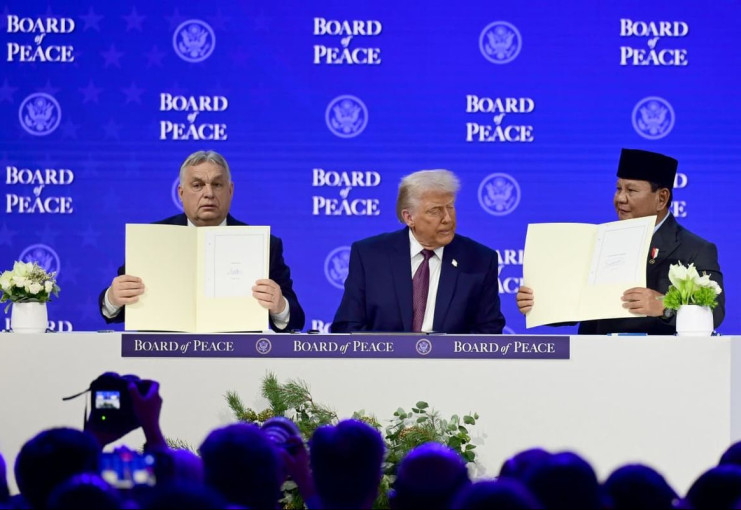
United States President, Donald Trump, has once again stirred global political debate after announcing the formation of a Peace Council he calls the Board of Peace (BoP), a multilateral agreement he claims could promote world peace. The initiative emerged amid growing doubts over the effectiveness of the United Nations. Indonesia’s decision to join the Trump-initiated Peace Council has been widely regarded as a foreign policy misstep.
Professor of International Relations at the Faculty of Social and Political Sciences, Universitas Gadjah Mada (Fisipol UGM), Professor Nur Rachmat Yuliantoro, stated that the BoP initiative is not entirely aimed at resolving global conflicts.
According to him, the BoP reflects Trump’s reaction to his failure to secure the Nobel Peace Prize.
“What Trump has done can be seen as the action of an individual rather than the President of the United States, appointing himself as Chair of the BoP, which has subsequently triggered strong resistance from America’s European allies,” he explained on Wednesday (Jan. 28).
Professor Yuliantoro further noted that distrust in the United Nations is not the primary factor behind the establishment of the BoP. U.S. geopolitical interests also play a role, but Trump has failed to articulate them clearly.
He emphasized that the formation of the BoP represents Trump’s hubris, reinforced by support from his hardline followers.
He added that the regulation requiring nearly IDR 17 trillion in membership fees for each country seeking permanent membership in the BoP also reflects the transactional nature of Trump’s foreign policy.
“I believe economic interests are the real motive behind the formation of the BoP, not world peace,” Professor Yuliantoro asserted.
He said it is still too early to assess whether the initiative genuinely promotes peace. He argued that further observation is needed to determine whether the BoP will operate in accordance with its stated objectives.
However, he expressed pessimism after examining the structure of the BoP’s membership. In his view, the BoP is likely to become merely a stage for power projection.
“Even after paying the mandatory fees, BoP member states will likely remain powerless in the face of pressure driven by Trump’s interests,” he said.
Indonesia’s participation in the initiative, according to Professor Yuliantoro, constitutes a serious foreign policy blunder, or even a fatal diplomatic error, especially given the obligation to pay a IDR 17 trillion contribution.
He stressed that Indonesia’s decision to join the BoP creates a dilemma for the country’s own principles and raises questions about why Indonesia would join a so-called ‘peace’ body chaired by a key supporter of genocide.
For him, this clearly contradicts the constitutional mandate that “colonialism must be abolished in this world, as it is incompatible with humanitarianism and justice.”
“Internationally, this move will weaken Indonesia’s position among those who continue to support Palestine,” he added.
In closing, Professor Yuliantoro reaffirmed that Indonesia’s foreign policy principle is independent and active, as evidenced by its engagement with the United Nations to advance multilateralism and resolve international issues, thereby maintaining global stability, security, and prosperity.
He said that this constitutionally mandated diplomatic direction is fundamentally at odds with the formation of the BoP.
“The UN Security Council is far from ideal, but it is better than the BoP in every respect,” he concluded.
Author: Fatihah Salwa Rasyid
Editor: Gusti Grehenson
Post-editor: Rajendra Arya
Photograph: Presidential Secretariat