


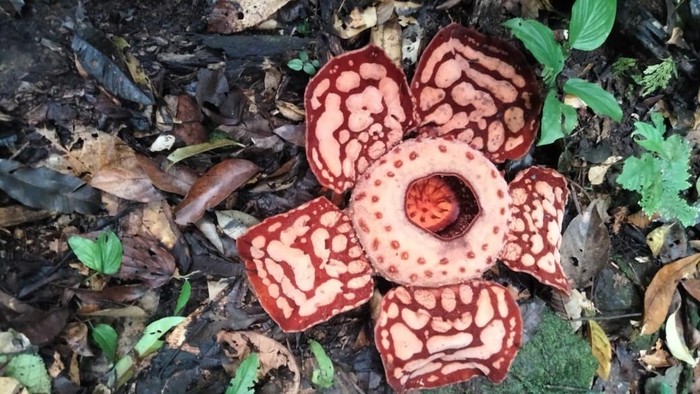
Amid the dense rainforest of West Sumatra, a research team has successfully documented the appearance of the giant Rafflesia hasseltii during a collaborative study involving the National Research and Innovation Agency (BRIN), the University of Bengkulu, and the Bengkulu Rare Flora Community. Supported by the University of Oxford Botanic Garden and Arboretum and BRIN’s RIIM Expedition Program, the research once again highlights the significant challenges facing Indonesia’s biodiversity conservation efforts.
Professor Budi S. Daryono of the UGM Faculty of Biology stated that Rafflesia hasseltii is not a new discovery. The rare flower, native to the rainforests of West Sumatra, has long been recorded and is well documented in his scientific publications.
He explained that Rafflesia hasseltii belongs to the Rafflesiaceae family, which comprises three genera—Rafflesia, Rhizanthes, and Sapria. Within the Rafflesia genus alone, he noted that 42 species have been identified in Indonesia, although nearly all are categorized as threatened due to habitat degradation.
“There are currently 42 species in the Rafflesia genus, and they are now endangered because their ecosystems are deteriorating,” he said on Monday (Dec. 1).
The recent documentation also highlights the serious threats to Rafflesia’s survival. As a holoparasitic plant entirely dependent on its host, Tetrastigma, Rafflesia is highly sensitive to environmental changes. Professor Daryono emphasized that the survival of the forest relies on the integrity of forest ecosystems.
Forest fragmentation caused by plantations, mining, and land-use change in Sumatra, Kalimantan, and Java has narrowed its natural habitat, disrupting its life cycle. Climate change further intensifies the pressure on this species.
“An increase of even one to two degrees forces it to struggle for survival,” he explained.
He added that Indonesia still lags in species exploration and discovery. Countries such as Malaysia and the Philippines have documented new Rafflesia species more rapidly due to consistent research funding and advanced molecular technologies.
In Indonesia, exploration is often constrained by limited budgets, insufficient resources, and the absence of a sustained biodiversity inventory program. As a result, some Rafflesia populations have disappeared before being documented, and many potential new species remain unidentified.
In response to these challenges, Professor Daryono stressed the importance of beginning conservation efforts with field exploration. He noted that routine fieldwork is essential to update distribution records, detect new populations, and prevent species loss.
These activities must be supported with scientific identification and classification to verify the accuracy of findings. The expert also highlighted the need to use molecular technologies, such as DNA analysis, to accelerate species determination and distinguish morphologically similar types.
“Naming must be carried out clearly so we can claim new species supported by molecular technology,” he said.
In addition to strengthening research, he underscored the importance of in-situ conservation by preserving tropical rainforests that serve as the habitat of Tetrastigma, allowing Rafflesia to survive. According to him, successful conservation depends entirely on maintaining intact, unfragmented ecosystems.
However, when natural habitats become too degraded to restore, ex situ conservation becomes a crucial rescue measure by developing populations in botanical gardens, national parks, or research-based conservation centers.
“If we cannot fully protect it in its habitat, then we must bring it elsewhere so it can be cultivated,” he added.
For long-term preservation, Professor Daryono also emphasized the need to involve local communities in safeguarding Rafflesia habitats. He noted that surrounding communities serve as the first guardians of Rafflesia habitat and must therefore be educated about the species as a national asset.
He encouraged efforts to instill knowledge of Rafflesia’s uniqueness and vulnerability from an early age, especially among younger generations, as an important investment in Indonesia’s future conservation efforts.
Professor Daryono reaffirmed that conservation measures, from exploration, identification, and molecular verification to community engagement, are not merely technical procedures. He explained that these steps form the foundation for long-term research opportunities.
If basic conservation can be secured, continued research may reveal untapped benefits of Rafflesia, including potential bioactive compounds for phytopharmaceuticals or treatments for degenerative diseases.
“Bioprospecting is important, but only after all aspects of conservation succeed. We cannot discuss its benefits before we can preserve and cultivate it,” the professor concluded.
Author: Cyntia Noviana
Editor: Gusti Grehenson
Post-editor: Salma
Photograph: Detik.com/Faried