



The threat of artificial intelligence-based information manipulation, such as deepfake technology and the potential emergence of agentic AI capable of automatically spreading disinformation, is becoming increasingly concerning. This is compounded by the fact that current digital platform algorithms prioritize user engagement over the accuracy of information. Therefore, cross-sector collaboration is essential to ensure continuous monitoring and verification of information.
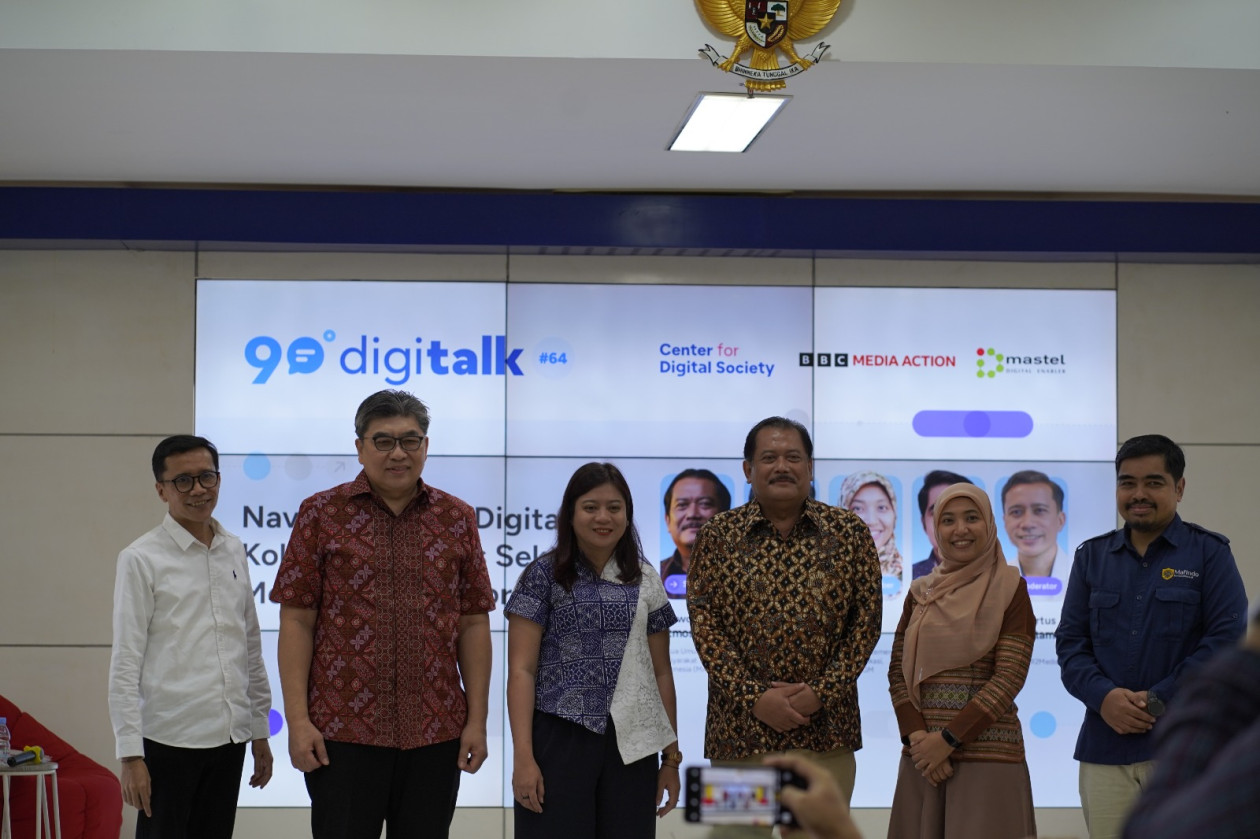
These concerns were raised during the Policy Paper Discussion: Roadmap for Addressing Disinformation in Indonesia at DigiTalk #64 titled “Navigating the Digital Space: Cross-Sector Collaboration to Combat Disinformation.” The discussion, organized by the Center for Digital Society (CfDS) together with the Masyarakat Telematika Indonesia (Mastel) and BBC Media Action, featured Septiaji Eko Nugroho, Chair of the Masyarakat Anti Fitnah Indonesia (Mafindo), and Neil R. Tobing, Head of Digital Media and Broadcasting (DigiBroadcast) at Mastel.
Dean of the Faculty of Social and Political Sciences (FISIPOL UGM), Dr. Wawan Mas’udi, emphasized that digital transformation is not solely about technological advancement but also entails complex social consequences.
“Digital transformation is not merely about technology, but about how it is leveraged to strengthen social and industrial aspects. The pandemic taught us that digital technology can serve as a unifying tool; however, if not managed properly, it can instead widen social disparities,” Dr. Mas’udi said in a statement released to journalists on Thursday (Feb. 19).
Septiaji Eko Nugroho, Chair of Mafindo, stressed that disinformation can have serious social and psychological impacts on its victims. He explained that Indonesia has developed a growing fact-checking ecosystem through collaboration among civil society, journalists, the government, and digital platforms. This collaboration proved effective in strengthening information resilience, particularly during the COVID-19 pandemic.
However, he underscored that fact-checking alone is insufficient to counter the rapid spread of hoaxes. Various studies indicate that disinformation spreads much faster than factual clarification. For this reason, Mafindo has developed a prebunking approach, or “information vaccination,” to build public resilience against disinformation from the outset.
Septiaji also highlighted the rising threat of AI-based information manipulation, including deepfake technology and the potential emergence of agentic AI capable of automatically disseminating disinformation. He noted that this situation requires the strategic use of AI technology to support monitoring and verification processes.
Meanwhile, Neil R. Tobing, Head of DigiBroadcast at Mastel, pointed out that Indonesia’s digital information governance still faces various structural challenges. He cited examples of how social media can accelerate the escalation of social conflicts through the spread of unverified information.
“Within hours, a local disturbance can turn into a national issue because social media is no longer merely a communication channel but an active participant shaping public narratives,” he explained.
Neil added that responses to the spread of digital information are often unsynchronized due to the absence of an adequate regulatory framework. He argued that this condition demonstrates that Indonesia’s digital governance is not yet fully prepared to handle crisis situations.
In his presentation, he emphasized the importance of distinguishing between misinformation, disinformation, and malinformation. According to him, this distinction is essential to ensure that policies addressing disinformation are implemented accurately without threatening freedom of expression.
Neil also underscored key factors accelerating the spread of disinformation, including digital platform algorithms that prioritize user engagement over information accuracy, as well as growing public distrust in official information sources.
“Disinformation does not only target individuals with low literacy; it often appeals to emotions, identity, and the psychology of social groups,” he stated.
He further explained that the impact of disinformation does not stop in the digital sphere but can trigger social polarization, conflict, and even mass mobilization. With Indonesia’s exceptionally high social media penetration, the risk of disinformation spreading is increasingly significant.
Neil asserted that addressing disinformation cannot rely on a single solution such as content removal alone. He advocated for a systemic approach involving cross-sector collaboration among the government, digital platform industry, media, academics, and civil society. The roadmap formulated during the discussion proposes five key pillars: strengthening digital literacy, developing a robust fact-checking ecosystem, enhancing digital governance, fostering cross-sector collaboration, and advancing research and technological innovation. He stressed that the roadmap is not a censorship tool, but rather an evidence-based policy dialogue framework that upholds democratic principles and freedom of expression.
Neil emphasized that young people hold a strategic role as primary users of the digital space. He encouraged the public, particularly the younger generation, to be more critical in consuming and sharing information.
“Young people are not merely policy objects, but key actors in building a healthy digital space. The future of digital democracy is also determined by the small decisions we make every day,” he concluded.
Author: Jelita Agustine
Editor: Gusti Grehenson
Post-editor: Zabrina Kumara
Photo: Freepik