


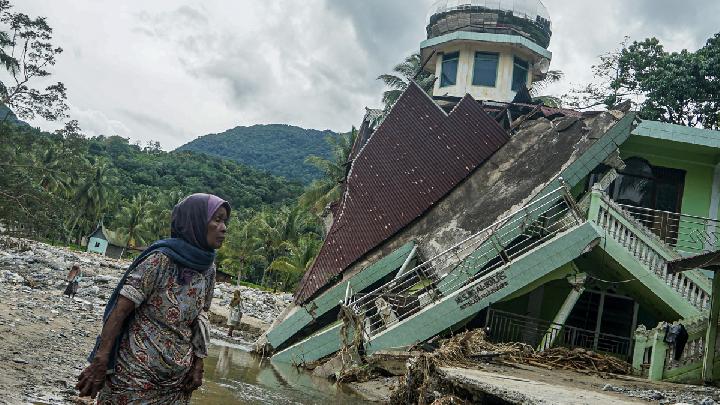
Aceh, North Sumatra, and West Sumatra are facing profound grief following flash floods and landslides that struck in late November. Extreme weather marked by relentless rainfall claimed hundreds of lives. Buildings collapsed, infrastructure was damaged, and thousands of homes were inundated, underscoring the extensive impact of these extreme weather events.
UGM hydrology expert Professor Agus Maryono noted that the flash floods and landslides affecting several areas in Sumatra were not caused solely by extreme weather, but by a combination of meteorological, geographical, geological, and hydraulic factors.
“If it were only due to extreme weather, the flooding would not have been this severe. But what we are seeing is truly extraordinary,” Professor Maryono said on Wednesday (Dec. 3).
In addition to vulnerable landforms, Professor Maryono explained that hydraulic channels were obstructed. Extreme meteorological conditions, compounded by deforestation, have increased surface runoff capacity, causing rainwater to flow rapidly across the ground.
Professor Maryono further explained that flash floods generally occur due to very heavy rainfall combined with slope failures along medium- and small-sized rivers. However, in this case, widespread deforestation across several areas is suspected to have significantly increased runoff, leading to major flooding.
“What we observed were deforested areas that triggered increased runoff. This was further compounded by landslides or natural blockages, which ultimately led to severe flooding,” Professor Maryono explained.
According to the expert, the government’s primary step in responding to the current flood disaster must be to immediately complete evacuations and rescue efforts.
“All efforts should be fully focused on the victims. Those who survived and those still missing must be found as soon as possible,” he stressed.
Subsequently, the government can proceed with emergency response and recovery efforts, including rebuilding public facilities, reconstructing bridges, and restoring housing while taking into account the impacts of the disaster.
As for preventive measures, Professor Maryono emphasized the importance of prioritizing environmentally friendly development. The application of eco-hydraulic approaches, he said, could help prevent future flood disasters.
“Eco-hydraulic methods, for example, require widened riverbanks to be planted with fast-growing vegetation to trap sediment. This helps stabilize river slopes,” Professor Maryono explained.
Author: Salwa
Editor: Gusti Grehenson
Post-editor: Salma
Photograph: Antara