


Universitas Gadjah Mada once again demonstrated its commitment to community service through the KKN-PPM (Universitas Gadjah Mada’s community service program)Peduli Bencana Sumatera 2026 program. The initiative represents UGM’s concrete contribution to supporting the post-disaster recovery phase through a multidisciplinary approach that focuses on the infrastructure, health, and education sectors. The community service activities were carried out for 30 days from late January to early March 2026.
The Coordinator of the UGM KKN-PPM Unit, Dewarta Bagus Bagaskara, a student from the Department of Civil Engineering at the UGM Vocational College (SV UGM), said that his participation was driven by humanitarian concern and the desire to apply academic knowledge directly in the field.
“My main motivation is humanitarian concern. I believe that the knowledge I gain in university will be far more beneficial when applied directly in the field, especially during the post-disaster recovery phase,” he said on Wednesday (Apr. 4).
In the infrastructure sector, the UGM KKN-PPM team repaired community sanitation facilities and installed water purification systems to ensure access to clean water. In addition, the students assisted in distributing and mapping out temporary shelters, built a mosque hall that serves as a community activity center, and installed solar-powered street lighting.
Meanwhile, in the education and public facilities sector, the team built sanitation facilities and installed water tanks at a local junior high school, and revitalized the maternity room at the community health center to support maternal and child healthcare services.
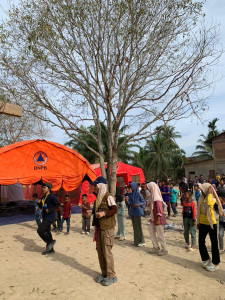
In the health sector, students conducted socialization and handwashing practice sessions at schools, provided soap, revitalized healthcare service rooms, and organized free medical services in collaboration with the Ministry of Health of Indonesia and the local community health center.
“The team also provided Sujok Therapy correspondence therapy and donated medical equipment to village health workers, including midwives and community health volunteers,” he said.
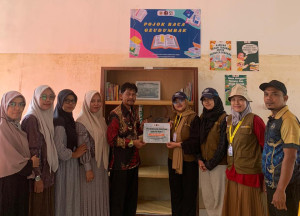
Meanwhile, in the education sector, students assisted with teaching and learning activities at elementary and junior high schools, organized literacy activities and group exercise sessions, built reading corners stocked with donated books, and conducted waste management education in coordination with the mosque management.
The implementation of this community service program was naturally accompanied by challenges in the field. It was noted that the main challenge during the program was logistical and accessibility-related, as several affected locations were difficult to reach. Nevertheless, these limitations did not diminish the students’ enthusiasm to carry out their work programs optimally. Bagaskara said the team’s most memorable moment was when residents were once again able to access clean water and see progress in the construction of temporary shelters.
“There was a moment when we saw residents smiling again as clean water began to flow. That was when I realized how extraordinary the resilience of our communities truly is,” he said.
Through this program, UGM not only encourages students to apply their academic knowledge in practical ways but also fosters leadership character and social solidarity.
“Becoming the unit coordinator has been the most real leadership lesson for me. I learned that being a leader is not about giving orders, but about serving and listening to both team members and local residents,” he said.
The KKN-PPM Peduli Bencana Sumatera 2026 program reaffirms UGM’s role as a university that not only focuses on education and research but also actively engages with communities, especially in times of crisis. Through collaboration, empathy, and teamwork, UGM remains committed to contributing to recovery efforts and strengthening community resilience after disasters.
Author: Jelita Agustine
Editor: Gusti Grehenson
Post-editor: Zabrina Kumara
Photo: KKN-PPM Team