


Violence against women and children is often described as a hidden wound, as it is frequently regarded as a “domestic matter” that outsiders should not interfere with. This mindset must be corrected, as violence is a shared concern. Women play a significant role in regional progress and development.
Data from the National Commission on Violence Against Women (Komnas Perempuan) recorded that 339,782 of the total complaints received in 2024 were related to gender-based violence (GBV), with 3,442 cases reported directly to Komnas Perempuan.
Violence occurring in the personal sphere continues to dominate GBV reports, accounting for 99 percent or 336,804 cases, including Online Gender-Based Violence (OGBV).
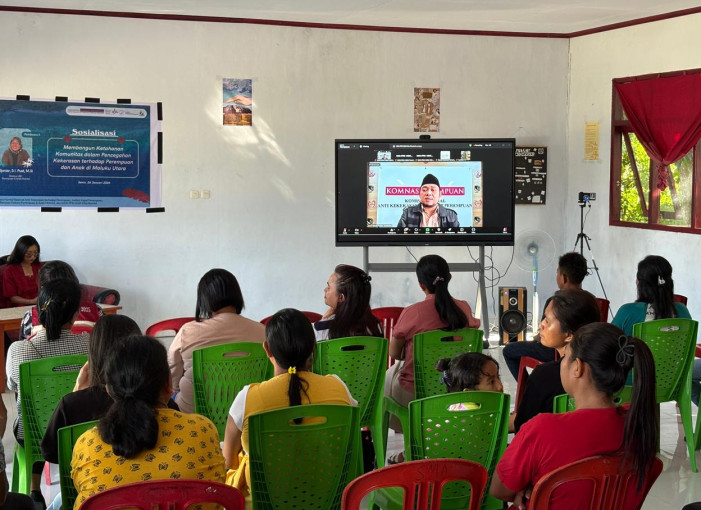
This issue was highlighted during the Prevention of Violence Against Women and Children in North Maluku event, organized by the UGM Community Service Program (KKN-PPM UGM) Team, Kita Morotai, in collaboration with Komnas Perempuan and the Morotai Women and Children Legal Aid Institute (LBH PA Morotai) on Monday (Jan. 26).
Carrying the theme “Building Community Resilience in Preventing Violence Against Women and Children in North Maluku,” the event was held at the auditorium of SMA Nusa Damai Posi-Posi, Morotai. The activity was attended by more than 50 participants, including village women, young women from the community, and community leaders.
Unit-Level Student Coordinator (Kormanit) Rasya Wahyu Anggita said the socialization activity aimed to enhance women’s understanding of violence prevention. The team also sought to encourage youth participation in bringing discussions on women’s protection into public spaces at the village level.
“Through this activity, the UGM team hopes that participants can understand the forms of violence, recognize their rights and available protection pathways, and become part of a community that looks out for one another and dares to speak up,” Anggita said in a written statement received on Friday (Feb. 6).
Komnas Perempuan Commissioner Daden Sukendar broadened participants’ perspectives by presenting data from the 2024 Annual Report (CATAHU). He revealed a rising trend in reported cases of gender-based violence, reaching 330,097 cases nationwide.
“These figures serve as an alarm for society to stop normalizing all forms of violence, whether within households or in social environments,” he said.
On the same occasion, he also introduced the Sexual Violence Crime Law (UU TPKS) as a legal instrument that guarantees victims’ rights to handling, protection, and recovery, as well as the SAPA 129 reporting channel.

Director of the Morotai Women and Children Legal Aid Institute, Djuniar, reported that 222 cases of violence occurred in North Maluku Province, including 22 specific cases handled by the Pulau Morotai Police as of September 2025. Djuniar highlighted the high cost and limited accessibility of sea transportation, which often becomes an obstacle for victims seeking to report cases in the city center.
As a solution, LBH PA Morotai, in collaboration with the KAPAL Perempuan Institute, initiated a proactive “jemput bola” strategy by establishing complaint posts in several villages, such as Waringin Village and Usbar Pantai Village.
“We want to shorten the distance to access justice for victims, so the reporting system becomes more efficient,” he said.
Dr. Atrida Hadianti, serving as the Field Supervising Lecturer (DPL), stated that education on protection against violence toward women and children represents UGM’s commitment to remaining present in disadvantaged, frontier, and outermost regions through community service activities carried out by UGM KKN-PPM students.
“Geographical distance should not become a barrier for citizens to receive education about their rights to self-protection,” she said.
Dr. Hadianti hoped that this cross-sector collaboration could serve as a sustainable model for strengthening communities on Indonesia’s small islands by improving women’s and children’s understanding of access to protection from the threat of violence.
The Community Service Program (KKN-PPM) continues to provide a platform for UGM to contribute to realizing a more just and decent quality of life for communities in remote areas.
Author: Ika Agustine
Editor: Gusti Grehenson
Post-editor: Jasmine Ferdian
Photographs: Kita Morotai Team