


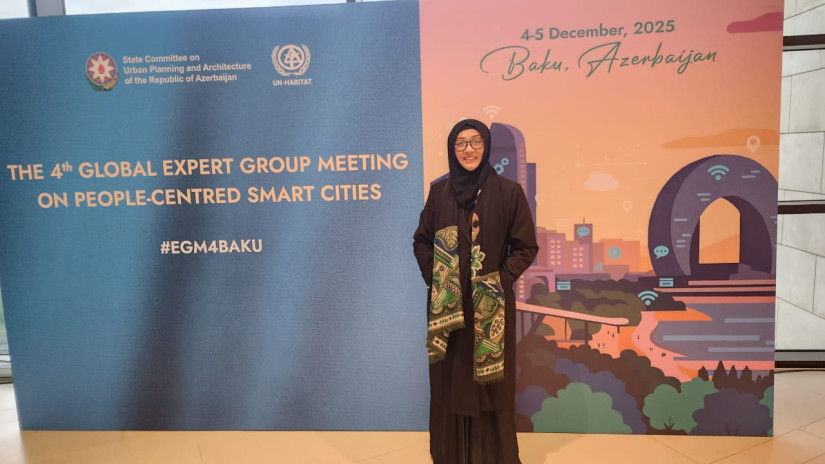
The role of Universitas Gadjah Mada (UGM) academics has once again gained international recognition. A lecturer from the UGM Faculty of Geography (Geography UGM), Professor Rini Rachmawati, was involved as an expert in the UN-Habitat Global Expert Working Group on the International Guidelines for People-Centered Smart Cities, held in Baku, Azerbaijan, on Dec. 4–5.
The forum brought together experts from various countries to formulate international guidelines for smart city development that place people at the center of urban development. Rachmawati’s participation underscores Indonesia’s scholarly contribution to global urban policymaking under the auspices of the United Nations.
Professor Rachmawati’s appointment as an expert was the result of a selection process that began in 2023. She was nominated by the Ministry of Public Works and Housing and the Ministry of Home Affairs to take part in the UN-Habitat expert selection. Through this process, she was chosen as one of the experts representing Indonesia alongside specialists from other countries.
“This appointment is highly meaningful, as it allows me to share Indonesia’s good practices in smart city development and implementation with UN-Habitat,” she said on Thursday (Dec. 18).
Her extensive experience in assisting local governments has been a key asset in her contribution. For more than seven years, Professor Rachmawati has been involved in preparing and evaluating smart city master plans in various cities, regencies, and provinces. She has also supported regions in independently drafting and updating smart city planning documents in response to urban dynamics.
“I have continuously engaged in discussions on smart city theory, concepts, and implementation practices with governments and various stakeholders,” she explained.

This contribution has been further strengthened through internationally oriented academic activities. Geography UGM, together with the UGM Center for Southeast Asian Social Studies, regularly organizes summer course programs on smart cities, smart villages, and the digital transformation of society.
These programs involve expert instructors and participants from various countries, enriching global perspectives on smart city development.
“These academic and research experiences form the basis of my substantive input in drafting the People-Centered Smart Cities Guidelines,” she added.
At the fourth Expert Working Group meeting in Baku, Professor Rachmawati presented several strategic ideas. She emphasized the importance of implementing the guidelines through pilot projects in selected cities and conducting continuous evaluations of their implementation.
She also encouraged involving experts as facilitators in introducing the guidelines through training programs for governments and academics in various countries.
“These guidelines need to be widely understood so that they can be implemented effectively at both national and local levels,” she explained.
The People-Centered Smart Cities Guidelines place people at the core of urban development. The guidelines emphasize four main principles: shared prosperity, inclusive digital human rights, sustainability and resilience, and community participation and collaboration. This approach ensures that physical, social, and digital infrastructure contribute to sustainable cities that respect human rights.
“These guidelines stress that smart cities are not solely about technology, but about the well-being and engagement of citizens,” she said.
As an urban geography expert, Professor Rachmawati noted that geography as a discipline plays a strategic role in smart city development.
Territorial, spatial, and environmental approaches help to understand the diversity of urban characteristics and the specific needs of each region. Spatial analysis and the integration of geospatial data form an essential foundation for adaptive smart city planning and implementation.
“Urban geography provides a comprehensive framework for understanding urban dynamics and supporting sustainable smart city development,” she explained.
Looking ahead, the People-Centered Smart Cities Guidelines are scheduled to be launched at the 13th World Urban Forum (WUF 13), to be held in Baku, Azerbaijan, in May 2026.
The forum is the largest global event under UN-Habitat, bringing together governments, academics, and urban development stakeholders from around the world. The launch at WUF 13 will position the guidelines as an international reference for people-centered smart city policy development.
“These guidelines are expected to serve as a shared reference for member countries, including Indonesia, in aligning urban development policies and practices,” she concluded.
Author: Triya Andriyani
Post-editor: Rajendra Arya
Photographs: Professor Rini Rachmawati