


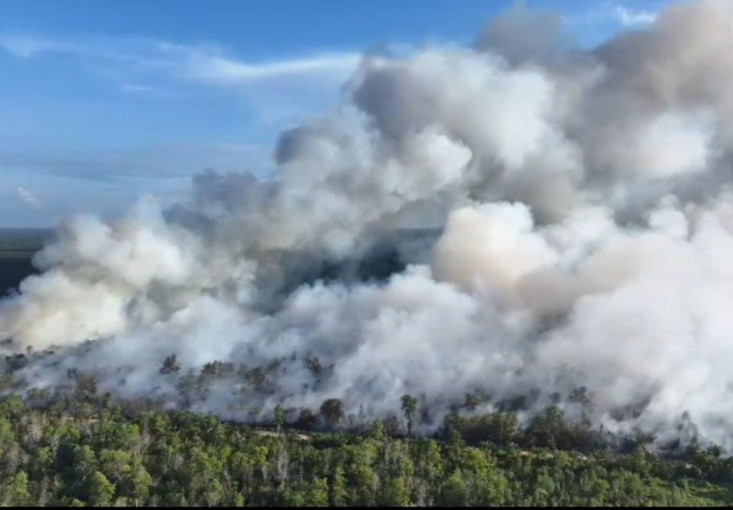
The Meteorology, Climatology, and Geophysics Agency (BMKG) predicts that most regions in Indonesia will experience an earlier and longer dry season this year. Approximately 57.2 percent of the country will face a prolonged dry season, while around 46.5 percent of regions will enter the dry season earlier than usual. Of these, 16.3 percent are expected to begin the dry season as early as April. These areas include western Java, most of Central Java to East Java, West Nusa Tenggara (NTB), East Nusa Tenggara (NTT), Kalimantan, Sulawesi, and Sumatra.
This extended dry season presents a heightened risk of forest and land fires (karhutla). Several regions have already been affected, including Riau, where burned areas have reached 4,440.21 hectares and continue to increase. In response to the projected challenges of forest and land fires, both government and private-sector decision-making are encouraged to adopt more adaptive policies that involve all stakeholders.
A lecturer from the Faculty of Forestry at Universitas Gadjah Mada (Forestry UGM), Fiqri Ardiansyah, emphasized the need for budgeting that prioritizes a sustainable emergency management framework. According to him, budgets should align with the full cycle of emergency management, including prevention, mitigation, preparedness, response, and recovery.
He also highlighted the strategic role of peatland rewetting infrastructure compared to short-term solutions. To address forest and land fires, Weather Modification Operations (OMC), bore wells, and canal blocking are considered synergistic instruments to maintain ecosystem moisture and minimize fire risks.
“OMC, bore wells, and canal blocking are part of prevention and mitigation efforts,” said Fiqri on Monday (March 30).
Based on several studies, Fiqri noted that canal blocking is quite effective as a mitigation measure for forest and land fires, both in the short and long term.
“Peatlands that burn are generally degraded peatlands. Therefore, canal blocking is expected to reduce water loss from peat ecosystems, keeping them moist,” he explained.
In response to the government’s call for private-sector involvement, Fiqri proposed a collaborative model that goes beyond ad hoc instructions during emergencies. He advocated establishing permanent cooperation agreements implemented through measurable, routine field activities.
“Permanent collaboration can be carried out through regular joint roll calls, patrols, and monitoring with the Regional Disaster Management Agency (BPBD), Manggala Agni, and others, along with assistance for Community Fire Care groups (MPA),” he said.
As a preventive measure, Fiqri stressed that fundamental changes must begin with human behavior at the ground level to prevent forest and land fires.
“Raising awareness to improve public understanding of the dangers of uncontrolled fire use is crucial, as most fires originate from human activities,” he emphasized.
As a concrete solution, Fiqri encouraged companies and communities to implement Zero Burning Land Management (PLTB), particularly in regions outside Java, to break the cycle of recurring fires.
“Zero Burning Land Management can serve as an alternative,” he concluded.
Author: Aldi Firmansyah
Editor: Gusti Grehenson
Post-Editor: Zabrina Kumara
Photo: Manggala Agni Dumai Documentation