


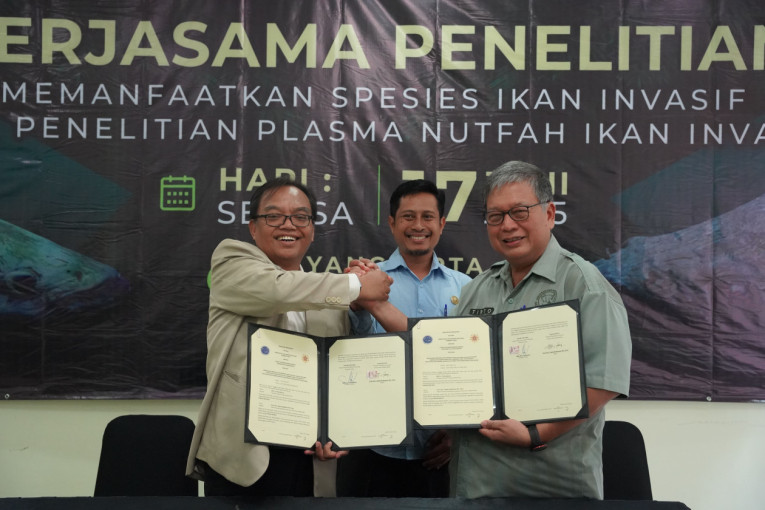
The Faculty of Veterinary Medicine (FKH) UGM signed a collaborative research agreement with Gembira Loka (GL) Zoo on Tuesday (Jun. 17) at Mayang Tirta Room, Gembira Loka Yogyakarta.
The scope of this cooperation includes collaboration in education and the utilization of invasive fish species and Ostriches (Struthio camelus) for germplasm research.
Some of these invasive fish species are Arapaima, Alligator Gar, Piranha, Redtail Catfish, Snakehead, and Nile Tilapia.
Dean of FKH UGM, Professor Teguh Budipitojo, stated that his faculty supports the collaborative research undertaken with GL Zoo.
This activity serves as a preparation for future veterinarians from FKH UGM and Indonesia to study endemic animals from outside Indonesia.
“The signing of this cooperation agreement is a first step in providing veterinary higher education opportunities to utilize species available at Gembira Loka for education and research,” Professor Budipitojo explained.
According to Professor Budipitojo, this joint research collaboration uses invasive fish species as research subjects for invasive fish germplasm in Indonesia.
This includes both native and non-native fish species that have massively colonized certain habitats and can cause ecological, economic, and social losses.
Meanwhile, ostrich species will be used as learning and research material for students and lecturers.
“We want to optimize germplasm for the development of veterinary science, especially in the poultry field, and as an effort to preserve the resources and germplasm of ostrich species,” he said.

Director of GL Zoo, KMT A. Tirtodiprojo, stated that cooperation between FKH UGM and Gembira Loka has been initiated for a long time.
However, only this time does the cooperation include research and education, primarily on issues of invasive species.
The large number of endemic animals entering Indonesia and becoming predators to the environment, while also endangering the community, poses a challenge for higher education in solving these problems.
“This cooperation certainly opens up great opportunities to deepen scientific knowledge, education, and research, so it becomes a first step in broader collaboration going forward,” KMT Tirtodiprojo said.
Support also came from the Yogyakarta Special Region (DIY) Department of Fisheries and Marine Affairs.
Fitrianto Noorcahyo, as their representative, mentioned that his department also plans to enter into a cooperation agreement with FKH UGM regarding the use of invasive species for education.
He admitted that the monitoring of invasive fish in Yogyakarta is the most advanced in Indonesia.
However, Noorcahyo hopes that this type of cooperation will further strengthen invasive fish monitoring while educating the public about their dangers.
After the signing of the cooperation charter, a tour of GL Zoo was conducted to review several animal breeding areas, including ostriches and tigers, which are endemic Indonesian animals.
Author: Lazuardi
Editor: Gusti Grehenson
Post-editor: Afifudin Baliya